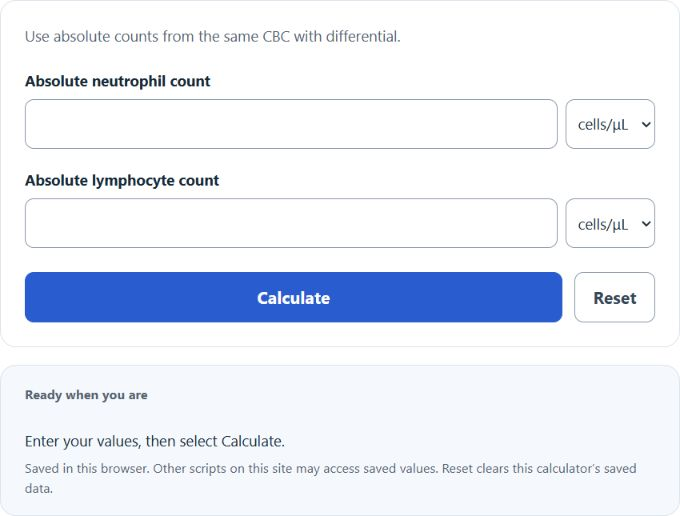
Calculate neutrophil-lymphocyte ratio (NLR) from absolute neutrophil and lymphocyte counts in cells/μL, K/μL, or ×10⁹/L from lab reports.
Medical note: This calculator is for educational purposes only and is not medical advice or a diagnosis. NLR is a non-specific marker and should be interpreted by a licensed clinician in context (symptoms, exam, full CBC/differential, medications, pregnancy, acute stress, etc.). Use values from a CBC with differential performed by a certified lab. If you have concerning symptoms or abnormal results, seek medical care.
Related Calculators
- Platelet/Lymphocyte Ratio Calculator
- Mentzer Index Calculator
- HCT Calculator
- Globulin Albumin Ratio Calculator
- All Health and Medical Calculators
Neutrophil-Lymphocyte Ratio Formula
The neutrophil-lymphocyte ratio, or NLR, is calculated by dividing the absolute neutrophil count by the absolute lymphocyte count. Both values must be in the same unit before division.
- NLR = neutrophil-lymphocyte ratio
- ANC = absolute neutrophil count
- ALC = absolute lymphocyte count
If your inputs use different units, the calculator first converts both counts to cells/μL, then applies the formula.
- cells/μL = no conversion needed, factor 1
- ×10³/μL, also written K/μL = multiply by 1000
- ×10⁹/L = multiply by 1000
The calculator has three main functions: it converts neutrophils and lymphocytes to the same base unit, divides neutrophils by lymphocytes, and returns the NLR as a unitless ratio. Use absolute counts from a CBC with differential, not neutrophil and lymphocyte percentages.
Common Blood Count Units for NLR
Lab reports may show white blood cell differentials in different absolute count units. These units are commonly equivalent after conversion.
| Unit on lab report | Meaning | Conversion to cells/μL |
|---|---|---|
| cells/μL | Cells per microliter | Multiply by 1 |
| K/μL or ×10³/μL | Thousands of cells per microliter | Multiply by 1000 |
| ×10⁹/L | Billions of cells per liter | Multiply by 1000 |
Typical Context for NLR Results
NLR is not a diagnosis by itself. Interpretation depends on your age, health conditions, medications, recent infection, and the reason the test was ordered.
| NLR result | General context |
|---|---|
| About 1 to 3 | Often seen in many healthy adults, but normal ranges vary by lab and population. |
| Above the applicable reference interval | May be seen with inflammation, infection, stress response, steroid use, or other conditions. A value above 3 is not a universal abnormal threshold. |
| Very high | Should be reviewed with the full CBC and clinical situation, especially if counts are far outside the lab reference range. |
Example Calculations
Example 1: Your absolute neutrophil count is 4.8 K/μL and your absolute lymphocyte count is 1.6 K/μL.
The neutrophil-lymphocyte ratio is 3.0000.
Example 2: Your absolute neutrophil count is 6200 cells/μL and your absolute lymphocyte count is 2000 cells/μL.
The neutrophil-lymphocyte ratio is 3.1000.
FAQ
Should I use percentages or absolute counts for NLR?
Use absolute counts. The calculator is designed for absolute neutrophils and absolute lymphocytes, such as ANC and ALC. This tool expects absolute counts. When both percentages use the same total white blood cell count, their ratio is mathematically the same as ANC/ALC; do not mix percentages and absolute counts.
Is NLR a unitless number?
Yes. NLR is unitless because it divides one cell count by another cell count. The units cancel out as long as both values are converted to the same unit first.
What does a high NLR mean?
A high NLR can occur when neutrophils are elevated, lymphocytes are low, or both. It may be associated with inflammation, infection, physical stress, corticosteroid use, or other medical conditions. It should not be interpreted alone. Review it with the rest of the CBC, the lab reference ranges, and guidance from a qualified clinician.