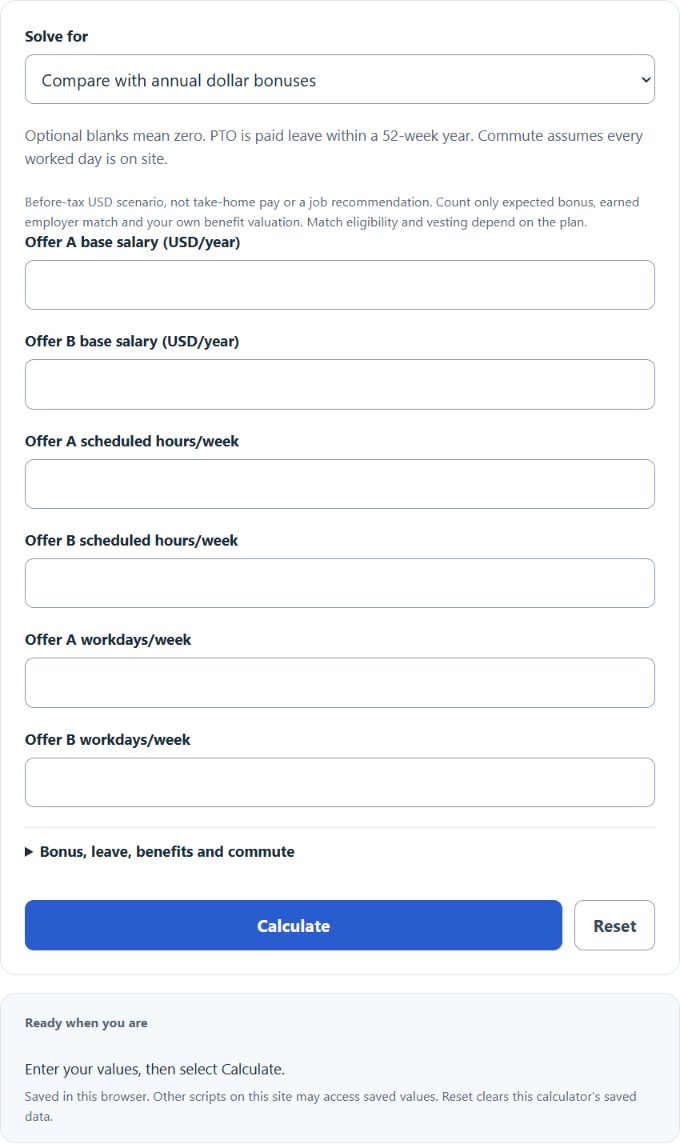
Free job offer comparison calculator: weigh two offers by total compensation and true hourly pay, including bonus, 401(k) match, PTO, and commute time.
Job Offer Comparison Formula
The calculator scores each offer two ways. First it estimates annual value from the entered salary, expected bonus, earned employer match and your valuation of other benefits. This is before tax and includes noncash value:
TC = S + B + M + 12 * V
Then it divides that total by the hours the job actually takes from your year, including the commute, to get a true hourly rate:
TH = TC / ((Hw + Hc) * Ww)
 Ww = 52 - (PTO / D)
 Hc = (C / 60) * D
Variables:
- TC is total annual compensation, in dollars
- S is the base salary
- B is the annual bonus, entered as a dollar amount or as a percent of salary
- M is the annual value of the employer 401(k) match, equal to S times the match percent
- V is the monthly value of other benefits; enter a negative number for extra costs such as a pricier health premium
- TH is true hourly pay
- Hw is scheduled work hours per week
- Hc is commute hours per week, computed from C, the round-trip commute in minutes per day, and D, the number of work days per week
- Ww is working weeks per year, which shrinks as PTO days grow
Enter the base salary, bonus, hours per week, and PTO days for each offer, then open the optional section to add the 401(k) match, other benefits, commute time, and work days per week. The calculator reports total compensation and true hourly pay for both offers side by side, along with the difference.
True hourly pay matters because a salary hides the hours behind it. A job that pays more on paper but demands 45-hour weeks, a long commute, and only two weeks of vacation can hand you fewer dollars per hour of your life than a lower salary with normal hours, a short drive, and four weeks off. Dividing total compensation by the hours the job really consumes puts both offers on the same scale.
The numbers are only half the decision. Weigh qualitative factors too: growth and promotion prospects, the stability of the company, remote or flexible work options, the manager and team, and how each role positions you for the job after this one. A modest pay gap is often worth trading for a much better trajectory.
Sample Comparison: Higher Salary vs Higher True Hourly Pay
This sample comparison shows how the offer with the bigger salary can lose once hours, PTO, and commute are counted. Both offers assume a 5-day work week with no bonus, match, or other benefits, so total compensation equals salary.
| Line item | Offer 1 | Offer 2 |
|---|---|---|
| Base salary | $105,000 | $95,000 |
| Hours per week | 50 | 40 |
| PTO days per year | 10 | 15 |
| Commute (round trip) | 90 min/day | 30 min/day |
| Working weeks | 50 | 49 |
| Actual annual hours | 2,875 | 2,082.5 |
| True hourly pay | $36.52 | $45.62 |
The employer 401(k) match is part of total compensation, not a footnote. This table shows the annual value of a full match at common salaries and match rates.
| Base salary | 3% match | 4% match | 6% match |
|---|---|---|---|
| $60,000 | $1,800 | $2,400 | $3,600 |
| $75,000 | $2,250 | $3,000 | $4,500 |
| $90,000 | $2,700 | $3,600 | $5,400 |
| $105,000 | $3,150 | $4,200 | $6,300 |
| $120,000 | $3,600 | $4,800 | $7,200 |
Example Problems
Example 1: Compare two offers on true hourly pay.
Offer A pays $95,000 for 45-hour weeks with 10 PTO days and a 60-minute round-trip commute. Offer B pays $88,000 for 40-hour weeks with 20 PTO days and a 20-minute commute. Both are 5-day weeks with no bonus, match, or other benefits, so TC equals the salary.
Offer A: Ww = 52 – (10 / 5) = 50 working weeks. Hc = (60 / 60) * 5 = 5 commute hours per week. Annual hours = (45 + 5) * 50 = 2,500. TH = 95,000 / 2,500 = $38.00 per hour.
Offer B: Ww = 52 – (20 / 5) = 48 working weeks. Hc = (20 / 60) * 5 = 1.67 commute hours per week. Annual hours = (40 + 1.67) * 48 = 2,000. TH = 88,000 / 2,000 = $44.00 per hour.
Offer A pays $7,000 more per year, but Offer B pays $6.00 more per true hour and takes about 500 fewer hours of your year.
Example 2: Add bonus, match, and benefits to one offer.
An offer has an $80,000 salary, a 10 percent bonus, a 4 percent 401(k) match, and other benefits worth $200 per month. TC = 80,000 + 8,000 + 3,200 + 12 * 200 = $93,600. With 40-hour weeks, 15 PTO days, 5 work days, and a 30-minute commute: Ww = 52 – (15 / 5) = 49, Hc = (30 / 60) * 5 = 2.5, annual hours = (40 + 2.5) * 49 = 2,082.5, and TH = 93,600 / 2,082.5 = $44.95 per hour.
Frequently Asked Questions
How do you compare two job offers with different benefits?
Convert everything to annual dollars so both offers share one scale. Add the base salary, the expected bonus, the employer 401(k) match, and 12 times the monthly value of benefits such as health coverage, HSA contributions, or stipends; use a negative benefits value where one employer costs you more, like a higher health premium. Then divide each total by actual annual hours, including commute, to see which offer pays more per hour of your time.
Should I take the job with the higher salary?
Not automatically. Salary is one input, not the verdict. An offer that pays more but expects longer weeks, grants less PTO, and adds an hour of daily commuting can pay meaningfully less per true hour, and weaker benefits can erase the salary gap entirely. Run both offers through the calculator first, then let per-hour value, benefits, and career trajectory make the call together.
How much is a 401(k) match worth?
Employer match formulas, contribution requirements and vesting vary by plan. A dollar-for-dollar match can add one employer dollar per eligible employee dollar up to the plan limit, but it is not always immediately vested. If an earned employer contribution equals 4% of a $90,000 annual salary, its annual value is $3,600 before investment changes. Enter the employer match you expect to earn as a percentage of salary, rather than the employee contribution percentage.