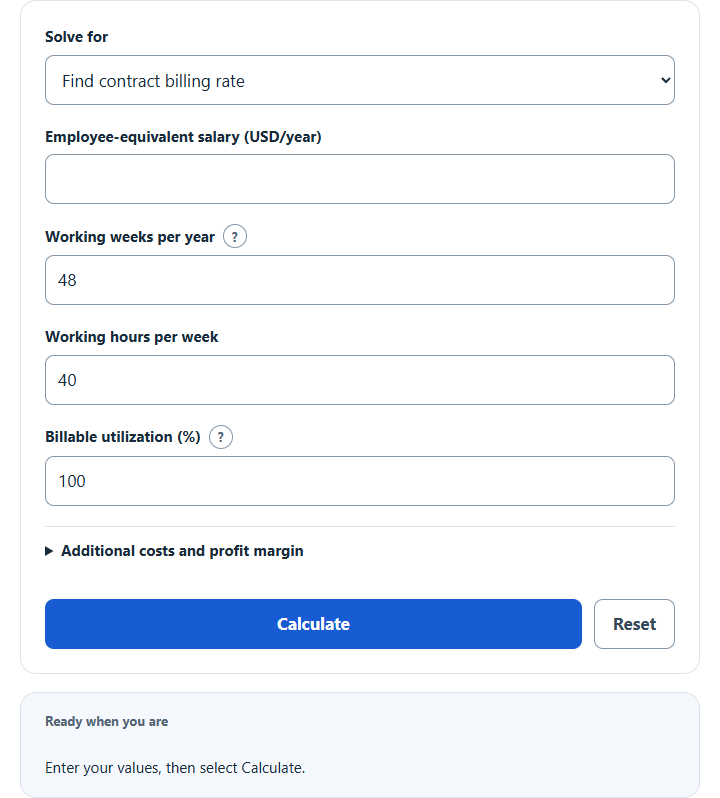
Convert a salary to an equivalent contract hourly rate, or a contract rate back to salary, using your working weeks, hours, benefits, expenses and margin.
Equivalent Contract Rate Formula
The loaded-cost model below uses your own costs and billable hours. It does not assume an average benefits factor or guarantee equivalent take-home pay.
Historical comparison only: the March 2025 BLS civilian data reported $47.92 total compensation and $32.92 wages per hour worked, a ratio of about 1.456. The 31.3% benefits share uses total compensation as its denominator. This aggregate is not a contractor default; BLS benefits include paid leave. Do not add leave wages already in annual salary or remove the same leave twice through weeks and utilization.
- Where r is the contract billing rate (USD/hour); S is annual salary and E is additional annual business expense (USD/year)
- W is working weeks/year, h is working hours/week, and u is the billable fraction of those hours. b is additional benefits/payroll costs as a fraction of salary; m is profit as a fraction of revenue (below 1).
Calculate annual cost S × (1 + b) + E, then divide by billable hours W × h × u and by (1 − m). Enter percentages as percentages in the calculator. Exclude leave from W once, and use u for nonbillable time within those working weeks. Additional costs must not repeat costs already included in salary or elsewhere.
| Yearly Salary (USD) | Contract Rate (USD/hr) |
|---|---|
| 40,000 | 32.94 |
| 50,000 | 41.18 |
| 60,000 | 49.41 |
| 65,000 | 53.53 |
| 70,000 | 57.65 |
| 75,000 | 61.76 |
| 80,000 | 65.88 |
| 85,000 | 70.00 |
| 90,000 | 74.12 |
| 95,000 | 78.24 |
| 100,000 | 82.35 |
| 110,000 | 90.59 |
| 120,000 | 98.82 |
| 130,000 | 107.06 |
| 140,000 | 115.29 |
| 150,000 | 123.53 |
| 160,000 | 131.76 |
| 175,000 | 144.12 |
| 200,000 | 164.71 |
| 250,000 | 205.88 |
| Historical illustration, rounded to 2 decimals: rate = salary × (1.456 / 1768) = salary × 14/17000. Here 1,768 = 2,080 × 85% is an assumed billing schedule, not a BLS working-hours standard. The historical aggregate factor is not a current default or a personalized benefits estimate. | |
How to Calculate Equivalent Contract Rate?
The following examples use 50 working weeks, 40 hours/week, 100% billable utilization, and zero additional benefits, expenses and margin. These are example assumptions; the calculator starts with typical values (48 weeks, 40 hours, 100%) that you can change.
Example Problem #1:
- First, determine the total yearly salary ($).
- The annual salary is USD 50,000; the example billable hours are 50 × 40 × 1 = 2,000 hours.
- Finally, calculate the Equivalent Contract Rate using the equation above:
r = [S × (1 + b) + E] / [W × h × u × (1 − m)]
The values provided above are inserted into the equation below and computed.
r = [50,000 × (1 + 0) + 0] / [50 × 40 × 1 × (1 − 0)] = 25.00 USD/hour
Example Problem #2:
For this problem, the variables required are provided below:
annual salary = USD 100,000; use the same schedule and zero additional costs and margin as Example #1
Test your knowledge using the equation and check your answer with the calculator.
r = 100,000 / 2,000 = 50.00 USD/hour