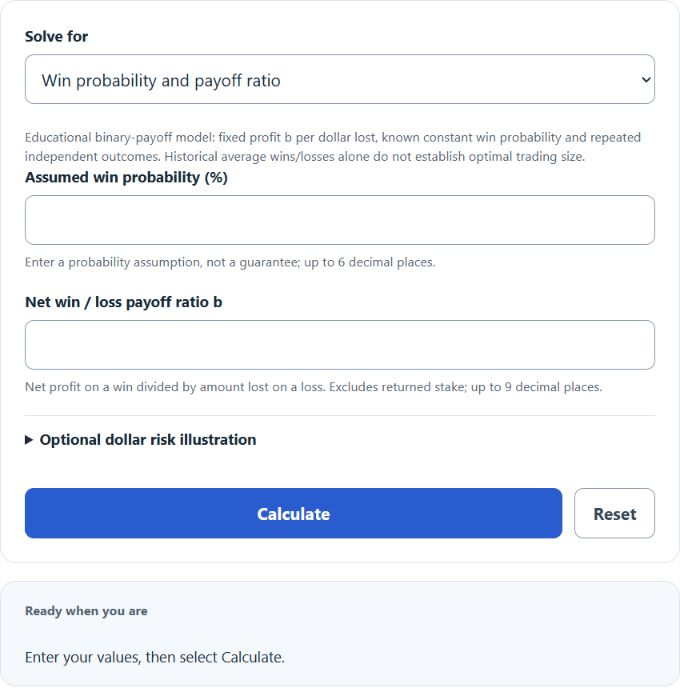
Explore a simplified binary-payoff Kelly model from an assumed win probability and net win/loss ratio, with half/quarter fractions and optional dollar risk illustrations.
Kelly Criterion Formula
For repeated independent binary outcomes with a known constant win probability and fixed net payoffs, Kelly maximizes expected logarithmic wealth growth. This calculator illustrates that model, not an optimal real-world trading allocation:
f* = W - (1 - W) / R
No-short model fraction = max(0, f*)
Percentage = 100 * fraction
Variables:
- f* is the unconstrained binary-model fraction of wealth lost in the modeled loss outcome; the percentage is 100 times that fraction
- W is the probability of winning as a decimal (0.55 for a 55% win rate)
- R is fixed net profit on a win divided by loss magnitude. Average-win/loss mode uses that ratio as a binary approximation, not a full outcome distribution
Enter an assumed probability and either a net payoff ratio or average net win/loss amounts. The latter is only a binary approximation. A nonpositive formula gives a zero fraction under the no-short constraint. Half/quarter outputs scale that fraction; optional dollar amounts are amounts at risk, not total position values. Expected net return per dollar at risk and break-even probability use the same assumptions. Zero account balance is valid; a blank omits dollar outputs.
Full Kelly Stakes by Win Rate and Ratio
Unconstrained formula percentages for common binary assumptions. Negative cells correspond to zero in this calculator’s no-short model; they are not a recommendation to open an opposite position.
| Win rate | R = 1.0 | R = 1.5 | R = 2.0 | R = 3.0 |
|---|---|---|---|---|
| 40% | -20% | 0% | 10% | 20% |
| 45% | -10% | 8.3% | 17.5% | 26.7% |
| 50% | 0% | 16.7% | 25% | 33.3% |
| 55% | 10% | 25% | 32.5% | 40% |
| 60% | 20% | 33.3% | 40% | 46.7% |
Full-Kelly fractions can be large. Half/quarter illustrations trade modeled growth against risk exposure but do not establish a safe drawdown limit or correct uncertain probabilities.
Example Problems
Example 1: Ratio form.
Your system wins 55% of the time and winners average 1.5x losers.
Under the binary assumptions, f* = 0.55 – (1 – 0.55) / 1.5 = 0.25. The model fractions are 25% full, 12.5% half and 6.25% quarter. Multiplying a $25,000 balance by 6.25% gives a $1,562.50 amount-at-risk illustration, not a trading recommendation.
Example 2: Dollar averages with no edge.
You win 45% of the time; the average win is $200 and the average loss is $250, so R = 0.8.
f* = 0.45 – 0.55 / 0.8 = -0.2375, or -23.75%. The assumed binary model has negative expected net return; its constrained no-short fraction is zero.
Frequently Asked Questions
Why do traders use half or quarter Kelly?
Fractional Kelly scales the full-model fraction. If probabilities or payoffs are estimated incorrectly, even a smaller fraction may expose capital to substantial loss. Variable outcomes, costs and correlated positions require a broader model; fractional Kelly does not guarantee capital protection.
Can I use Kelly for stock position sizing?
This two-outcome formula is not a general stock-position optimizer. A stop-loss may slip or gap and does not guarantee a fixed loss. Average wins/losses do not specify the full return distribution, correlations or simultaneous portfolio exposures. The displayed dollars represent modeled loss risk, not shares, notional value or borrowed capital.
What does a negative Kelly mean?
A negative unconstrained fraction means negative expected net return under the entered binary assumptions. With a no-short constraint the model returns zero. It does not prove future returns or evaluate whether an opposite trade has a valid edge.