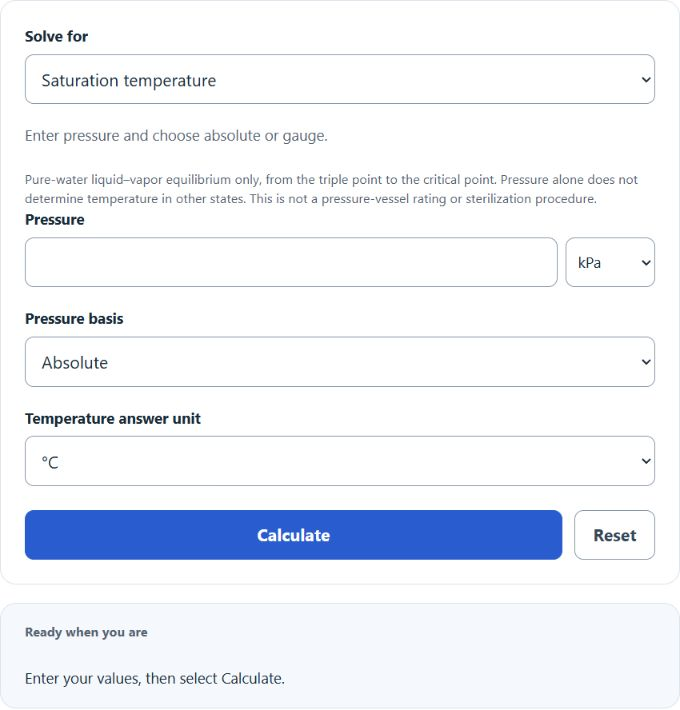
Calculate pure-water saturation temperature from absolute or gauge pressure in kPa, bar, psi, or MPa, or calculate absolute saturation pressure from temperature. This is a water–steam equilibrium model, not a general pressure-to-temperature conversion.
Related Calculators
- Cup to PSI Calculator
- Absolute Pressure Calculator
- Atmospheric Pressure Calculator
- Partial Pressure Calculator
- Water Vapor Pressure Calculator
- Boiling Point Calculator
- All Unit Converters
kPa to Temperature Formula
The calculator uses the IAPWS SR1-86(1992) water saturation-pressure correlation. It applies from the water triple point (273.16 K) to the critical point (647.096 K). Enter absolute pressure, or select gauge and supply ambient pressure; the default ambient pressure is 101.325 kPa.
- P = absolute saturation pressure (kPa); Pc = 22,064 kPa
- T = absolute temperature (K); Tc = 647.096 K; °C = K − 273.15
- ai and bi are the water correlation coefficients and exponents below. Temperature from pressure is found by bounded numerical inversion.
| Term i | Exponent bi | Coefficient ai |
|---|---|---|
| 1 | 1 | -7.85951783 |
| 2 | 1.5 | 1.84408259 |
| 3 | 3 | -11.7866497 |
| 4 | 3.5 | 22.6807411 |
| 5 | 4 | -15.9618719 |
| 6 | 7.5 | 1.80122502 |
| Source: IAPWS SR1-86(1992). Convenient saturation approximation for pure water. Pressure alone does not define temperature outside liquid–vapor equilibrium. | ||
| Absolute pressure (kPa) | Temperature (°C) | Temperature (°F) |
|---|---|---|
| 0.2 | Below triple point | Outside model range |
| 0.5 | Below triple point | Outside model range |
| 1 | 6.97 | 44.55 |
| 2 | 17.50 | 63.49 |
| 3 | 24.08 | 75.34 |
| 5 | 32.87 | 91.17 |
| 7 | 39.00 | 102.20 |
| 10 | 45.81 | 114.45 |
| 13 | 51.03 | 123.86 |
| 16 | 55.31 | 131.56 |
| 20 | 60.06 | 140.10 |
| 25 | 64.96 | 148.93 |
| 30 | 69.09 | 156.37 |
| 40 | 75.86 | 168.54 |
| 50 | 81.32 | 178.37 |
| 60 | 85.93 | 186.67 |
| 70 | 89.93 | 193.88 |
| 80 | 93.49 | 200.27 |
| 90 | 96.69 | 206.04 |
| 101.325 | 99.97 | 211.95 |
| Pure-water liquid–vapor saturation via IAPWS SR1-86(1992). Values below 0.611657 kPa are outside this model. Temperatures are rounded estimates. | ||
Boiling Point of Water by Altitude
Atmospheric pressure decreases with altitude, directly lowering water's boiling point. This affects cooking times, food safety, and equipment calibration at elevation.
| Location | Altitude (m) | Pressure (kPa) | Boiling Point (°C) | Boiling Point (°F) |
|---|---|---|---|---|
| Sea level | 0 | 101.3 | 100.0 | 211.9 |
| Denver, CO, USA | 1,609 | 83.4 | 94.6 | 202.3 |
| Mexico City, Mexico | 2,240 | 77.1 | 92.5 | 198.5 |
| Lhasa, Tibet | 3,656 | 64.4 | 87.8 | 190.0 |
| Everest Base Camp | 5,364 | 51.5 | 82.1 | 179.7 |
| Mt. Everest Summit | 8,849 | 31.4 | 70.1 | 158.3 |
| Approximate standard-atmosphere pressures for illustration; actual weather and local pressure vary. Temperatures use IAPWS SR1-86(1992) at the listed absolute pressures. Cooking time cannot be inferred from temperature alone. | ||||
Industrial and Scientific Reference Points
| Application | Pressure (kPa abs) | Temp (°C) | Notes |
|---|---|---|---|
| Water triple point | 0.611657 | 0.01 | Nominal triple point of pure water |
| Normal boiling point | 101.325 | 99.974 | Approximately 100 °C at one standard atmosphere |
| Pressure-cooker illustration | 170–207 | 115.1–121.3 | Saturated-water estimates at the listed absolute pressures. Follow the equipment instructions; no cooking-time reduction is implied. |
| Steam saturation reference | 206.8 | 121.27 | Pressure and temperature alone do not validate sterilization. Use the validated cycle, load, air-removal and monitoring requirements for the equipment. |
| Higher-pressure steam reference | 241.3 | 126.25 | Saturation reference only; this is not a sterilization cycle or exposure-time recommendation. |
| Water critical point | 22,064 | 373.946 | Critical endpoint of the liquid–vapor coexistence curve |
| Water saturation values: IAPWS SR1-86(1992). Sterilization requires a validated process; see CDC steam sterilization guidance. This table does not determine a safe cycle. | |||
FAQ
Which equation does this calculator use?
It uses the six-term IAPWS water saturation-pressure correlation and numerically inverts it for temperature. The coefficients above apply to pure water only; this calculator does not use Antoine constants.
What range and accuracy limits apply?
The supported liquid–vapor saturation range is 0.01–373.946 °C, approximately 0.611657–22,064 kPa absolute. The correlation is a convenient approximation to the complete IAPWS formulation. Mixtures, dissolved substances, ice sublimation, superheated steam and compressed-liquid states need other models. Use an appropriate validated engineering reference for design.
Does this calculator support other liquids or sterilization cycles?
It supports pure water only and has no Materials tab. Other liquids need substance-specific data. A saturation temperature calculation cannot establish sterilization effectiveness or a safe pressure-vessel operating limit.