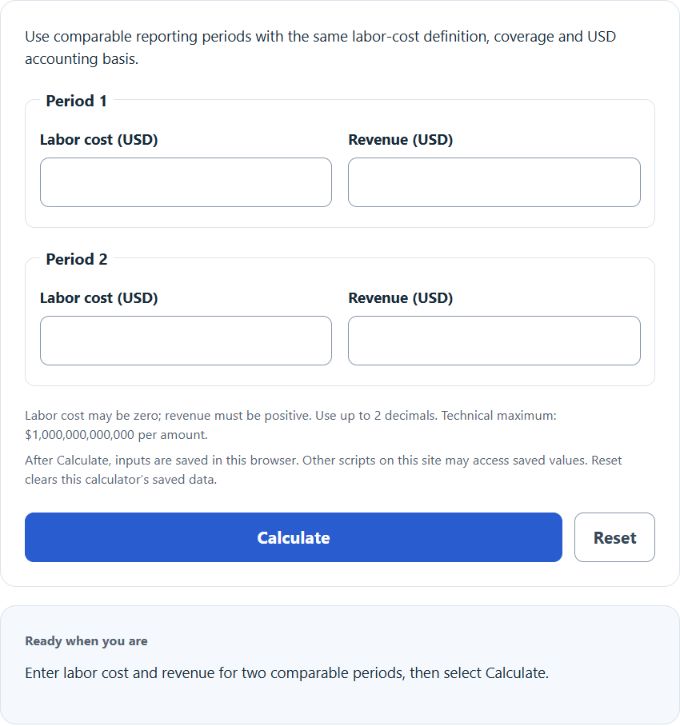
Compare two periods and break the change in labor percentage into labor-cost and revenue contributions.
- Labor Percentage Calculator
- Direct Labor Costs Calculator
- Labor Efficiency Variance Calculator
- Cost Income Ratio Calculator
- Business Finance Calculators
- Department Labor Percentage Mix Calculator
Labor Percentage Change Breakdown Formula
For labor cost L and revenue R, labor percentage is 100L/R. Subscripts 0 and 1 identify the first and second periods.
- Total change = 100(L1/R1 − L0/R0)
- Labor-cost contribution = 50(L1 − L0)(1/R0 + 1/R1)
- Revenue contribution = 50(L0 + L1)(1/R1 − 1/R0)
Enter all four amounts in USD. Costs can be zero; revenues must be positive. The change and contributions are in percentage points (pp), not relative percent change.
How the Breakdown Works
Changing cost first and revenue second gives a different allocation from changing revenue first. This calculator averages both orders, following the two-factor Shapley method. The contributions add to the total change before rounding; separately rounded displays may differ slightly.
Use comparable reporting periods, organizational scope, cost definitions and accounting bases. Rescaling just one period can change the allocation even when its percentage stays the same. These are arithmetic contributions, not proof of business causes or a staffing recommendation.
How to Use the Calculator
- Enter the first period’s labor cost and matching revenue.
- Enter comparable amounts for the second period, then select Calculate.
- Compare the signed contributions. Open Calculation details to see both update orders.
Worked Example
Labor cost rises from $30,000 to $33,000 while revenue rises from $100,000 to $120,000. Labor percentage falls from 30% to 27.5%, a change of −2.5 pp.
The labor-cost contribution is +2.75 pp and the revenue contribution is −5.25 pp. Together: +2.75 − 5.25 = −2.5 pp.
Frequently Asked Questions
Can the percentage stay unchanged while both contributions are nonzero?
Yes. If both amounts rise proportionally, the contributions can offset. For $30,000/$100,000 changing to $36,000/$120,000, they are +5.5 pp and −5.5 pp.
Does a lower labor percentage mean better efficiency?
The ratio alone cannot establish efficiency, service quality or profitability. The calculation only allocates the change in the supplied cost-to-revenue ratio.
Can labor percentage exceed 100%?
Yes. Labor costs can exceed revenue. The calculator retains that result rather than capping it.
Method Reference
Anthony F. Shorrocks, Decomposition Procedures for Distributional Analysis, June 1999 draft, sections 2 and 3.1. The calculator applies its symmetric two-factor allocation to labor cost divided by revenue.