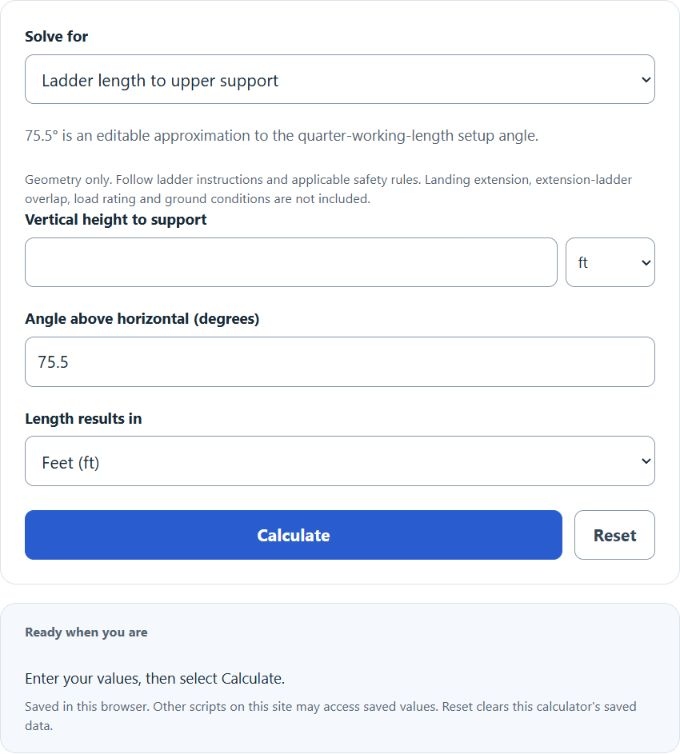
Calculate ladder length, vertical reach, base distance, or setup angle in feet, meters, inches, and centimeters with a 4:1 geometry check.
- All Construction Calculators
- Ladder Angle Calculator
- Distance Angle Calculator
- Angle of Elevation Calculator
- Wall Angle Calculator
Ladder Geometry and the Quarter-Working-Length Rule
This calculator solves the right triangle formed by a leaning ladder, level ground, and a vertical support. It does not certify a safe setup or include landing extension or extension-ladder overlap. OSHA’s non-self-supporting ladder rule places the base approximately one quarter of the working ladder length from the support; this differs from one quarter of vertical rise. The examples below use an explicitly illustrative rise-to-run ratio of 4:1.
H is the vertical height to the resting surface, B is the base distance from the wall, L is the ladder length to the contact point, and E is the vertical extension above the landing; extra sloped ladder length is E/sin(θ). For roof or elevated landing access, use 3 ft, 36 in, 0.9144 m, or 91.44 cm for E, depending on the unit system selected.
What the calculator is measuring
- Ladder height means the vertical rise from the ground to the roof edge, landing, or upper support point.
- Ladder length means the actual sloped length of ladder needed to reach that point at the entered angle.
- Base distance is how far the ladder foot should be placed away from the wall or structure.
Placement guidance and the example geometry
OSHA’s quarter-working-length placement gives an angle of arccos(1/4), approximately 75.52°. A 4:1 vertical-rise-to-base triangle gives approximately 75.96°. These are close approximations but are not the same definition. Follow the applicable rules and ladder instructions; a computed angle alone does not establish safety.
How to use the ladder height calculator
- Measure the vertical height from the ground to the roof edge, landing, or contact point.
- Enter that value in feet, meters, inches, or centimeters.
- Choose the solve mode and enter the setup angle, or use vertical height and base distance to find the angle.
- If you will step onto the roof or landing, include the extra extension above the landing.
- Select a real ladder using its manufacturer’s usable working length, overlap, standing limits and applicable safety requirements.
Example
If the roof edge is 12 ft above the ground, the ladder base should be 3 ft from the wall. The ladder needs about 12.37 ft to reach the roof edge itself, and about 15.46 ft if its rails continue 3 ft vertically above that landing at this same illustrative angle. Extension-ladder overlap is still not included.
In practice, you would round up to a ladder size that meets or exceeds the computed minimum rather than choosing a ladder that is shorter than the result.
Quick reference table
| Vertical height | Base distance | Ladder to contact point | With 3 ft vertical rail extension |
|---|---|---|---|
| 8 ft | 2 ft | 8.25 ft | 11.34 ft |
| 12 ft | 3 ft | 12.37 ft | 15.46 ft |
| 16 ft | 4 ft | 16.49 ft | 19.58 ft |
| 20 ft | 5 ft | 20.62 ft | 23.71 ft |
| 24 ft | 6 ft | 24.74 ft | 27.83 ft |
Common mistakes to avoid
- Measuring along the roof or wall surface instead of measuring the true vertical height from the ground.
- Forgetting the landing extension when the ladder will be used to get on or off a roof.
- Using the exact minimum as the ladder size instead of rounding up to an available ladder length.
- Confusing ladder length with working reach; your usable reach depends on body position and safe standing limits, not just the ladder size.
- Placing the base too close or too far away after calculating the correct ladder length.
When this formula applies
- Straight ladders leaning against a wall or structure
- Extension ladders used to reach roofs, platforms, or elevated landings
- Setups where the base can be placed at the recommended 4-to-1 distance
This method is not intended for self-supporting stepladders, articulated ladders in specialty positions, or situations where obstacles prevent correct base placement.
Frequently asked questions
Is ladder height the same as ladder length?
No. Ladder height is the vertical rise to the target point. Ladder length is the actual sloped ladder needed to span that rise at the entered angle.
Do I always add 3 ft to the ladder length?
No. For upper-landing access, OSHA generally requires side rails at least 3 ft above the landing, with a specified alternative when extension is not possible. That is a vertical height: the extra sloped length is 3 ft divided by sin(θ). This calculator reports length to the support only; verify extension, anchoring, overlap and manufacturer requirements separately.
Can I use metric units?
Yes. The same geometry works in any unit system as long as all measurements stay consistent. If you switch units, the landing extension must also be converted to the same unit.
What should I measure if the roof is sloped?
Measure the vertical height to the resting edge or landing point, not the slope length of the roof. The calculator needs vertical rise, because the geometry uses rise and base offset. OSHA’s placement rule separately refers to the working ladder length.