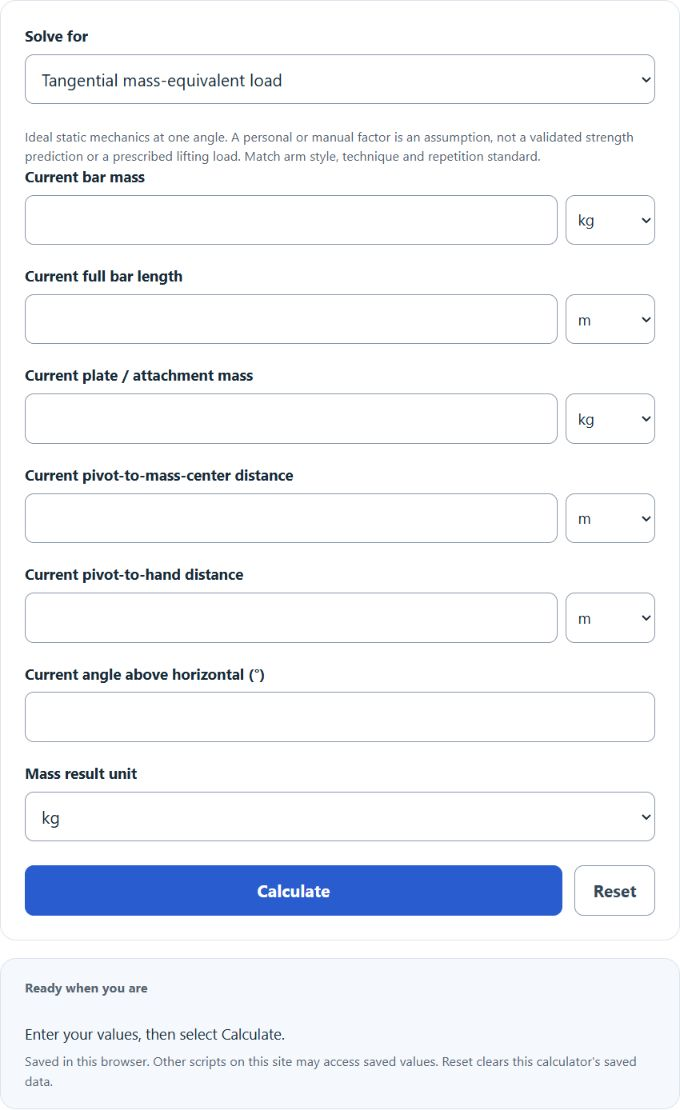
Separate landmine mechanics from strength transfer by calculating start-angle effective load before applying any personal overhead-press factor.
How the Landmine Press To Overhead Press Calculator Works
The mechanics mode resolves the bar and added mass into a tangential mass-equivalent load at the hands at one start angle. Strength-transfer modes then apply a separate personal or manual strict-press factor as an unvalidated scenario, not a reliable prediction or prescribed load.
Keeping mechanics and transfer separate prevents the angled bar’s effective load from being mislabeled as overhead-press strength. Every geometric field remains editable, and reverse mode algebraically solves the required added mass.
Landmine Torque and Transfer Formulas
Formula: effective load = cos(angle) x (bar mass x bar length / 2 + plate mass x plate-center distance) / hand distance; strict OHP = effective load x personal factor
The angle is converted to radians once for cosine. Reverse mode first divides the strict-press target by the factor, then solves the moment equation for plate mass and forward-checks the target.
Choosing Comparable Inputs
Each mass and length field has a unit selector and is converted internally to kilograms and meters. Changing an input unit converts its entered value. Measure distances from the landmine pivot. Start angle is above horizontal and must be 0 through 85 degrees. Match one-arm or two-arm style between calibration and prediction.
| Start angle | Cosine multiplier | Relative gravitational moment | What changes |
|---|---|---|---|
| 0 degrees | 1.0000 | 100.0% | Maximum gravity moment in this model |
| 15 degrees | 0.9659 | 96.6% | Slight reduction |
| 30 degrees | 0.8660 | 86.6% | Moderate reduction |
| 45 degrees | 0.7071 | 70.7% | Common worked-example angle |
| 60 degrees | 0.5000 | 50.0% | Half the horizontal-position moment |
Understanding Your Results
The selected answer appears first. Effective load, torque, bar and plate moments, factor and calibration details, forward check, geometry, and a five-angle sensitivity table follow.
The sensitivity rows recalculate the current setup at five angles without repeating strength estimates. They show why geometry matters while leaving the personal transfer factor untouched.
Worked Example
With a 20 kg, 2.2 m bar, 40 kg added at 2.05 m, hands at 2.1 m, and a 45-degree start, effective load is 35.0186 kg. A deliberately entered factor of2 produces a70.0372 kg overhead-press scenario. It does not establish that the person can safely lift that load.
Common Mistakes
Do not call effective load a strict press without a transfer factor, mix length units, measure from the sleeve instead of the pivot, use 90 degrees in reverse solving, or hide a negative solved plate mass.
Assumptions and Limitations
The model assumes a uniform straight bar, frictionless pivot, concentrated added mass, and tangential hand force at the start position. It does not model acceleration, body position, changing angle, or muscle force.
Browse the complete Exercise Strength Conversions calculator collection or return to the Sports & Fitness Calculators hub.
Sources
Rui Zhao and colleagues, Landmine Press Kinematics Measured with an Enhanced YOLOv8 Model and Mathematical Modeling, Sensors,2026. This mechanics and measurement study does not validate a universal strict-overhead-press conversion.