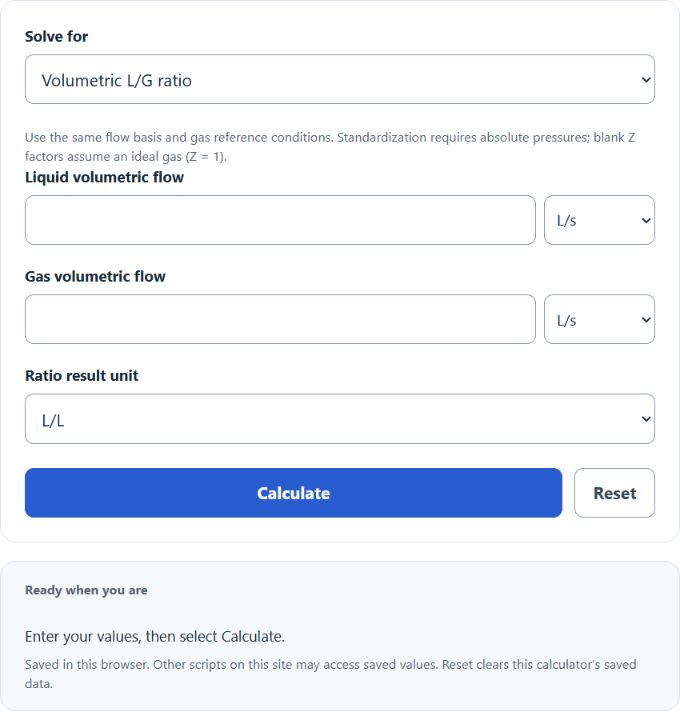
Calculate liquid-to-gas ratios from liquid and gas flow rates by volume, mass, or moles, or standardize gas flow for pressure and temperature.
Related Calculators
- Volume Fraction Calculator
- Percent Volume Calculator
- Van Der Waals Equation Calculator
- Diffusion Rate Calculator
- All Chemistry Calculators
Liquid To Gas Ratio Formula
The following volume relationship also applies to volumetric flow rates measured over the same time basis. Select the volumetric, mass or molar basis in the calculator.
Variables:
- R is the liquid to gas ratio
- V_l is the volume of liquid
- V_g is the volume of gas
Divide liquid by gas on the selected matching-unit basis. Gas standardization is separate and conserves molar flow: Qref = Qactual × (Pactual/Pref) × (Tref/Tactual) × (Zref/Zactual), using absolute pressures and kelvin temperatures. Blank Z factors equal 1.
What is a Liquid To Gas Ratio?
The liquid to gas ratio is a measure used to describe the proportion of liquid to gas in a mixture. This ratio is important in various industrial and scientific applications, such as chemical engineering, environmental science, and process engineering. Understanding the liquid to gas ratio can help in optimizing processes, ensuring safety, and improving efficiency in systems where both liquid and gas phases are present.
How to Calculate Liquid To Gas Ratio?
The following steps outline how to calculate the Liquid To Gas Ratio.
- First, determine the volume of the liquid (V_l).
- Next, determine the volume of the gas (V_g).
- Finally, calculate the liquid to gas ratio using the formula R = V_l / V_g.
- For a flow-rate calculation, use comparable liquid and gas flow rates and select their units. For the example volumes below, divide 10 by 5 to obtain a matching-unit volumetric ratio of 2.
Example Problem :
Use the following variables as an example problem to test your knowledge.
Volume of Liquid (V_l) = 10 m³
Volume of Gas (V_g) = 5 m³