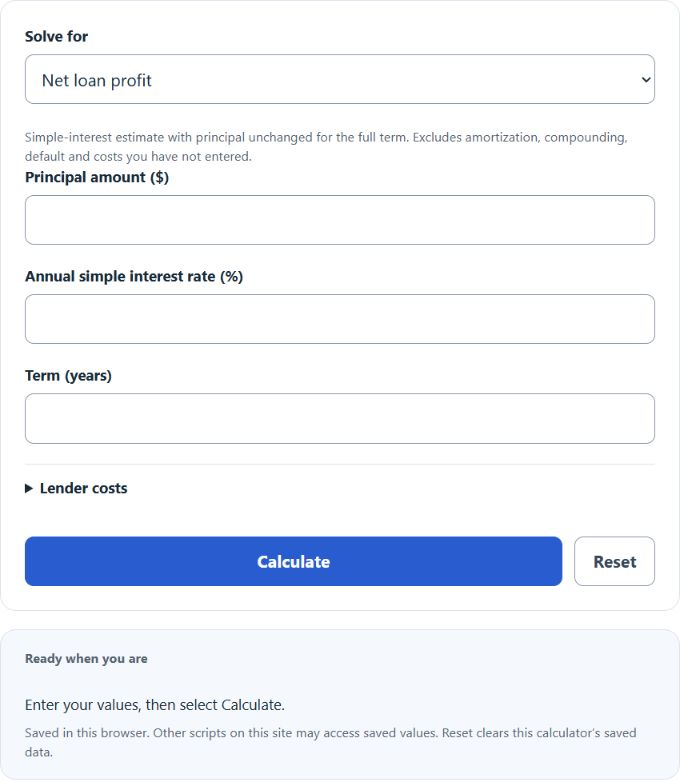
Calculate loan net profit, principal, interest rate, repayment period, or fees by choosing the value to solve for and entering the required values. Lender costs may be left blank for zero when they are not the value being solved.
Related Calculators
- Debenture Interest Calculator
- ATM Calculator
- Bank Guarantee Cost Calculator
- Liquidity Premium Calculator
- Expected Profit Calculator
- All Business Calculators
Loan Profit Formula
The following equation estimates loan profit using simple interest with principal outstanding unchanged for the full term. It excludes amortization, compounding, default and costs not entered.
- Where LP is the loan profit ($)
- TR is simple-interest revenue, excluding returned principal: principal × (annual interest rate / 100) × years ($)
- TC is the total costs or expenses associated with the loan ($)
To calculate the loan profit, subtract the total costs from the total revenue associated with the loan.
What is a Loan Profit?
Definition:
Loan profit is the lender’s interest revenue less lender-paid fees and expenses in this simplified model. Returned principal is not profit; fees collected from the borrower and omitted costs are not modeled separately.
How to Calculate Loan Profit?
Example Problem:
The following example outlines the steps and information needed to calculate the Loan Profit.
First, determine the total revenue from the loan. In this example, a $10,000 loan is issued at 5% annual interest for 2 years, resulting in $10,000 × 0.05 × 2 = $1,000 in interest.
Next, determine the total costs. Assume the lender has various fees and expenses totaling $150 over the life of the loan.
Finally, calculate the loan profit using the formula above:
LP = TR - TC
TR = $1,000
TC = $150
LP = $1,000 - $150 = $850
FAQ
What factors can affect the total loan profit?
Several factors influence loan profit, including the interest rate, the repayment period, initial fees, ongoing operational expenses, and the risk of default. Changes in any of these areas could increase or decrease overall profitability.
How can I reduce the risk of losing money on a loan?
To reduce risk, lenders often conduct thorough credit checks, require collateral for secured loans, and maintain adequate reserves for potential losses. Properly assessing a borrower’s ability to repay can help mitigate the risk of default.
Are there any regulations that affect loan profitability?
Yes. Loan profitability is often influenced by government regulations, such as caps on interest rates, consumer protection requirements, and rules governing the terms of lending agreements. Staying compliant is crucial for legal and ethical lending practices.