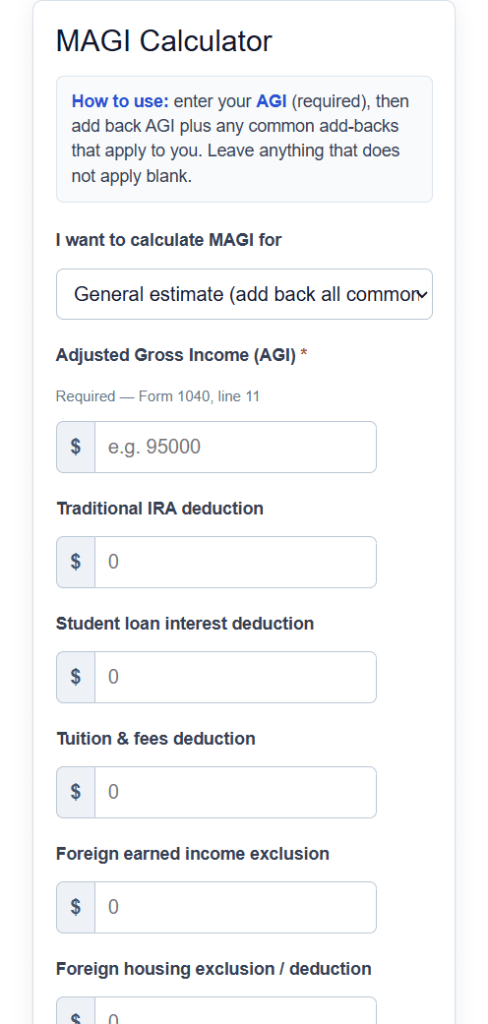
Calculate your Modified Adjusted Gross Income (MAGI) from your AGI to check eligibility for IRA deductions, Roth contributions, and tax credits.
MAGI Formula
There is no single MAGI. Every version starts from your adjusted gross income (AGI) and adds back a list of items that depends on the tax benefit you are checking. The general form is:
MAGI = AGI + add-backs
The calculator changes which add-backs it asks for based on what you select in "I want to calculate MAGI for". The common provision-specific formulas are below.
Traditional IRA deduction:
MAGI = AGI + IRA deduction + student loan interest + foreign earned income exclusion + foreign housing + excluded savings bond interest + excluded adoption benefits
Roth IRA contribution eligibility:
MAGI = AGI + traditional IRA deduction add-backs - Roth conversion income
Premium Tax Credit (health insurance):
MAGI = AGI + tax-exempt interest + non-taxable Social Security + foreign earned income excluded
Net Investment Income Tax (NIIT):
MAGI = AGI + verified net section 911 adjustment + other required Form 8960 adjustments
Where:
- AGI is your adjusted gross income from Form 1040, line 11.
- IRA deduction is the traditional IRA contribution you deducted.
- Student loan interest is the deduction you took for interest paid on student loans.
- Foreign earned income exclusion and foreign housing are amounts you excluded under the foreign income rules.
- Tax-exempt interest is interest that was not included in AGI, such as municipal bond interest.
- Non-taxable Social Security is the portion of benefits not counted in AGI.
- Roth conversion income is income from converting or rolling a traditional account into a Roth, which you subtract back out for the Roth eligibility test.
The displayed additions are added to AGI. In Roth mode, taxable conversion and qualified-plan rollover income included in AGI is subtracted. Because the add-back list is different for each benefit, the same person can have several different MAGI figures in the same year.
Add-Backs by MAGI Type
This table shows which items are added back to AGI for the most common reasons people calculate MAGI.
| Purpose | Main Add-Backs to AGI |
|---|---|
| Traditional IRA deduction | IRA deduction, student loan interest, foreign earned income/housing, savings bond interest, adoption benefits |
| Roth IRA eligibility | Same as traditional IRA list, minus Roth conversion income |
| Premium Tax Credit | Tax-exempt interest, non-taxable Social Security, excluded foreign earned income |
| Net Investment Income Tax | Verified net adjustment from the Form 8960 MAGI worksheet |
| Education credits | Foreign earned income/housing exclusions, Puerto Rico and American Samoa income |
The following table shows the 2026 Roth IRA contribution phase-out ranges, one of the most common reasons to check MAGI.
| Filing Status | Full Contribution Below | No Contribution At Or Above |
|---|---|---|
| Single / Head of household | $153,000 | $168,000 |
| Married filing jointly | $242,000 | $252,000 |
| Married filing separately and lived with spouse during the year | $0 (phaseout starts immediately above zero) | $10,000 |
Example Problems
Example 1: Traditional IRA deduction. Your AGI is $68,000. You deducted a $6,000 traditional IRA contribution and $1,500 of student loan interest. To check your IRA deduction MAGI, add those items back:
MAGI = 68,000 + 6,000 + 1,500 = 75,500
Your MAGI for the IRA deduction test is $75,500.
Example 2: Premium Tax Credit. Your AGI is $42,000. You received $3,000 of tax-exempt municipal bond interest and $4,000 of non-taxable Social Security benefits. The Premium Tax Credit MAGI is:
MAGI = 42,000 + 3,000 + 4,000 = 49,000
Your MAGI for marketplace health coverage is $49,000.
FAQ
Is MAGI the same as AGI? No. AGI is a single number on your tax return. MAGI takes that AGI and adds back specific deductions and excluded income. If you took none of those deductions or exclusions, your MAGI can equal your AGI, but the two are calculated for different purposes.
Why do I get different MAGI numbers? The add-back list changes depending on the benefit. The MAGI used for a Roth IRA is not the same as the MAGI used for the Premium Tax Credit or the Net Investment Income Tax. Pick the purpose that matches what you are checking, and the calculator uses the correct add-backs for it.
Where do I find the numbers to enter? Use the adjusted gross income amount on your tax return. The add-back amounts come from the related schedules and forms, such as Schedule 1 for the IRA deduction and student loan interest, and Form 2555 for foreign earned income. Enter only the items that apply to you and leave the rest at zero.
Rules reviewed October 20, 2026. IRA adjustments follow IRS Publication 590-A, Worksheets 1-1 and 2-1. 2026 Roth phaseouts follow IRS 2026 IRA limits. PTC household treatment follows Form 8962 instructions; NIIT adjustments require the Form 8960 MAGI worksheet.