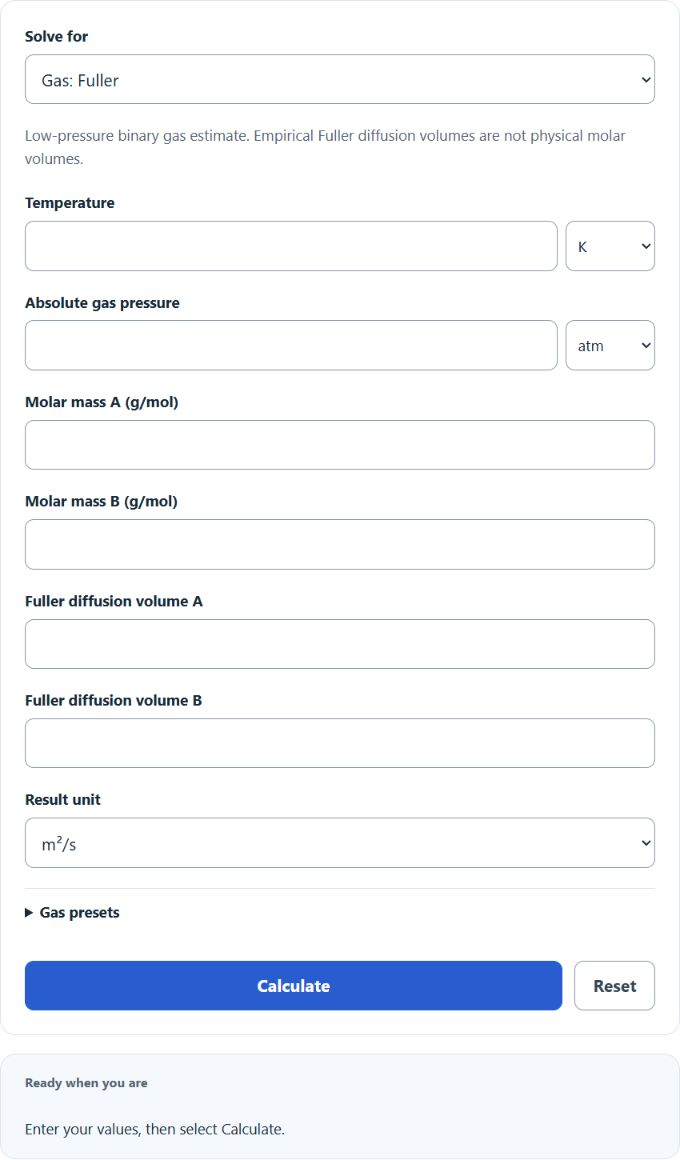
Calculate gas and liquid mass diffusivity from temperature, pressure, viscosity, molar mass, diffusion volume, and particle radius.
Related Calculators
- Diffusion Time Calculator
- Diffusion Rate Calculator
- Specific Heat Calculator
- Thermal Resistance Calculator
- Average Density Calculator
- All Chemistry Calculators
Mass Diffusivity Formula
Select a model appropriate to the material and conditions. The calculator estimates mass diffusion coefficients; thermal diffusivity k/(ρ cp) is a different property.
Variables:
- D is the mass diffusion coefficient (m²/s) in the Stokes–Einstein example
- k_B is the Boltzmann constant, 1.380649×10⁻²³ J/K
- T is the absolute temperature (K)
- μ is dynamic viscosity (Pa·s) and r is hydrodynamic particle radius (m)
For Stokes–Einstein, divide k_B T by 6π μ r. Gas modes use the Chapman–Enskog or Fuller correlations; Wilke–Chang estimates dilute liquid diffusion. Each model needs its own parameter data and applicability check.
What is Mass Diffusivity?
Mass diffusivity, also known as the diffusion coefficient, is a measure of how quickly molecules spread out and mix due to random motion. It is a key parameter in the study of mass transfer and is used to describe the rate at which particles move through a medium. The higher the mass diffusivity, the faster the diffusion process. This property is crucial in various fields such as chemical engineering, environmental science, and material science, where understanding the rate of diffusion can impact the design and optimization of processes and materials.
How to Calculate Mass Diffusivity?
The following steps outline how to calculate the Mass Diffusivity.
- First, choose a model suited to the gas, dilute liquid solute, or dispersed particle.
- Next, enter absolute temperature and the selected model’s required parameters.
- Next, check pressure, viscosity, radius, and correlation-specific units as applicable.
- Finally, select the result unit and calculate the diffusion coefficient.
- After inserting the values and calculating the result, check your answer with the calculator above.
Example Problem :
Use the following variables as an example problem to test your knowledge.
For a Stokes–Einstein example, temperature T = 300 K.
Dynamic viscosity μ = 0.001 Pa·s (1 cP).
Hydrodynamic radius r = 100 nm gives D ≈ 2.197×10⁻¹² m²/s.