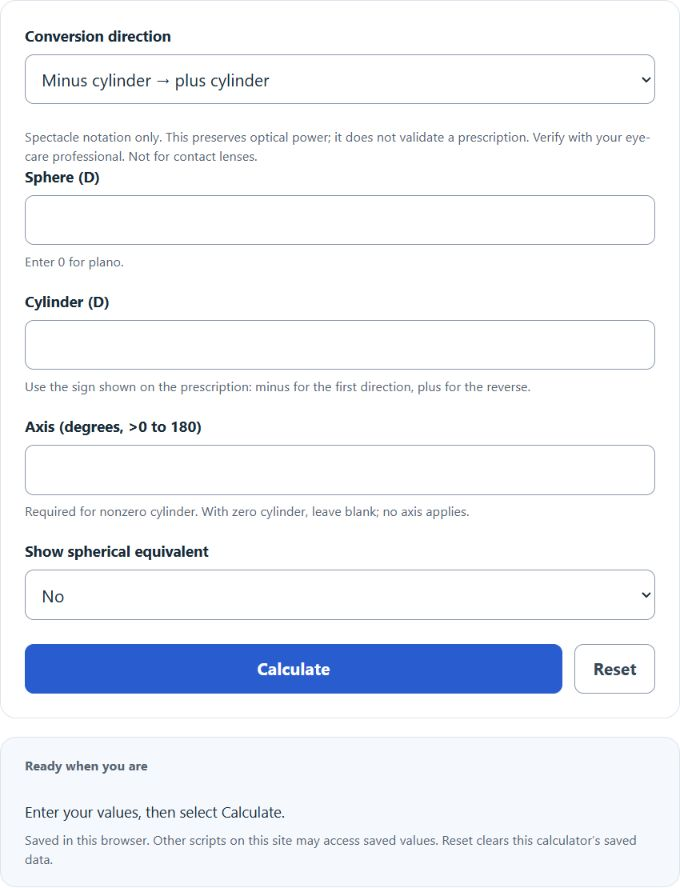
Calculate the transposed form of any eyeglass prescription by converting between minus cylinder and plus cylinder notation, including the new sphere, cylinder, and axis.
Important: This tool only transposes spectacle (eyeglass) lens notation and does not validate whether a prescription is accurate or appropriate. Do not use it to self-prescribe—verify the converted values with your optometrist/ophthalmologist or dispensing optician. Not for contact lens prescriptions. If you have eye pain or sudden vision changes, seek professional care promptly.
Related Calculators
- Plus to Minus Cyl Calculator
- Spherical Equivalent Calculator
- Prentice's Rule Calculator
- Lens Thickness Calculator
- Diopter Distance Calculator
- Diopter to mm Calculator
- All Health and Medical Calculators
Cylinder Transposition Formula
Transposition rewrites a sphero-cylindrical prescription in the opposite cylinder form without changing its optical power. The same three steps work in both directions, whether you start in minus cylinder or plus cylinder notation.
New Sphere = Old Sphere + Old Cylinder
New Cylinder = -1 x Old Cylinder
New Axis = Old Axis + 90 (if Axis is 90 or less), or Old Axis - 90 (if Axis is over 90)
Old Sphere is the spherical power in diopters (D). Old Cylinder is the cylindrical power in diopters; it is negative in minus cylinder form and positive in plus cylinder form. Old Axis is the cylinder orientation in degrees greater than 0 through 180 (conventionally whole degrees 1–180). New Sphere is the algebraic sum of the old sphere and old cylinder. New Cylinder keeps the same magnitude but the opposite sign. New Axis is the perpendicular meridian, wrapped into the greater-than-0 through 180 degree range. The spherical equivalent, used to estimate a single-power lens, is Old Sphere plus half of Old Cylinder.
Transposition Reference Values
The table below shows how sample prescriptions convert between the two cylinder forms. The two entries in each row describe the same lens.
| Minus cylinder form | Plus cylinder form |
|---|---|
| -2.00 / -1.50 x 180 | -3.50 / +1.50 x 90 |
| +1.00 / -0.75 x 45 | +0.25 / +0.75 x 135 |
| -3.25 / -0.50 x 90 | -3.75 / +0.50 x 180 |
| Plano / -1.00 x 120 | -1.00 / +1.00 x 30 |
Axis rule check: an axis of 90 or less gains 90 degrees, and an axis over 90 loses 90 degrees, so the result stays greater than 0 through 180 degrees; fractional axes are preserved.
Example Calculations
Example 1. You have a minus cylinder prescription of -2.00 / -1.50 x 180 and want the plus cylinder form. New Sphere is -2.00 plus -1.50, which is -3.50. New Cylinder is the opposite sign of -1.50, which is +1.50. The axis is 180, which is over 90, so subtract 90 to get 90. The transposed prescription is -3.50 / +1.50 x 90.
Example 2. You have a plus cylinder prescription of +1.00 / +0.75 x 45 and want the minus cylinder form. New Sphere is +1.00 plus +0.75, which is +1.75. New Cylinder is the opposite sign of +0.75, which is -0.75. The axis is 45, which is 90 or less, so add 90 to get 135. The transposed prescription is +1.75 / -0.75 x 135.
FAQ
Does transposition change the strength of the lens? No. Transposition only rewrites the same prescription in the other cylinder form. The corrective power at every meridian is identical, so the lens you receive is the same.
Why does the axis shift by exactly 90 degrees? The cylinder describes power along one meridian and zero along the meridian 90 degrees away. When you flip the sign of the cylinder, you are describing the same lens from the perpendicular meridian, so the axis must rotate by 90 degrees to keep the orientation consistent.
What is the spherical equivalent and when do you use it? The spherical equivalent is Old Sphere plus half of Old Cylinder. It estimates the single spherical power that best matches a sphero-cylindrical lens, which is useful for trial lenses, contact lens fitting starting points, and quick comparisons. Turn on the spherical equivalent option in the calculator to see it alongside the transposed values.