Calculate moisture ratio, moisture content from wet and dry mass, drying time, wet/dry basis conversions and wood equilibrium moisture content.
- All Food and Cooking Calculators
- Moisture Loss Calculator
- Moisture Content Calculator
- Drying Rate Calculator
- Percent Water Calculator
- Humidity Ratio Calculator
Calculator Functions
| Function | What it does | What it requires |
|---|---|---|
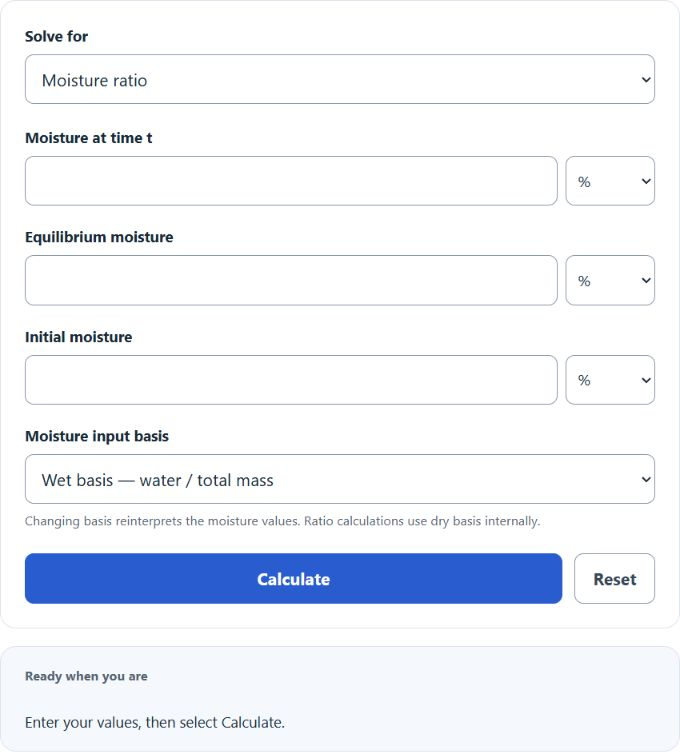
| Moisture ratio | Finds how far a material has dried, on a scale from 1 at the start to 0 at equilibrium | Requires the moisture at time t, the equilibrium moisture, the initial moisture and their basis |
| Moisture content from wet and dry mass | Finds moisture content on a wet and a dry basis from two weighings | Requires the wet mass before drying, the dry mass after drying and the result basis |
| Moisture at time t from ratio | Finds the moisture content that matches a given moisture ratio | Requires the moisture ratio, the equilibrium moisture, the initial moisture and their basis |
| Equilibrium moisture from ratio | Finds the equilibrium moisture that makes a ratio and two moisture readings agree | Requires the moisture ratio, the moisture at time t, the initial moisture and their basis |
| Initial moisture from ratio | Finds the starting moisture that makes a ratio and two moisture readings agree | Requires the moisture ratio, the moisture at time t, the equilibrium moisture and their basis |
| Drying time from target ratio | Estimates the time a fitted drying equation takes to reach a moisture ratio | Requires the target moisture ratio, the rate coefficient k, the drying equation and the time unit |
| Drying time from target moisture | Estimates the time a fitted drying equation takes to reach a moisture content | Requires the target, equilibrium and initial moisture, their basis, k, the drying equation and the time unit |
| Moisture at a given drying time | Predicts the moisture content after a set drying time | Requires the elapsed time, the equilibrium and initial moisture, their basis, k, the drying equation and the time unit |
| Wet / dry basis conversion | Converts a moisture content between wet basis and dry basis | Requires the moisture content and the basis it is stated on |
| Wood equilibrium moisture estimate | Estimates the moisture content wood settles at in air of a given temperature and humidity | Requires the air temperature (°C or °F) and the relative humidity |
Moisture values go in as a percent or a fraction, on a wet basis (water ÷ total mass) or a dry basis (water ÷ dry solids). The basis setting says how the entered numbers are read and does not convert them. The three drying-time functions offer the Newton / Lewis, Modified Page and Coefficient-scaled equations, with time in seconds, minutes or hours, and the last two add an exponent n and a coefficient a. Optional settings switch moisture results between percent and fraction, and Wet / dry basis conversion can also split a known total or dry-solids mass into water and dry solids.
Moisture Ratio Formulas
| MR | Moisture ratio, with no unit |
| Mt | Moisture content at time t, dry basis |
| Me | Equilibrium moisture content, dry basis |
| M0 | Initial moisture content, dry basis |
The ratio is defined on dry-basis moisture contents, in mass of water per mass of dry matter [1]. Wet-basis entries are converted to dry basis first, so the same three readings give a different ratio when the basis setting changes.
Moisture ratio
The main formula applies directly. Dry-basis readings of 50% now, 10% at equilibrium and 80% at the start give (0.5 − 0.1) ÷ (0.8 − 0.1) = 0.571429. The initial moisture must be above the equilibrium moisture, and the current moisture must lie between the two, so the ratio stays between 0 and 1.
Moisture content from wet and dry mass
The water mass is the wet mass minus the dry mass. Wet basis divides it by the wet mass and dry basis divides it by the dry mass, and both are shown as percentages. A 10 kg sample that dries to 8 kg held 2 kg of water, which is 20% wet basis and 25% dry basis. The dry mass cannot be larger than the wet mass.
Moisture at time t from ratio
This is the main formula solved for Mt. The answer is converted back to the basis and format selected for the inputs.
Equilibrium moisture from ratio
(1 − MR)
A ratio of exactly 1 is rejected, because it leaves the equilibrium moisture undetermined. So is any result at or above the initial moisture, or below zero.
Initial moisture from ratio
A ratio of 0 is rejected, because a fully dried sample says nothing about where it started.
Drying time from target ratio
t = [−ln(MR ÷ a)]1/n ÷ k
The three drying equations are one expression with different settings. Newton / Lewis fixes a = 1 and n = 1, giving MR = exp(−kt). Modified Page fixes a = 1 and takes n, giving MR = exp(−(kt)n), which is not the same as the Page form exp(−ktn). Coefficient-scaled takes both a and n, and with n = 1 it is the Henderson and Pabis equation, a × exp(−kt) [1]. The second line solves the expression for time. With Newton / Lewis and k = 0.1 per minute, a ratio of 0.5 is reached after ln(2) ÷ 0.1 = 6.931472 minutes. The target ratio must be above 0, since equilibrium is only approached, and it cannot be above a.
Drying time from target moisture
The target, equilibrium and initial moisture are first turned into a moisture ratio with the main formula. That ratio then goes through the same time equation as Drying time from target ratio.
Moisture at a given drying time
The selected drying equation gives the moisture ratio at the elapsed time, and Mt = MR × (M0 − Me) + Me turns it into a moisture content. After 10 minutes with Newton / Lewis and k = 0.1 per minute, MR = exp(−1) = 0.367879. For a material drying from 80% to an equilibrium of 10%, dry basis, that is 0.367879 × 0.7 + 0.1 = 35.7516%.
Wet / dry basis conversion
WB = DB ÷ (1 + DB)
WB and DB are fractions here. Wet basis is the mass of water per unit mass of wet material, and dry basis is the mass of water per unit mass of completely dry material [2]. A wet-basis value of 20% is 0.2 ÷ 0.8 = 25% dry basis, which matches the published conversion table [2]. Wet basis is always below 100%, while dry basis can exceed it. When a mass is supplied, a total mass is split as dry solids = total ÷ (1 + DB), and a dry-solids mass gives water = dry solids × DB.
Wood equilibrium moisture estimate
EMC is the equilibrium moisture content of wood in percent, dry basis, and h is the relative humidity as a decimal. The four parameters depend on the temperature T in °F: W = 330 + 0.452T + 0.00415T², K = 0.791 + 0.000463T − 0.000000844T², K₁ = 6.34 + 0.000775T − 0.0000935T² and K₂ = 1.09 + 0.0284T − 0.0000904T² [3]. A temperature entered in °C is converted to °F first. At 70 °F and 50% relative humidity the estimate is 9.2% moisture content. Temperatures outside 30 to 210 °F are rejected.
Limits of This Estimate
- The drying equations are curve fits. The rate coefficient k, the exponent n and the coefficient a come from regression on measured drying data for one material and one set of drying conditions [1], so a coefficient fitted to a different equation, time unit or product gives a wrong time.
- Coefficient-scaled with a other than 1 does not start at a moisture ratio of 1, so it cannot describe the first moments of drying.
- Wood equilibrium moisture estimate is a general fit to tabulated data. Actual values vary between species and between pieces of the same species, mostly at high humidity, and they depend on whether the wood is gaining or losing moisture [3].
- Moisture content from wet and dry mass treats all of the mass lost in drying as water.
Sources
- Younis, Abdelkarim and Zein El-Abdein, Kinetics and mathematical modeling of infrared thin-layer drying of garlic slices, Saudi Journal of Biological Sciences (2018): moisture ratio definition, the Lewis, Modified Page and Henderson and Pabis equations, and fitting of their constants by regression
- Food and Agriculture Organization of the United Nations, Grain storage techniques, Drying principles and general considerations: wet-basis and dry-basis moisture content and the conversion table between them
- USDA Forest Products Laboratory, Wood Handbook (FPL-GTR-282), Chapter 4, Equations 4-2 and 4-5: moisture content from wet and oven-dry mass, the equilibrium moisture content equation and its limits