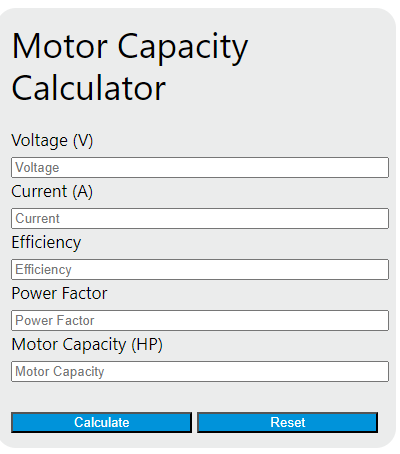
Enter the motor’s RMS voltage and current, efficiency, and power factor into the calculator to estimate motor output capacity (power). Select single‑phase or three‑phase AC; for three‑phase, use line‑to‑line voltage and line current.
- All Automotive Calculators
- HP to Amps Calculator
- HP to Current Calculator
- Volts to Horsepower Calculator
- AC Motor Power Calculator
- Motor Current Calculator
- Three Phase Power Calculator
Motor Capacity Formula
The motor capacity calculator estimates the mechanical output power of an AC motor from electrical operating data. In practice, motor capacity is usually expressed as horsepower (HP) or kilowatts (kW). The estimate depends on the measured voltage and current, plus how efficiently the motor converts electrical power into shaft power.
HP = \frac{K \cdot V \cdot I \cdot \eta \cdot PF}{746}kW = \frac{K \cdot V \cdot I \cdot \eta \cdot PF}{1000}The phase constant depends on the motor type and the measurements used:
K = 1 \text{ for single-phase AC}K = \sqrt{3} \text{ for three-phase AC using line-to-line voltage and line current}What the Formula Means
The calculation starts with real electrical input power, adjusts it for efficiency, and then converts the result into horsepower if needed. This makes the calculator especially useful when you know the motor’s operating voltage, running current, efficiency, and power factor but want a fast estimate of output capacity.
P_{in} = K \cdot V \cdot I \cdot PFP_{out} = P_{in} \cdot \etaHP = \frac{P_{out}}{746}Variable Definitions
| Symbol | Description | Typical Use |
|---|---|---|
| HP | Motor capacity in horsepower | Estimated shaft output power |
| kW | Motor capacity in kilowatts | Metric power rating |
| V | Voltage in volts | Use RMS voltage |
| I | Current in amperes | Use RMS running current |
| η | Efficiency as a decimal | Represents conversion from electrical input to mechanical output |
| PF | Power factor as a decimal | Accounts for the real portion of AC input power |
| K | Phase constant | Single-phase or three-phase multiplier |
Single-Phase and Three-Phase Forms
For clarity, the general equation can be written in its most common forms below.
HP_{1\phi} = \frac{V \cdot I \cdot \eta \cdot PF}{746}HP_{3\phi} = \frac{\sqrt{3} \cdot V_{LL} \cdot I_{L} \cdot \eta \cdot PF}{746}For three-phase motors, use line-to-line voltage and line current. Mixing line values with phase values will produce the wrong result.
How to Use the Calculator
- Select whether the motor is single-phase or three-phase.
- Enter the operating voltage as an RMS value.
- Enter the running current as an RMS value.
- Enter motor efficiency and power factor.
- Calculate the output capacity in horsepower or kilowatts.
If efficiency is given as a percentage, convert it to decimal form before using the formula:
\eta = \frac{\eta_{\%}}{100}Rearranged Equations
If you know any four of the variables, the remaining one can be solved directly. These rearrangements are useful for troubleshooting and for validating measurements.
| Unknown | Rearranged Formula |
|---|---|
| Current | I = \frac{746 \cdot HP}{K \cdot V \cdot \eta \cdot PF} |
| Voltage | V = \frac{746 \cdot HP}{K \cdot I \cdot \eta \cdot PF} |
| Efficiency | \eta = \frac{746 \cdot HP}{K \cdot V \cdot I \cdot PF} |
| Power Factor | PF = \frac{746 \cdot HP}{K \cdot V \cdot I \cdot \eta} |
Examples
Example 1: Single-phase motor
Given 220 V, 10 A, 85% efficiency, and 0.90 power factor:
HP = \frac{1 \cdot 220 \cdot 10 \cdot 0.85 \cdot 0.90}{746} \approx 2.26kW = 0.746 \cdot 2.26 \approx 1.69
Example 2: Three-phase motor
Using the same electrical values but treating the motor as three-phase with line-to-line voltage and line current:
HP = \frac{\sqrt{3} \cdot 220 \cdot 10 \cdot 0.85 \cdot 0.90}{746} \approx 3.91kW = 0.746 \cdot 3.91 \approx 2.92
Practical Notes
- Use running values, not startup values. Inrush current during motor starting is much higher than steady-state current and will overstate capacity.
- Use RMS measurements. The formula assumes RMS voltage and current for AC operation.
- Power factor matters. Two motors can draw similar current but produce different real power if their power factors differ.
- Efficiency matters too. Higher efficiency means more of the input power becomes useful shaft power.
- Nameplate output and calculated output may differ. Nameplate HP is a rated continuous output, while this calculation reflects the motor’s estimated output at the measured operating point.
Common Mistakes
- Using three-phase phase voltage instead of line-to-line voltage.
- Entering efficiency as 90 instead of 0.90 when the formula requires a decimal value.
- Ignoring power factor and using apparent power as if it were real power.
- Using no-load current, locked-rotor current, or transient measurements.
- Assuming the result is exact even when efficiency or power factor are estimated rather than measured.
HP and kW Conversion
If you want to convert the result between horsepower and kilowatts, use the following relationship:
kW = 0.746 \cdot HP
HP = \frac{kW}{0.746}This calculator is most useful for estimating motor shaft output under steady AC operating conditions, checking whether measured electrical input aligns with expected mechanical output, and quickly comparing single-phase and three-phase motor performance.