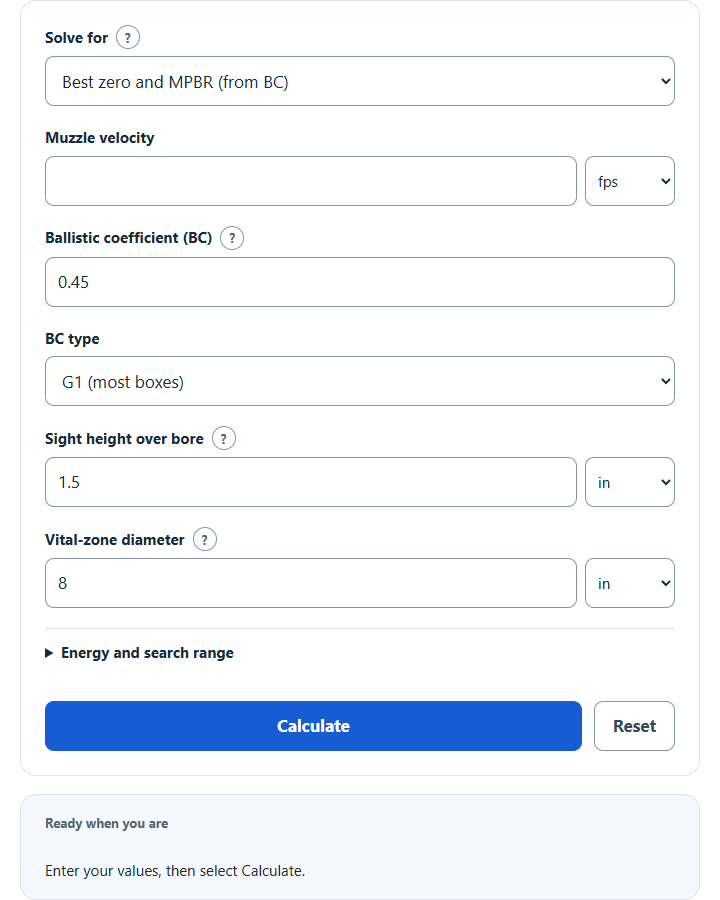
Calculate maximum point-blank range (MPBR) and the best zero from muzzle velocity, BC, sight height and vital-zone size, with typical values filled in.
- All Miscellaneous Calculators
- Bullet Energy Calculator
- Muzzle Velocity Calculator
- Muzzle Energy Calculator
MPBR Rule-of-Thumb (Estimator) Formula
The following example shows a rule-of-thumb estimate sometimes used to get a quick, rough MPBR value from muzzle velocity. It is not a true MPBR calculation (real MPBR requires a chosen vital-zone size and a trajectory model that accounts for drag, sight height, zero, and other factors).
- Estimated MPBR is the rough estimate of maximum point-blank range (yards)
- Vmuzzle is muzzle velocity (feet per second, fps)
To estimate MPBR in yards using this heuristic, divide muzzle velocity in fps by 10.
How to Use This MPBR Estimator
The following steps outline how to use the rule-of-thumb estimator.
- Determine the muzzle velocity of the projectile as it leaves the barrel (fps, or convert to fps).
- Use the estimator formula above: Estimated MPBR (yd) ≈ Vmuzzle(fps) / 10.
- Calculate the estimated MPBR, or use the calculator above for a trajectory-based estimate.
- For a true MPBR, use a ballistics calculator that lets you set the vital-zone size, sight height, ballistic coefficient/drag model, and zero distance.
Example Problem :
Use the following variables as an example problem to test your knowledge (rule-of-thumb estimate).
muzzle velocity (fps) = 3000
Estimated MPBR (yd) ≈ V / 10 = 3000 / 10 = 300