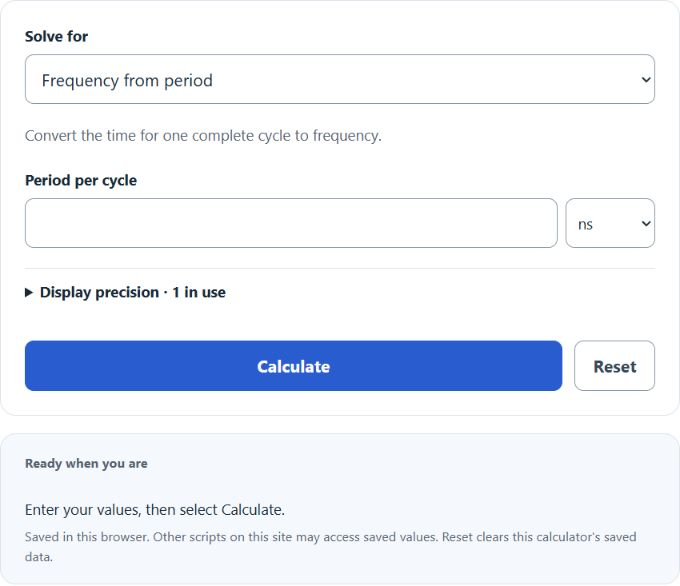
Convert time periods in seconds, milliseconds, microseconds, nanoseconds, or picoseconds to frequency in Hz, kHz, MHz, or GHz and back.
| Period to Frequency | Frequency to Period |
|---|---|
| 1 ns = 1 GHz | 1 GHz = 1 ns |
| 2.5 ns = 400 MHz | 2.4 GHz = 0.4167 ns |
| 5 ns = 200 MHz | 100 MHz = 10 ns |
| 8 ns = 125 MHz | 50 MHz = 20 ns |
| 10 ns = 100 MHz | 25 MHz = 40 ns |
| 12.5 ns = 80 MHz | 10 MHz = 100 ns |
| 20 ns = 50 MHz | 1 MHz = 1 µs |
| 25 ns = 40 MHz | 500 kHz = 2 µs |
| 40 ns = 25 MHz | 200 kHz = 5 µs |
| 50 ns = 20 MHz | 100 kHz = 10 µs |
| 62.5 ns = 16 MHz | 10 kHz = 100 µs |
| 100 ns = 10 MHz | 1 kHz = 1 ms |
| 200 ns = 5 MHz | 440 Hz = 2.2727 ms |
| 250 ns = 4 MHz | 60 Hz = 16.6667 ms |
| 500 ns = 2 MHz | 50 Hz = 20 ms |
| 1 µs = 1 MHz | 30 Hz = 33.3333 ms |
| 2 µs = 500 kHz | 24 Hz = 41.6667 ms |
| 10 µs = 100 kHz | 1 Hz = 1 s |
| 1 ms = 1 kHz | 0.5 Hz = 2 s |
| 16.6667 ms = 60 Hz | 0.1 Hz = 10 s |
| Formulas: f = 1 ÷ T and T = 1 ÷ f (T in seconds, f in hertz). | |
- All Unit Converters
- Hertz to NM Calculator
- Nanometers to Joules Calculator
- Energy to Wavelength Calculator
- Hz to RPM Calculator
ns to Hz Formula
Frequency and period are reciprocals of each other. To convert a period given in nanoseconds into a frequency in hertz, first change the period to seconds and then take its reciprocal. Because one nanosecond is 0.000000001 second:
HZ = 1 / (NS * 0.000000001)
That simplifies to a single division:
HZ = 1,000,000,000 / NS
To go the other way, from a frequency in hertz back to a period in nanoseconds, use the same relationship in reverse:
NS = 1,000,000,000 / HZ
Variables:
- HZ is the frequency in hertz, the number of cycles completed in one second
- NS is the period, the time for one complete cycle, measured in nanoseconds
- 1,000,000,000 is the number of nanoseconds in one second (1 s = 1e9 ns)
Pick a direction at the top of the calculator. In the default mode you enter a period and the tool returns the matching frequency; switch the selector to enter a frequency and get the period in nanoseconds instead. The unit menu next to the input lets you type the period in picoseconds, nanoseconds, microseconds, milliseconds, or seconds, and the frequency in Hz, kHz, MHz, or GHz, so you do not have to convert by hand first.
Every result is also broken out into hertz, kilohertz, megahertz, and gigahertz along with the period in nanoseconds, microseconds, and seconds, which is useful because a shorter period always means a higher frequency. Open Display precision to select the maximum significant figures shown.
Nanosecond and Frequency Conversion Chart
The first table converts common periods in nanoseconds into their frequency. A smaller period gives a higher frequency.
| Period (ns) | Frequency (Hz) | Frequency (scaled) |
|---|---|---|
| 1 | 1,000,000,000 | 1 GHz |
| 2 | 500,000,000 | 500 MHz |
| 5 | 200,000,000 | 200 MHz |
| 10 | 100,000,000 | 100 MHz |
| 20 | 50,000,000 | 50 MHz |
| 50 | 20,000,000 | 20 MHz |
| 100 | 10,000,000 | 10 MHz |
| 1,000 | 1,000,000 | 1 MHz |
The second table works in reverse, turning common frequencies into a period in nanoseconds.
| Frequency | Period (ns) | Period (us) |
|---|---|---|
| 1 GHz | 1 | 0.001 |
| 500 MHz | 2 | 0.002 |
| 100 MHz | 10 | 0.01 |
| 50 MHz | 20 | 0.02 |
| 10 MHz | 100 | 0.1 |
| 1 MHz | 1,000 | 1 |
| 1 kHz | 1,000,000 | 1,000 |
Example Problems
Example 1: Convert a period in nanoseconds to a frequency.
A digital signal has a period of 20 ns and you want its frequency. Divide one billion by the period:
HZ = 1,000,000,000 / 20 = 50,000,000 Hz = 50 MHz.
Example 2: Convert a frequency to a period in nanoseconds.
A processor runs at 2.5 GHz, which is 2,500,000,000 Hz, and you want the period of one clock cycle. Divide one billion by the frequency in hertz:
NS = 1,000,000,000 / 2,500,000,000 = 0.4 ns.
Frequently Asked Questions
How do you convert nanoseconds to hertz?
Divide 1,000,000,000 by the period in nanoseconds. The period is the time for one full cycle, so its reciprocal is the number of cycles per second, which is the frequency in hertz. For example, a 25 ns period gives 1,000,000,000 / 25 = 40,000,000 Hz, or 40 MHz.
What frequency is a period of 1 nanosecond?
One nanosecond is 0.000000001 second, so its frequency is 1,000,000,000 / 1 = 1,000,000,000 Hz, which is 1 GHz. Each time you halve the period the frequency doubles, so 0.5 ns would be 2 GHz.
Why are period and frequency inversely related?
Period measures how long one cycle takes, while frequency counts how many cycles fit into one second. If each cycle takes less time, more of them fit into a second, so a shorter period always means a higher frequency. Multiplying a period in seconds by its frequency in hertz always gives 1.