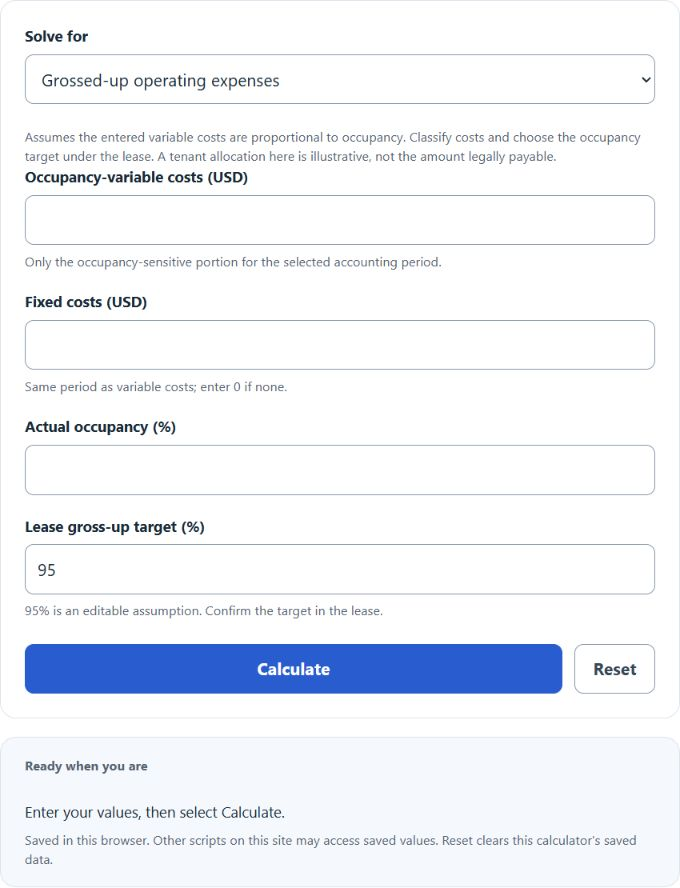
Calculate grossed-up operating expenses for a commercial lease by scaling variable costs from actual occupancy to a standard occupancy level, then adding fixed costs and any tenant pro rata share.
Related Calculators
- Occupancy Percentage Calculator
- Vacancy Rate Calculator
- Demand Ratio Calculator
- Cash on Cash Return Calculator
- All Business Calculators
Operating Expense Gross-Up Formula
Factor = max(1, GU / AO)
GUV = VE * Factor
TGE = FE + GUV
Where GUV is the grossed-up variable operating expenses, VE is the variable operating expenses actually incurred, GU is the gross-up standard occupancy percentage, AO is the actual occupancy percentage, TGE is the total grossed-up operating expenses, and FE is the fixed operating expenses.
This calculator assumes the entered variable costs are proportional to occupancy. It scales only that occupancy-sensitive portion upward when actual occupancy is below the entered lease target; costs remain unchanged when occupancy meets or exceeds the target. Add fixed costs without adjustment. Multiplying the normalized total by a tenant percentage gives only an illustrative allocation, not the tenant's actual obligation. Base-year or expense-stop deductions, exclusions, caps, recovery limits and other lease rules are not modeled.
Typical Gross-Up Standards and Effect
The table below shows how a variable expense of $100,000 grosses up at different actual occupancy levels when the gross-up standard is set to 95%.
| Actual Occupancy | Gross-Up Standard | Grossed-Up Variable Expense |
|---|---|---|
| 50% | 95% | $190,000.00 |
| 75% | 95% | $126,666.67 |
| 90% | 95% | $105,555.56 |
| 95% | 95% | $100,000.00 |
The lower the actual occupancy, the larger the upward adjustment, since the formula scales the cost to what it would be at the standard occupancy level.
Example
A building has $100,000 in variable operating expenses and $50,000 in fixed operating expenses. Actual occupancy for the year was 75%, and the lease allows grossing up to a 95% standard.
Under the proportional-cost assumption, gross up the variable expenses: 100,000 * (95 / 75) = $126,666.67. Add $50,000 of fixed expenses for $176,666.67 total. A 10% illustrative allocation is $17,666.67, using unrounded intermediate amounts. This does not calculate a base-year expense increase or a lease invoice. At 95% or higher actual occupancy, the model instead retains the original $150,000 total.
FAQ
Why are operating expenses grossed up?
Grossing up protects the landlord from absorbing the per-tenant cost of a partly empty building. It charges each tenant roughly what they would pay if the building were near full, so occupied tenants are not under-billed when occupancy is low.
Which expenses should not be grossed up?
Keep fixed portions unchanged. Only costs that actually vary with occupancy qualify under this model; a utility, janitorial or management category may contain fixed and variable portions. The lease determines eligibility and the appropriate estimation method, which may differ from simple proportional scaling.
Which gross-up standard should I enter?
Use the target stated in the lease. Filed lease examples use 95% or 100%, but neither is universal. The calculator's editable 95% default is an assumption to confirm. Use costs and occupancy from a consistent accounting period and apply any required base-year adjustment consistently.