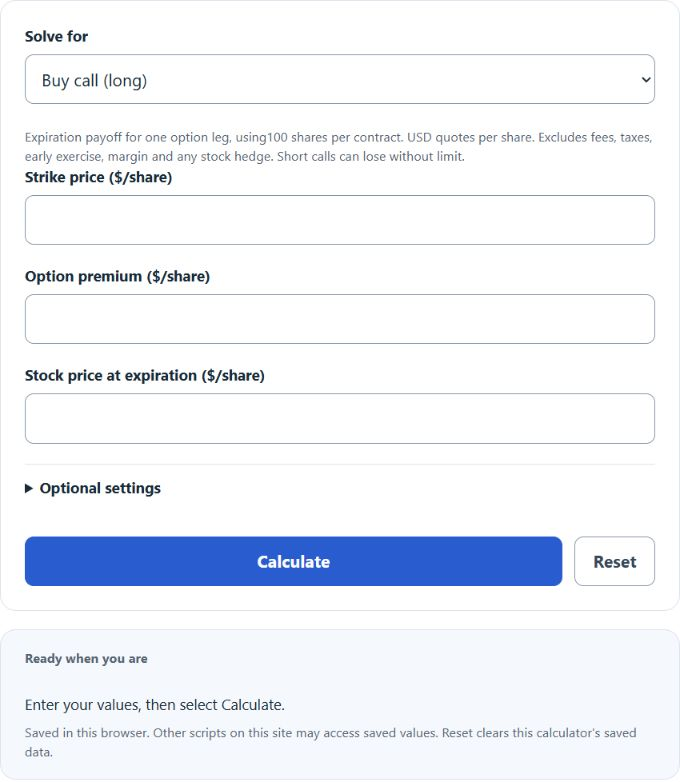
Estimate expiration profit or loss for a long or short call or put, including breakeven and signed payoff bounds. This educational tool assumes100-share contracts and excludes costs and any stock hedge.
Options Profit Formula
For a long call, profit at expiration is the stock price minus the strike, minus the premium paid, with the intrinsic part floored at zero:
P = (max(0, S - K) - Prem) * 100 * N
For a long put, the intrinsic value works in the other direction:
P = (max(0, K - S) - Prem) * 100 * N
Variables:
- P is the total profit or loss at expiration ($)
- S is the stock price at expiration ($)
- K is the option strike price ($)
- Prem is the premium per share paid (long) or collected (short) ($)
- N is the number of contracts, each covering 100 shares
For a short option, P = (Prem − intrinsic value) ×100 ×N. Select one of the four option positions and enter whole contracts (blank =1). Return on premium is shown for buyers only, and is undefined when premium is zero. The calculation covers the option leg, without any stock or cash collateral return.
Profit Scenarios at Expiration
This table shows total profit for one long call contract with a $100 strike bought for a $2.50 premium ($250 per contract) at different expiration prices.
| Stock at expiration | Intrinsic value | Profit / loss | Return on premium |
|---|---|---|---|
| $95 | $0.00 | -$250 | -100% |
| $100 | $0.00 | -$250 | -100% |
| $102.50 | $2.50 | $0 | 0% (breakeven) |
| $105 | $5.00 | $250 | 100% |
| $110 | $10.00 | $750 | 300% |
| $120 | $20.00 | $1,750 | 700% |
For this long-call example, the option payoff loses at most the premium before costs and its upside has no finite bound. Intrinsic value is zero at or below the strike; a positive profit requires exceeding the strike plus premium.
Example Problems
Example 1: Long call profit.
You buy 2 call contracts with a $50 strike for a $1.80 premium, and the stock closes at $55 at expiration.
Intrinsic value = 55 - 50 = $5.00. Profit per share = 5.00 - 1.80 = $3.20. Total = 3.20 * 100 * 2 = $640. Breakeven was 50 + 1.80 = $51.80.
Example 2: Long put that misses.
You buy 1 put with a $40 strike for a $2.00 premium and the stock closes at $43.
Intrinsic value = max(0, 40 - 43) = $0, so the put expires worthless. Loss = premium paid = 2.00 * 100 = $200, which was also the maximum possible loss.
Frequently Asked Questions
What is the breakeven price for an option?
For a positive premium, call breakeven is strike plus premium; put breakeven is strike minus premium. A negative put breakeven is unreachable at nonnegative stock prices. At zero premium, a range of prices produces zero P/L. These statements exclude costs.
Can I lose more than I paid for an option?
The option-leg loss for a buyer is limited to premium before costs. A short call has unbounded loss as stock price rises; a short put has its worst payoff at a zero stock price. Exercise or assignment can create additional stock exposure, which this calculator does not model.
Why is my real profit different before expiration?
Before expiration an option quote can include time value and depends on market conditions. This calculator uses intrinsic value at expiration, not a pricing model for closing a position early. Actual proceeds also depend on costs and execution.