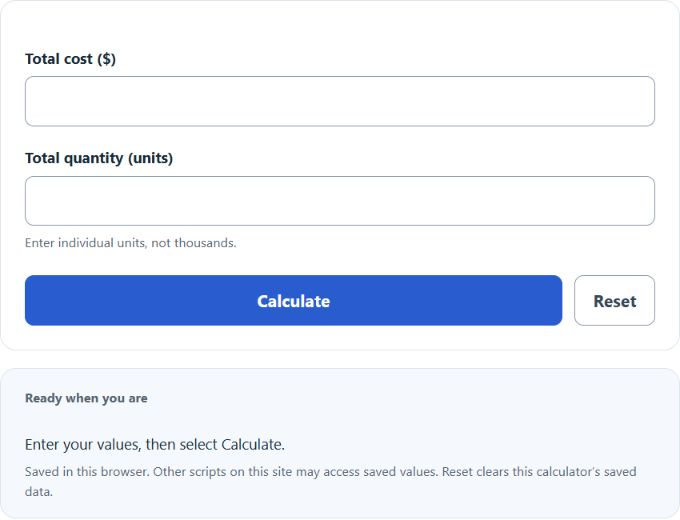
Calculate the price per 1,000 units from a total cost and quantity. Enter the cost in dollars and the number of individual units, then select Calculate to compare prices on the same quantity basis.
Price Per 1,000 Formula
Variables:
- P₁₀₀₀ is the price per 1,000 units ($ per 1,000 units)
- C is the total cost ($)
- Q is the total quantity in individual units; Q must be greater than zero
Note: Use the same currency and quantity unit for each price you compare. Include the same types of costs, such as delivery or tax, in each total. The result is a normalized rate; a supplier may charge a different amount for an actual order of 1,000 units because of discounts or fixed fees.
To calculate price per 1,000, divide the total cost by the total quantity, then multiply by 1,000. A zero cost gives a zero price; a zero quantity has no defined price per unit.
How to Calculate Price Per 1,000
Use these steps to compare prices per 1,000 units.
- First, find the total cost in dollars.
- Next, find the total quantity in individual units. For 5,000 items, enter 5000 rather than 5.
- Divide the cost by the quantity to get the price per unit.
- Multiply the price per unit by 1,000.
- Enter both values in the calculator and select Calculate. Changing an input retains the previous result until you calculate again.
Example Problem :
Use the following variables as an example problem to test your knowledge.
Total cost = $50
Total quantity = 5,000 units
Example solution: Price per 1,000 = ($50 ÷ 5,000) × 1,000 = $10 per 1,000 units.
Frequently Asked Questions
What does price per 1,000 mean?
It expresses a price on a common basis of 1,000 units. For example, a $10 price per 1,000 corresponds to $0.01 per unit. This makes different pack quantities easier to compare.
Should I enter the quantity in units or thousands?
Enter individual units. If a package contains 2,500 pieces, enter 2500. The calculator applies the factor of 1,000 for you.
Can I compare quantities other than items?
Yes. A unit can be one impression, sheet, gram, or another consistent quantity. Use the same unit on both sides of a comparison. Decimal quantities are accepted for measured goods; use whole quantities when counting indivisible items.
Does this tell me the actual cost of buying 1,000 units?
It gives the proportional price at the entered rate. The actual order cost can differ if a supplier uses volume discounts, minimum charges, delivery fees or taxes. Include comparable charges in each total cost.
How are small prices and saved results handled?
The calculator uses unrounded inputs and shows up to six decimal places, with scientific notation for very small or large values. A successful calculation is saved in this browser and identified as restored after reload. Reset clears this calculator’s saved values.