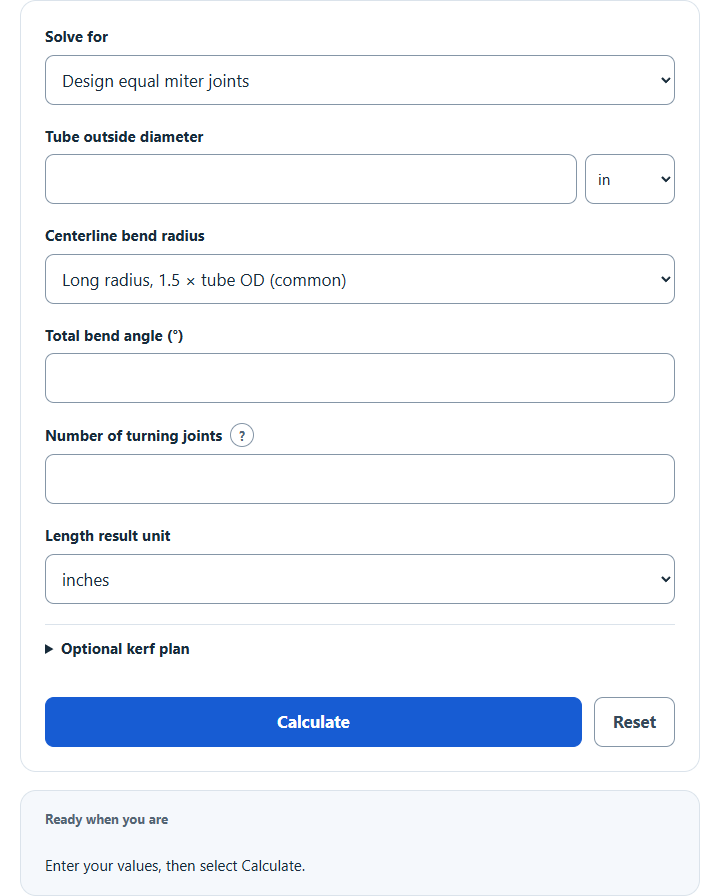
Calculate pie cut angles and long, center and short side lengths for an exhaust or tube bend from tube size, bend radius, total angle and number of joints.
- All Math and Numbers Calculators
- Cut Length Calculator
- Spinner Probability Calculator
- Dice Probability Calculator
Pie Cut Formula
This calculator plans one open, planar tube bend with equal miter joints. N is the number of turning joints, so N+1 physical sections are needed: N−1 full internal wedges and two half end sections. The end sections have square ends at the tangent limits, without additional straight extensions.
- β is total bend angle, greater than zero and up to180° in this open-bend model.
- D is actual tube outside diameter.
- R is effective/tangent centerline bend radius, greater than D/2.
- δ is direction change at each joint, less than180°. Each mating face is mitered by δ/2 from a square cut.
- N counts turning joints, not loose pieces. Each ideal end section has half the corresponding full-wedge long, center and short lengths.
These tangent dimensions describe straight miter segments. Circle chords using sine and curved arc lengths describe different geometry. The tangent construction is consistent with the production dimensions in SSAB’s pipes and fittings guide, Table25. It does not establish pressure, stress, flow or installation suitability.
Reference Tables
Equal-joint plans for a90° open bend. Miter values are angles from a square cut; confirm your saw’s scale convention.
| Joints | Pieces | Joint turn | Miter angle |
|---|---|---|---|
| 2 | 3 | 45° | 22.5° |
| 3 | 4 | 30° | 15° |
| 4 | 5 | 22.5° | 11.25° |
| 6 | 7 | 15° | 7.5° |
| 8 | 9 | 11.25° | 5.625° |
| 12 | 13 | 7.5° | 3.75° |
Ideal full internal-wedge axial dimensions for3in outside diameter,4.5in effective centerline radius and90° total turn. Table values are rounded to 4 decimal places; each end-section dimension is half its corresponding full-wedge value.
| Joints | Long (in) | Center (in) | Short (in) |
|---|---|---|---|
| 2 | 4.9706 | 3.7279 | 2.4853 |
| 3 | 3.2154 | 2.4115 | 1.6077 |
| 4 | 2.3869 | 1.7902 | 1.1935 |
| 6 | 1.5798 | 1.1849 | 0.7899 |
| 8 | 1.1819 | 0.8864 | 0.5909 |
| 12 | 0.7865 | 0.5899 | 0.3933 |
Worked Example
For a3in tube,4.5in effective centerline radius and90° bend with six turning joints:
- Joint turn =90°/6 =15°; miter from square =7.5°.
- Six joints connect seven pieces: five full internal wedges and two half end sections.
- Full-wedge center length =2 ×4.5 ×tan(7.5°) ≈1.184872in.
- Full-wedge long and short lengths are approximately1.579830in and0.789915in.
- Each ideal end section has long/center/short lengths of approximately0.789915/0.592436/0.394957in, before any extra straight extension.
- The ideal total centerline stock is6 ×1.184872478… ≈7.109235in. This excludes kerf, extra extensions, weld gaps, nesting and trimming.
For the maximum-angle mode, a91° total bend and a15° maximum joint turn require ceil(91/15) =7 joints, connecting8 pieces. The equal turn is13° per joint.
FAQ
Are pieces and joints the same count? No. This defined open bend has one more physical section than turning joints. It includes two half end sections. A plan for loose inserts between existing tube ends uses a different endpoint convention and must be laid out separately.
How does the optional kerf plan work? Enter measured stock loss along the tube axis per pass and the actual planned pass count. Their product is reported separately. Blank per-pass loss means zero; blank pass count omits the total. Nominal blade thickness normal to an angled cut is a different measurement, so it is not silently treated as axial loss.
Does this provide a certified cut list? No. Verify the actual material, fixtures, mating angles, end extensions, weld gaps and trim plan before cutting. Geometry alone gives no wall-thickness, pressure or structural rating.
Does this slice a food pie or pizza? The delivered tool is for tube pie-cut bends. Flat circular-sector slicing is a different task and is not represented by these inputs or formulas.