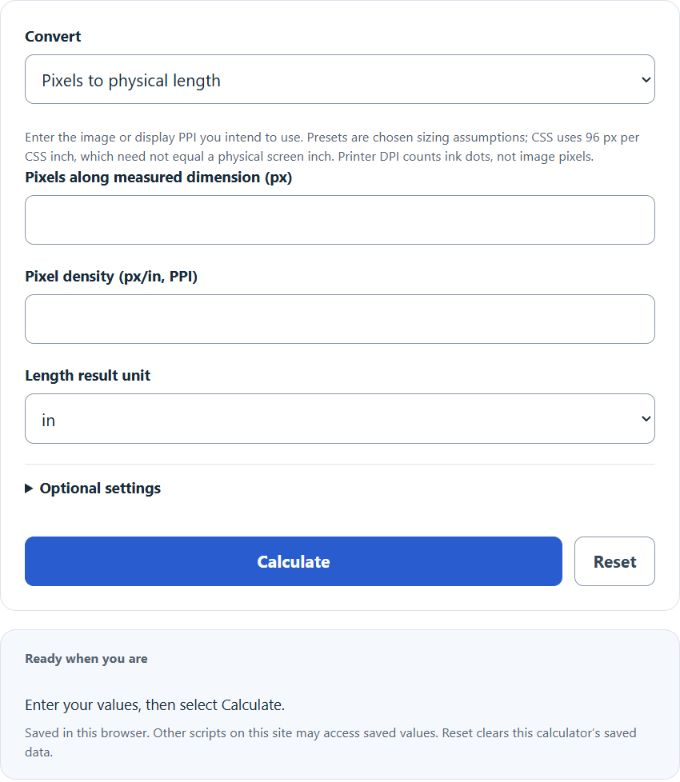
Convert pixels to inches or inches, cm, and mm to pixels using PPI presets for screen and print sizing, with exact results and clear formulas.
| Calculator Operations | Required Inputs |
|---|---|
| Convert Pixel Density (PPI) & Length to Pixels | Pixel Density (PPI), Length |
| Convert Pixels & Length to Pixel Density (PPI) | Pixels, Length |
| Convert Pixels & Pixel Density (PPI) to Length | Pixels, Pixel Density (PPI) |
Pixels to Inches Formula
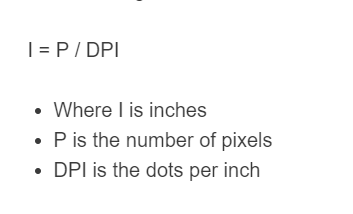
The following formula is used to convert a pixel measurement (along one dimension) to inches, given a pixel density (PPI).
- Where I is the length in inches
- P is the number of pixels along the measured length (for example, image width in pixels)
- PPI is image pixels per inch; printer DPI measures dots per inch and is a different quantity
To calculate inches from pixels, divide the pixel count (along the length) by the pixel density (PPI).
| Pixels (px) | Inches (in) | Centimeters (cm) | Millimeters (mm) |
|---|---|---|---|
| 72 | 0.240 | 0.610 | 6.096 |
| 96 | 0.320 | 0.813 | 8.128 |
| 150 | 0.500 | 1.270 | 12.700 |
| 300 | 1.000 | 2.540 | 25.400 |
| 450 | 1.500 | 3.810 | 38.100 |
| 600 | 2.000 | 5.080 | 50.800 |
| 720 | 2.400 | 6.096 | 60.960 |
| 900 | 3.000 | 7.620 | 76.200 |
| 1024 | 3.413 | 8.670 | 86.699 |
| 1080 | 3.600 | 9.144 | 91.440 |
| 1200 | 4.000 | 10.160 | 101.600 |
| 1280 | 4.267 | 10.837 | 108.373 |
| 1366 | 4.553 | 11.565 | 115.655 |
| 1440 | 4.800 | 12.192 | 121.920 |
| 1600 | 5.333 | 13.547 | 135.467 |
| 1920 | 6.400 | 16.256 | 162.560 |
| 2048 | 6.827 | 17.340 | 173.398 |
| 2560 | 8.533 | 21.675 | 216.747 |
| 3000 | 10.000 | 25.400 | 254.000 |
| 3840 | 12.800 | 32.512 | 325.120 |
| *Assumes 300 px/in (PPI). Formula: inches = pixels / PPI. At 300 px/in: 1 in = 300 px (1 in = 2.54 cm = 25.4 mm). | |||
Pixels to Inches Definition
Pixels to inches is the conversion of a pixel measurement (for example, the width of an image in pixels) to a physical length in inches using the specified image pixel density (PPI). Without a specified pixel density, pixels do not have a fixed physical size.
Example
Let’s look at an example of how to calculate inches from pixels. Suppose an image is 2,000 px wide and you want to size it at 100 px/in (100 PPI). Using the formula above, the width in inches is 2,000 / 100 = 20 inches.
FAQ
A pixel (“picture element”) is the smallest addressable element of a raster image or display. By itself, a pixel does not have a fixed physical size unless a pixel density (PPI/DPI) is specified.
DPI stands for dots per inch and is primarily used for print resolution. For screens, the comparable concept is PPI (pixels per inch). In this calculator, enter the pixel density you want to assume (typically in px/in).