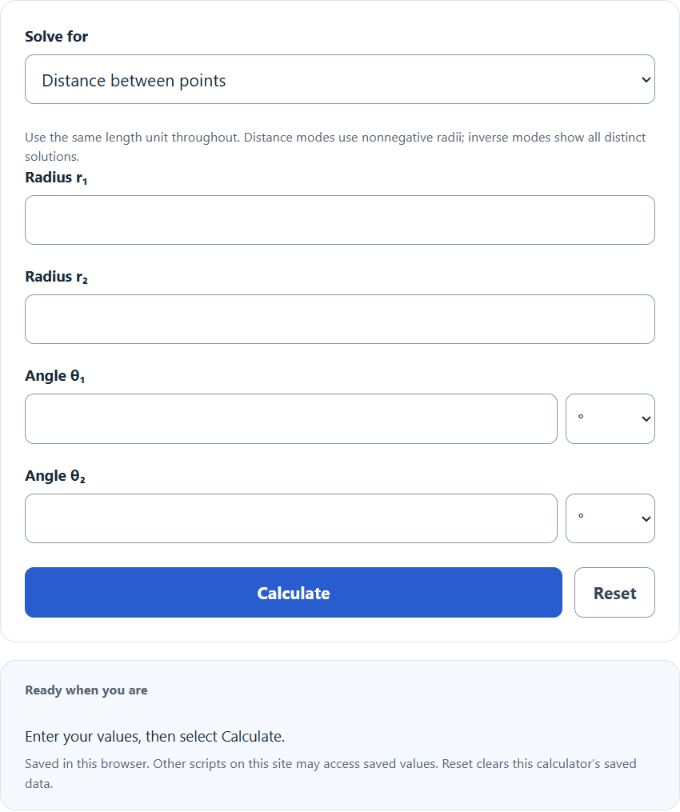
Calculate polar distance from r1, r2, θ1 and θ2, or convert between polar and Cartesian coordinates using x, y, r and θ in degrees or radians.
- All Math and Numbers Calculators
- All Distance Calculators
- Polar Coordinates Calculator
- Rotation Calculator (new coordinates by rotation)
- Actual Distance Calculator
Polar Distance Formula
The following formula gives straight-line distance in the plane. Use a common length unit and nonnegative radii for the distance modes. Radius and angle inverses may have two solutions; the calculator shows both.
- Where Dpolar is the Polar Distance
- r1,r2 are the radii (r1,r2)
- θ1,θ2 are the angles (θ1,θ2) (in the same unit: degrees or radians)
How to Calculate Polar Distance?
The following example problems outline how to calculate Polar Distance.
Example Problem #1:
- First, determine the radii (r1,r2).
- The radii (r1,r2) are given as 5, 10.
- Next, determine the angles (θ1,θ2).
- The angles (θ1,θ2) are provided as 30°, 50°.
- Finally, calculate the Polar Distance using the equation above.
Dpolar = √(r12 + r22 − 2·r1·r2·cos(θ2 − θ1))
The values given above are inserted into the equation below and the solution is calculated:
Dpolar = √(52 + 102 − 2·5·10·cos(50° − 30°)) = √(31.03) = 5.57
FAQ
What is Polar Distance?
Polar Distance refers to the distance between two points in a polar coordinate system, calculated using the radii and angles of these points relative to a common origin.
How does the Polar Distance formula work?
The Polar Distance formula uses the law of cosines: it computes r12 + r22 − 2r1r2cos(θ2 − θ1) and then takes the square root to get the actual distance.
Can the Polar Distance formula be used for any two points?
Yes, as long as the points are defined in polar coordinates (with a radius and an angle), the Polar Distance formula can be used to calculate the distance between them, regardless of their position.