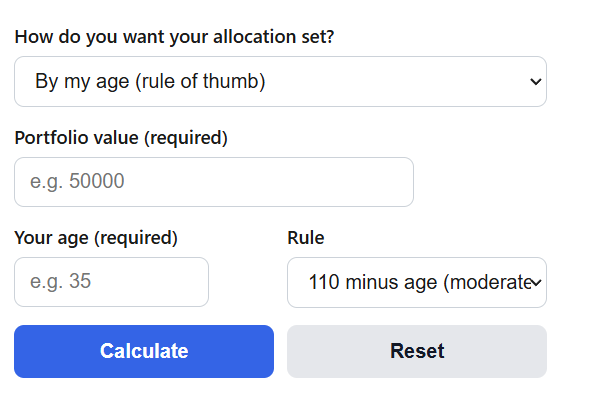
Portfolio asset allocation calculator. Get a stock, bond, and cash split from your age or risk profile and see dollar amounts for any portfolio value.
Asset Allocation Formula
The classic age-based rule sets your stock percentage by subtracting your age from a base number:
Stocks% = Base - Age
Each allocation percentage then converts to dollars against your portfolio value:
Amount = V * Allocation% / 100
Variables:
- Stocks% is the share of the portfolio held in stocks
- Base is the rule constant – 100 (conservative), 110 (moderate), or 120 (aggressive)
- Age is your current age in years
- V is the total portfolio value ($)
Choose the age mode and one of the three rule variants, or switch to the risk-profile mode for preset conservative, moderate, aggressive, or very aggressive mixes. The calculator splits the remainder between bonds and a small cash reserve, then converts every percentage into dollars for your portfolio value, giving you a target mix you can rebalance toward.
Allocations by Age (110 Minus Age Rule)
| Age | Stocks | Bonds | Cash |
|---|---|---|---|
| 25 | 85% | 10% | 5% |
| 35 | 75% | 20% | 5% |
| 45 | 65% | 30% | 5% |
| 55 | 55% | 40% | 5% |
| 65 | 45% | 50% | 5% |
| 75 | 35% | 60% | 5% |
The bond share here gives up five points to cash once the bond allocation reaches ten percent, mirroring how target-date funds hold a liquidity sleeve alongside fixed income.
Example Problems
Example 1: Age-based split.
You are 35 with a $50,000 portfolio using the 110 rule.
Stocks% = 110 – 35 = 75%. That is $37,500 in stocks, with the remaining 25% split $10,000 to bonds (20%) and $2,500 to cash (5%).
Example 2: Risk-profile split.
You pick the moderate profile (60/35/5) for a $200,000 portfolio.
Stocks = 200,000 * 0.60 = $120,000; bonds = $70,000; cash = $10,000.
Frequently Asked Questions
Which rule should I use – 100, 110, or 120 minus age?
The traditional rule used 100, but longer lifespans and low bond yields pushed many planners to 110 or 120 so portfolios keep growing through a multi-decade retirement. Use the higher base if you can tolerate bigger drawdowns without selling, the lower one if declines keep you up at night.
Where do international stocks and other assets fit?
The stock bucket usually includes both U.S. and international equities – a common split is two-thirds domestic, one-third international. Real estate, gold, or crypto typically come out of the stock allocation, since they carry equity-like volatility.
How often should I revisit my allocation?
The target itself only needs updating every few years as your age and circumstances change. Your actual portfolio, however, drifts with markets – most investors compare holdings to target annually, or whenever an asset class drifts about five percentage points from plan, and rebalance back.