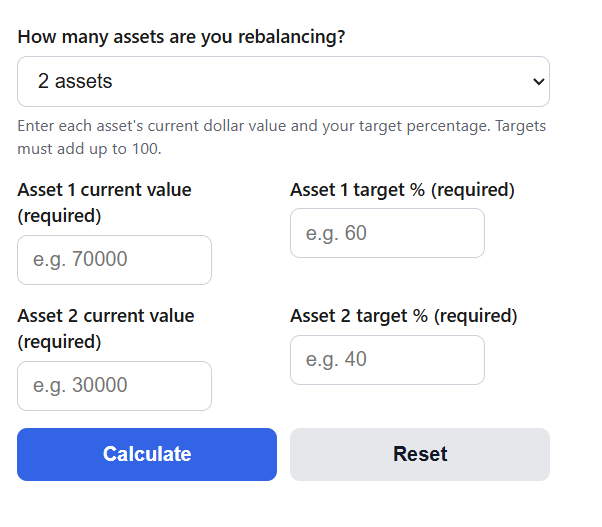
Portfolio rebalancing calculator. Enter current holdings and target percentages to see exactly how much of each asset to buy or sell to rebalance.
Portfolio Rebalancing Formula
For each asset, the trade needed is the difference between its target value and its current value:
Trade = (V * T% / 100) - C
Variables:
- Trade is the dollar amount to buy (positive) or sell (negative) for that asset ($)
- V is the total portfolio value - the sum of all current holdings ($)
- T% is the asset's target percentage of the portfolio
- C is the asset's current dollar value ($)
Select how many assets you are rebalancing (two to four), then enter each one's current dollar value and target percentage - the targets must sum to 100. The calculator totals the portfolio, shows each asset's current weight next to its target, and prints the exact buy or sell amount that restores the plan, along with the largest drift so you can judge whether rebalancing is worth the trades at all.
Rebalancing a 60/40 Portfolio After a Rally
A $100,000 portfolio that started at 60/40 has drifted after a stock rally. The plan below restores the targets.
| Asset | Current value | Current weight | Target | Action |
|---|---|---|---|---|
| Stocks | $70,000 | 70% | 60% | Sell $10,000 |
| Bonds | $30,000 | 30% | 40% | Buy $10,000 |
Rebalancing is mechanically simple - the discipline is in doing it when it feels wrong, because it always means trimming what has been winning to buy what has been lagging.
Example Problems
Example 1: Three-asset drift.
Holdings: $52,000 stocks, $22,000 bonds, $6,000 gold; targets 60/30/10. Total = $80,000.
Stock target = 80,000 * 0.60 = $48,000, so sell $4,000. Bond target = $24,000, so buy $2,000. Gold target = $8,000, so buy $2,000. Current weights were 65% / 27.5% / 7.5%, a maximum drift of 5 points.
Example 2: Rebalancing with new cash.
Instead of selling, add the $4,000 as fresh cash to bonds and gold ($2,000 each after recomputing on the new $84,000 total the same way). Directing contributions to underweight assets rebalances without triggering capital gains.
Frequently Asked Questions
How often should I rebalance?
The two common approaches are calendar-based (once or twice a year) and threshold-based (whenever an asset drifts about 5 percentage points from target). Studies find little return difference between them - what matters is having a rule and following it, since unrebalanced portfolios drift steadily riskier.
Does rebalancing improve returns?
Its main job is risk control - keeping your portfolio at the volatility you chose. It can add modest return when assets mean-revert, but in long bull markets it trails a drifting portfolio. Think of it as selling insurance premiums, not chasing performance.
How do I avoid taxes when rebalancing?
Rebalance inside tax-advantaged accounts first, where trades are tax-free. In taxable accounts, direct new contributions and dividends toward underweight assets, harvest losses when available, and prefer trimming lots with the smallest gains.