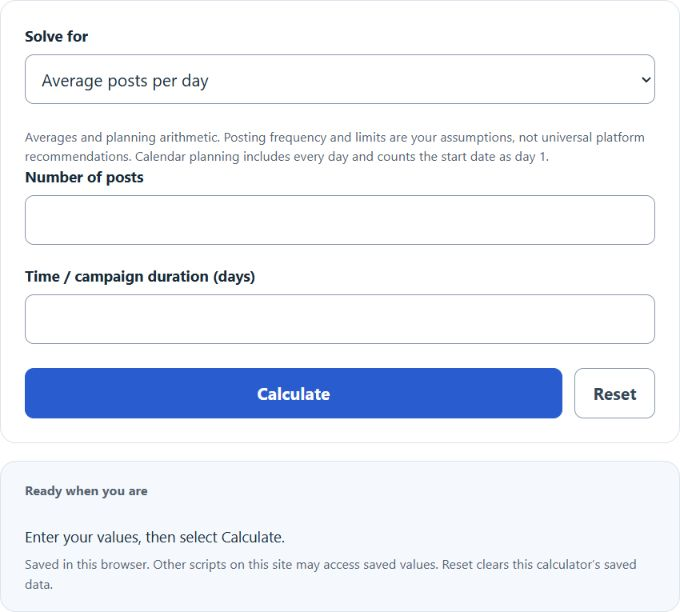
Calculate posts per day, total posts, or campaign duration, plus estimate campaign totals from your own platform posting range and project end dates from your posting pace.
Related Calculators
- Time Efficiency Calculator
- Study Time Calculator
- Break Time Calculator
- Date Calculator
- All Everyday Life and Education Calculators
Posts Per Day Formula
Variables:
- PPD is the Posts Per Day (posts/day)
- PO is the number of posts
- T is the total time (days)
To calculate Posts Per Day, divide the whole number of posts by a positive time frame in days. A fractional result is an average, not a requirement to publish a fraction of a post. Platform planning uses your supplied pace and optional verified cap; no universal recommendation or platform limit is assumed. End-date planning rounds required days up and counts the start date as day 1, including weekends.
How to Calculate Posts Per Day?
The following steps outline how to calculate the Posts Per Day.
- First, determine the number of posts.
- Next, determine the total time (days).
- Next, gather the formula from above = PPD = PO / T.
- Finally, calculate the Posts Per Day.
- After inserting the variables and calculating the result, check your answer with the calculator above.
Example Problem :
Use the following variables as an example problem to test your knowledge.
number of posts = 250
total time (days) = 23; average = 250 ÷ 23 ≈ 10.86956522 posts/day.
FAQs
How can I increase my posts per day efficiently?
To increase your posts per day efficiently, consider planning your content in advance, using scheduling tools to automate posting, and focusing on creating shorter, high-quality posts that require less time to produce.
Why is it important to calculate posts per day?
Calculating posts per day helps in maintaining a consistent online presence, engaging your audience regularly, and planning your content strategy effectively to meet your goals.
Can using the Posts Per Day Calculator help improve my social media strategy?
Yes, using a Posts Per Day Calculator can help improve your social media strategy by providing insights into your current posting habits, allowing you to make informed decisions on how to adjust your posting frequency for better engagement.
What should I do if my posts per day calculation is lower than my target?
If your posts per day calculation is lower than your target, consider creating a content calendar to plan your posts more effectively, repurposing existing content, or collaborating with others to increase your content output without sacrificing quality.