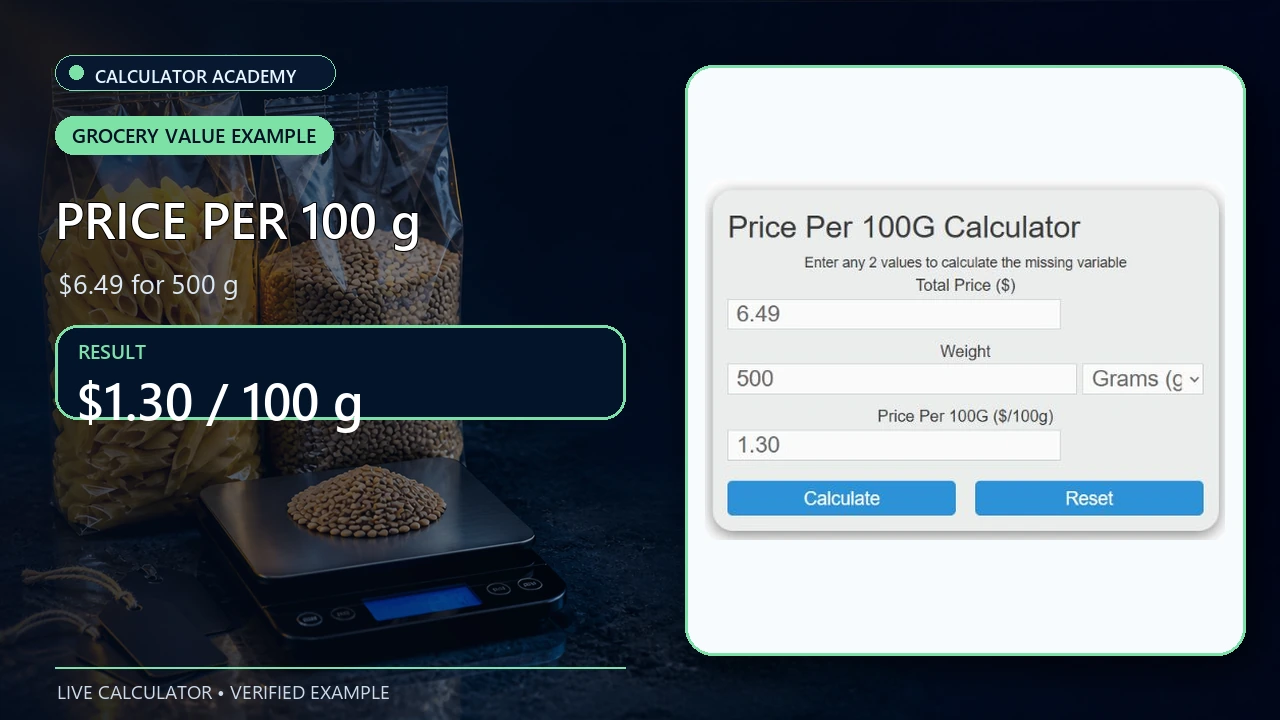
Calculate price per 100g, total price, or weight from any two values, with weight units in grams, kilograms, milligrams, pounds, or ounces.
- Business Finance Calculators
- Price Per Gram Calculator
- Price Per MG Calculator
- Price Per KG Calculator
- Price Per Pound Calculator
- Price Per Ounce Calculator
- Price Per Unit Calculator
Watch the full explanation and transcript.
How to read your result
Price per 100g turns different pack sizes into one fair comparison number. Lower is cheaper for the same amount of product.
- $0.68 per 100g is a better unit price than $0.74 per 100g.
- To estimate the price per kilogram, multiply the result by 10.
- If two options are very close, freshness, storage, and waste often matter more than the small unit-price gap.
Enter better inputs
- Use the actual price you will pay. Include sale pricing, coupons, or member discounts if they apply to your purchase.
- Use the net weight of the product, not shipping weight, package size, or container weight.
- For multipacks, enter the total price and the total net weight of all packs combined.
- For random-weight items like meat, cheese, or deli foods, use the exact label weight on that package.
- Make sure the unit matches the label. If the package is in kg, lb, oz, or mg, select that unit before calculating.
Compare like with like
This calculator is most useful when the products are truly comparable. The less alike the products are, the less helpful a straight price-per-100g comparison becomes.
| Situation | Best way to compare |
|---|---|
| Two pack sizes of the same product | Ideal use case. Price per 100g gives a clean value comparison. |
| Buy 2 for $X deals | Use the combined promo price and the combined weight. |
| Canned foods packed in liquid | If drained weight is shown, compare on drained weight when that is what you will actually eat. |
| Bone-in, peel-on, or shell-on foods | Shelf weight is not the same as edible weight. Adjust if edible yield is the real decision point. |
| Dry foods versus cooked or ready-to-eat versions | Do not compare directly unless you account for cooking yield and added water. |
| Products sold by volume | Use a per 100mL comparison instead. Price per 100g is for products sold by weight. |
| Concentrates, mixes, or products with different strength | Weight alone can mislead. Compare prepared yield or the usable amount if strength differs. |
What to do after you get the result
- Pick the lower number if the products are equivalent and you only care about value.
- Check the total savings, not just the unit price. A difference of $0.06 per 100g saves only $0.30 on a 500g pack.
- Think about waste. The larger pack is not the better buy if part of it goes stale, spoils, or sits unused.
- Watch the upfront cost. A lower unit price can still be the wrong choice if it forces you to spend more than your budget allows today.
- Keep convenience in perspective. Single-serve packs, resealable bags, and pre-cut foods often cost more per 100g because you are paying for packaging and convenience.
- Notice value changes even when the shelf price looks similar. If the price per 100g rises, you are getting less product for the money.
Use the calculator in reverse
You can enter any 2 values to solve for the third, which makes this useful for more than comparison shopping.
- If your target is $0.40 per 100g and the bag weighs 750g, your maximum buy price is $3.00.
- This is a practical way to set a personal price ceiling for staples or household goods sold by weight.
Quick conversions
Price per 100g is easy to scale. Multiply by 10 to get the price per kilogram.
| Price per 100g | Equivalent per kg |
|---|---|
| $0.25 | $2.50/kg |
| $0.50 | $5.00/kg |
| $1.00 | $10.00/kg |
| $2.50 | $25.00/kg |
| $5.00 | $50.00/kg |
Common mistakes
- Typing grams when the package is labeled in kilograms or ounces.
- Comparing net weight on one item to drained or edible weight on another.
- Ignoring multi-buy requirements on sale pricing.
- Assuming the bigger pack is automatically cheaper per 100g.
- Using price per 100g to compare products that are not close substitutes.
- Treating price per 100g as a quality score when ingredients, strength, or convenience are different.
Price Per 100g Formula
Price per 100g = (Total Price ÷ Weight in grams) × 100
That is the math behind the calculator. The useful part is what you do with the answer: compare fairly, avoid bad assumptions, and decide whether the cheaper unit price is actually the better purchase for you.