Calculate price per kilometer from a total cost or from fuel and electricity use, with trip cost, price per mile, passenger splits and reimbursement margin.
- All Automotive Calculators
- Rate Per km Calculator
- Price Per Metre Calculator
- Price Per Yard Calculator
- Cost Per Mile of Driving Calculator
- Pay Per Mile Calculator
- Towing Cost Per Mile Calculator
Price Per Kilometer Formula
The calculator uses different formulas depending on the solve mode you choose.
Cost ÷ Distance
Fuel Trip Cost
Electricity, total cost and budget distance
- PPK = price per kilometer
- TC = total trip cost
- D_km = distance in kilometers
- P = number of passengers
- CPP = cost per passenger
- PPPK = price per passenger-kilometer
- Fuel_L = fuel used in liters
- FE_L100 = fuel efficiency in liters per 100 kilometers
- FP_L = fuel price per liter
- EC = extra costs, such as tolls, parking, or fees
- RC_km = other running costs per kilometer
- Consumption_kWh100 = electricity use in kWh/100 km
- Price_kWh = electricity price per kWh
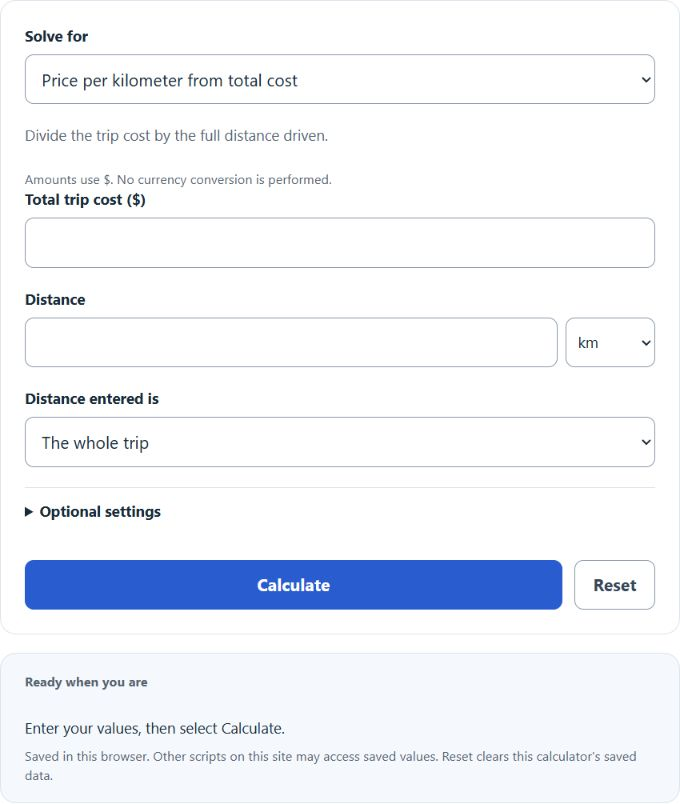
In the Cost ÷ Distance mode, you enter a total cost and distance. The result is the cost for each kilometer. If you enter passengers, the calculator also shows how the cost splits between people.
In the Fuel Trip Cost mode, the calculator estimates fuel used from distance and fuel efficiency. It then multiplies fuel used by fuel price and adds entered trip fees and other running costs. Electricity mode uses the same calculation with kWh and electricity price.
Total trip cost mode multiplies a rate by the full distance. Budget mode divides a budget by a positive rate. The return option doubles a one-way distance; passenger splits and reimbursement comparisons are optional. Amounts use the $ convention without currency conversion.
Illustrative Fuel Efficiency and Cost Inputs
These illustrative ranges are examples, not vehicle specifications or guaranteed typical values. Use your measured consumption or the specification for your vehicle and driving conditions.
| Vehicle type | Example L/100 km | Equivalent km/L | Cost effect |
|---|---|---|---|
| Small hybrid | 3.5 to 5.0 | 20.0 to 28.6 | Low fuel cost per km |
| Compact petrol car | 5.5 to 7.5 | 13.3 to 18.2 | Moderate fuel cost per km |
| SUV or crossover | 7.5 to 11.0 | 9.1 to 13.3 | Higher fuel cost per km |
| Pickup or large van | 10.0 to 16.0 | 6.3 to 10.0 | High fuel cost per km |
| Input type | What to enter | Notes |
|---|---|---|
| Fuel price | Price per liter, US gallon, or imperial gallon | The calculator converts it to price per liter for fuel cost calculations. |
| Distance | Kilometers or miles | Miles are converted to kilometers before the price per km is calculated. |
| Extra costs | Tolls, parking, ferry fees, road fees | These raise the total trip cost and price per kilometer. |
| Passengers | Number of people sharing the trip cost | Passenger count changes the split cost, not the total vehicle cost. |
Price Per Kilometer Examples
Example 1: Total cost divided by distance
You spend $90 on a 300 km trip.
The price per kilometer is $0.30/km.
Example 2: Fuel trip cost
You drive 450 km. Your car uses 7.5 L/100 km. Fuel costs $1.60 per liter. You also pay $12 in tolls.
The total trip cost is $66.00. The price per kilometer is about $0.15/km.
Price Per Kilometer FAQ
What is a good price per kilometer?
It depends on the vehicle, fuel price, route, and whether you include tolls or parking. An efficient vehicle can have lower fuel costs than a less efficient vehicle at the same fuel price. Trip fees and other running costs can change the comparison. For true operating cost, include maintenance, tires, insurance, depreciation, and other ownership costs.
Should I include tolls and parking in price per kilometer?
Include them if you want the real trip cost. Fuel-only price per kilometer is useful for comparing vehicle fuel use. Total trip price per kilometer is better when you want to split costs or estimate the full cost of a journey.
Why does the calculator convert miles to kilometers?
The main result is price per kilometer, so all distances must use kilometers in the formula. If you enter miles, the calculator converts miles to kilometers using 1 mile = 1.609344 kilometers. It can also show price per mile for comparison.