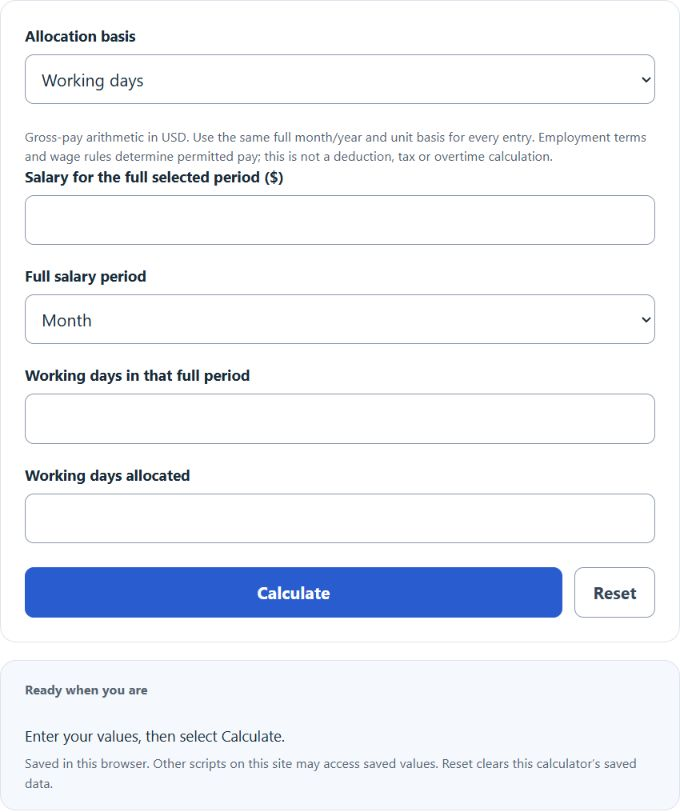
Calculate your prorated salary for a partial pay period by dividing your full monthly or annual pay by the total working days, calendar days, or hours and multiplying by the amount you actually worked.
Prorated Salary Formula
Prorated Salary = (Full Period Salary / Total Units in Period) * Units Worked
Where:
Full Period Salary is the gross pay you would receive for the complete period, either a full month or a full year.
Total Units in Period is the number of working days, calendar days, or hours that make up the complete period.
Units Worked is the number of those same days or hours you were actually employed or present during the period.
Dividing the full salary by the total units gives your daily or hourly rate, and multiplying that rate by the units you worked gives the prorated pay. Choose the working-day, calendar-day or hourly allocation basis required by your employment terms and applicable wage rules. This gross-pay estimate does not determine whether a salary deduction is permitted.
Daily Rate Reference
The daily rate depends on how many days you divide the salary by. The table below shows the daily rate for a sample monthly salary under common counts.
| Monthly Salary | 22 Working Days | 30 Calendar Days |
|---|---|---|
| $3,000 | $136.36/day | $100.00/day |
| $5,000 | $227.27/day | $166.67/day |
| $7,500 | $340.91/day | $250.00/day |
A 40-hour week multiplied by 52 weeks gives 2,080 hours as an illustrative annual basis. Actual workdays, paid leave and payroll conventions vary; enter the denominator for the same month or year as the salary.
Example Problems
Example 1. You earn $5,000 per month and start a job partway through a 22 working-day month, working 16 of those days. Your daily rate is 5000 / 22 = $227.27. Using the unrounded daily rate, the estimate is (5000 / 22) * 16 = $3,636.36 for that month.
Example 2. You earn $60,000 per year and leave after working 130 of the 260 working days in the year. Your daily rate is 60000 / 260 = $230.77. Using the unrounded daily rate, the estimate is (60000 / 260) * 130 = $30,000.00.
FAQ
Should I use working days or calendar days? Use the basis specified by your employment terms and applicable wage rules. Keep allocated units and total-period units consistent. This arithmetic does not decide whether partial-period pay or a deduction is lawful.
How do I prorate an annual salary? Set the salary period to year, then divide the annual salary by the total working days or hours in the year and multiply by the amount you worked. You can also divide the annual figure by 12 first to prorate within a single month.
Does a prorated salary change my hourly value? No. Proration only scales your pay to the portion of the period you worked. Your underlying daily or hourly rate stays the same; you simply receive fewer of those units.