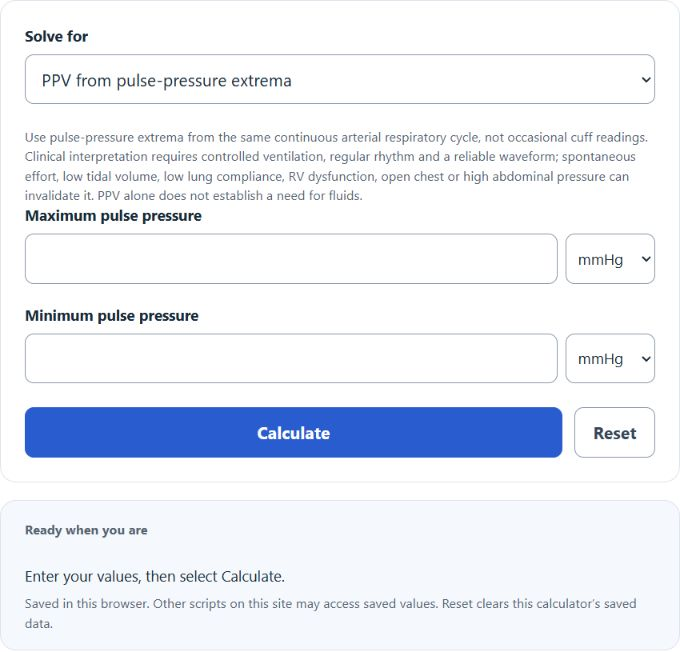
Calculate pulse pressure variation from extrema or two arterial beats, or review a monitor PPV against a historical study range. The reference bands do not predict an individual patient’s fluid response.
Related Calculators
- Driving Pressure Calculator
- Pulsatility Index Calculator
- Respiratory Rate Calculator
- Oxygenation Index Calculator
- All Health and Medical Calculators
Intended Use & Measurement Notes
Pulse pressure variation (PPV) is usually derived from a continuous arterial waveform over the respiratory cycle. It is generally not reliably obtained from sporadic cuff blood pressure measurements, and its interpretation depends heavily on patient/ventilator conditions.
When PPV May Be Unreliable
- Arrhythmias (irregular rhythm)
- Spontaneous breathing efforts (not fully controlled ventilation)
- Low tidal volume ventilation or very low lung compliance
- Right ventricular dysfunction / pulmonary hypertension
- Open chest conditions or markedly elevated intra-abdominal pressure
- Poor arterial waveform quality (e.g., overdamping/underdamping)
Further Reading
For clinical thresholds (including the commonly cited 9–13% “gray zone”), prerequisites, and limitations, consult critical care/anesthesia hemodynamic monitoring guidelines, standard textbooks, and your institution’s protocols.
Last updated: October 10, 2026.
Pulse Pressure Variation Formula
The following formula is used to calculate the pulse pressure variation (PPV) for a given maximum and minimum pulse pressure.
Variables:
- PPV is the pulse pressure variation (%)
- PPmax is the maximum pulse pressure
- PPmin is the minimum pulse pressure
To calculate the pulse pressure variation, subtract the minimum pulse pressure from the maximum pulse pressure. Divide the result by the average of the maximum and minimum pulse pressures, then multiply by 100 to get the percentage.
What is Pulse Pressure Variation?
Pulse pressure variation (PPV) is a dynamic parameter used to help assess fluid responsiveness in some patients, particularly in critical care and anesthesia settings. It is derived from changes in arterial pulse pressure during the respiratory cycle. PPV can be helpful when used under the right conditions (for example, fully controlled mechanical ventilation and a regular heart rhythm), but it can be unreliable in situations such as arrhythmias, spontaneous breathing efforts, or low tidal volumes. Under validated conditions, higher PPV may be associated with fluid responsiveness, but responsiveness is not itself an indication for fluids and does not establish benefit. The often-cited 9–13% gray zone came from an anesthetized population; a mixed ICU study found a wider 4–17% zone. Thresholds are setting-dependent.
How to Calculate Pulse Pressure Variation?
The following steps outline how to calculate the Pulse Pressure Variation (PPV).
- First, measure the maximum pulse pressure (PPmax) over a respiratory cycle.
- Next, measure the minimum pulse pressure (PPmin) over the same respiratory cycle.
- Next, calculate the average pulse pressure by adding PPmax and PPmin and dividing by 2.
- Finally, calculate the PPV using the formula: PPV = ((PPmax − PPmin) / ((PPmax + PPmin) / 2)) × 100.
- After inserting the values and calculating the result, check your answer with the calculator above.
Example Problem :
Use the following variables as an example problem to test your knowledge. (Reminder: pulse pressure is systolic pressure − diastolic pressure, and PPmax/PPmin are pulse pressures, not systolic/diastolic blood pressures.)
Maximum Pulse Pressure (PPmax) = 42 mmHg
Minimum Pulse Pressure (PPmin) = 38 mmHg (this gives PPV = 10%).