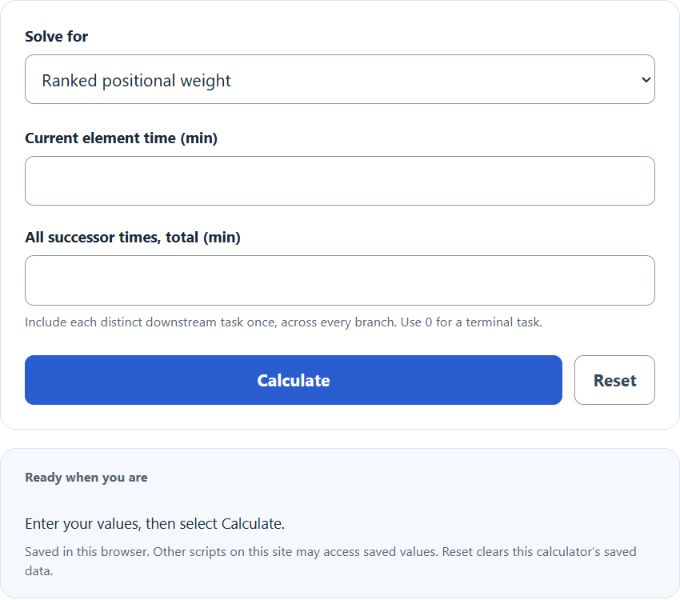
Calculate ranked positional weight, operating time, or sum of following task times in minutes when you know any two of the three values.
- All Math and Numbers Calculators
- Cycle Time Calculator
- Takt Time Calculator
- Throughput Time Calculator
- Production Rate Calculator
- Process Cycle Efficiency Calculator
Ranked Positional Weight Formula
Ranked positional weight is a priority measure used in assembly-line balancing and task sequencing. It combines the time required for the current element with the total time of the downstream elements that follow it in the precedence structure. In practice, tasks with larger positional weights are usually given higher assignment priority because they influence more of the remaining work.
Variable meanings:
- RPW: ranked positional weight
- OT: operating time of the current element
- FET: sum of the times for all elements that follow
If you already know the times of each downstream element, the following-element total can be written as:
Here, ti represents each distinct downstream successor task time, including indirect successors across all branches. Count a shared successor once, even if multiple paths reach it.
How the Calculator Can Solve for Any Missing Value
Choose the value to solve for, then enter the other two in minutes. The calculator uses their linear relationship and rejects a negative inferred time.
| Term | Meaning | Practical Note |
|---|---|---|
| Operating time | Time required for the current element only | Do not combine this with predecessor or follower times. |
| Following-element time | Total time of all distinct downstream successor elements across every branch | Use the same unit as the operating time. |
| Ranked positional weight | Combined priority value for ranking tasks | Higher values generally indicate greater downstream impact. |
How to Calculate Ranked Positional Weight
- Identify the current element you want to evaluate.
- Record that element’s operating time.
- List the elements that follow it in the precedence structure.
- Add the times of those following elements to get the following-element total.
- Add the current element time and the following-element total to obtain the ranked positional weight.
This value is commonly used after a precedence diagram has already been built. Once each task has a positional weight, tasks can be ranked from highest to lowest before workstation assignments are made.
Example 1
An element takes 3 minutes, and the sum of all following element times is 20 minutes.
The ranked positional weight is 23 minutes.
Example 2
If the ranked positional weight is 48 minutes and the following-element total is 31 minutes, the operating time of the current element is:
The operating time is 17 minutes.
Example 3
If an element is the last task in the sequence, there are no following elements. In that case, the following-element total is zero and the positional weight matches the element’s own time.
This is useful for checking terminal tasks at the end of a process.
Why Ranked Positional Weight Matters
- Supports line balancing: helps prioritize tasks before assigning them to workstations.
- Reflects downstream impact: tasks that affect more remaining work receive greater weight.
- Improves planning consistency: provides a repeatable rule for ordering tasks.
- Helps compare tasks: two tasks may have similar operating times but very different importance once followers are included.
Common Input Tips
- Keep all values in the same unit of time.
- Use the operating time for the current element only.
- Make sure the following-element total comes from the same precedence structure used in your analysis.
- If there are no following elements, enter zero for the following-element total.
- Times must be nonnegative; the positional weight cannot be smaller than either component.
Interpretation Guide
| Situation | What It Usually Means |
|---|---|
| High positional weight | The task contributes significant time itself or has substantial downstream work attached to it. |
| Low positional weight | The task has less total downstream influence in the process sequence. |
| No following elements | The task is near or at the end of the precedence structure, so its weight depends only on its own time. |
Common Questions
- What counts as a following element?
- Any direct or indirect successor reachable downstream from the current task in the precedence structure. Include all branches and count each distinct task once.
- Is ranked positional weight the same as cycle time?
- No. Cycle time is the target time available per unit or per station, while ranked positional weight is a task-priority measure used to help assign work.
- Can the calculator be used to solve backward for a missing input?
- Yes. If you know the ranked positional weight and one other value, the calculator can find the missing operating time or following-element total.