Choose takt time, net available production time, or equivalent units. Enter the two known values for the same planning period and select hours, minutes, or seconds.
- All Business Calculators
- Labor Productivity Calculator
- Capacity Utilization Calculator
- Total Manufacturing Cost Calculator
- Cycle Time Calculator
- Throughput Time Calculator
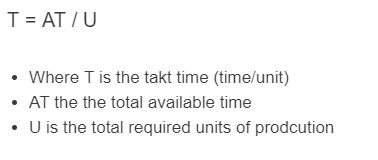
Takt Time Formula
Takt time is the maximum amount of time available to produce one unit while still meeting customer demand. It is a pacing metric used in manufacturing, assembly, fulfillment, and other repeatable operations where output must stay aligned with demand.
- T = takt time
- AT = net available production time
- U = required units of production during that same period
To get a correct result, both inputs must use the same time period. For example, if demand is measured per day, then available time must also be measured per day.
How to Use the Takt Time Calculator
- Enter the total available production time for the period you are planning.
- Enter the total units required in that same period.
- The calculator returns the allowable time per unit in hours, minutes, or seconds per unit.
If your result is 2 minutes per unit, your process must complete one finished unit every 2 minutes on average to satisfy demand.
What Counts as Available Time?
Takt time should be based on net available time, not the full clock time on the schedule. In most cases, this means removing time that is not actually available for production.
- ST = scheduled time
- B = breaks
- M = meetings or non-production activities
- PD = planned downtime
This keeps takt time realistic. Using total shift length without subtracting non-productive time usually makes the takt time look more generous than it really is.
How to Interpret the Result
- If your actual process completes units faster than takt time, capacity is likely sufficient.
- If your actual process completes units slower than takt time, demand will eventually outpace output.
- If actual cycle time is close to takt time, the operation is tightly matched to customer demand and may have little room for disruption.
Takt time is not the same as how long a task actually takes. It is the required pace. Actual process speed is usually tracked with cycle time.
Takt Time vs. Cycle Time vs. Lead Time
| Metric | Meaning | Primary Use |
|---|---|---|
| Takt Time | Allowed time per unit to meet demand | Sets the target production pace |
| Cycle Time | Actual time needed to complete one unit or one process step | Measures real process performance |
| Lead Time | Total elapsed time from order to delivery | Measures the full customer wait time |
In a healthy process, the bottleneck cycle time generally needs to be less than or equal to takt time. If it exceeds takt time, the system will struggle to keep up with demand.
Example Calculation
Assume a facility has 40 hours of net available production time during the week and must produce 1,000 units.
The required pace is therefore 2.4 minutes per unit. If the line produces one unit every 3 minutes, it is behind the required demand rate. If it produces one unit every 2 minutes, it has capacity margin.
Useful Time Conversions
- 1 hour = 60 minutes
- 1 minute = 60 seconds
- 1 hour = 3,600 seconds
- 8 hours = 480 minutes
- 10 hours = 600 minutes
- 12 hours = 720 minutes
Using minutes or seconds often makes takt time easier to apply on the floor, especially when the allowable time per unit is small.
Why Takt Time Matters
- Production planning: helps determine whether current staffing and equipment can meet demand.
- Line balancing: helps distribute work so each station operates at a pace aligned with demand.
- Bottleneck detection: highlights steps whose cycle time is too slow relative to the required pace.
- Scheduling: supports shift planning, labor allocation, and realistic output targets.
- Continuous improvement: gives teams a simple benchmark for process redesign and waste reduction.
Common Mistakes When Calculating Takt Time
- Using gross shift time instead of net available production time.
- Mixing time periods, such as daily demand with weekly available time.
- Confusing takt time with cycle time or throughput time.
- Ignoring planned downtime, setup windows, or scheduled meetings.
- Using average demand that hides strong daily or hourly demand swings.
Practical Notes
Takt time is best used where demand is reasonably stable over the planning interval. If customer demand changes sharply by hour, shift, or day, recalculate takt time for the relevant period instead of relying on a single long-range average.
It is also common to combine takt time with staffing, line balancing, and capacity analysis. Once the required pace is known, each process step can be compared to that pace to identify overload, idle time, and improvement opportunities.
FAQ
What is a good takt time?
There is no universal “good” takt time. A shorter takt time means demand is higher relative to available time. A longer takt time means the required pace is slower. The right value depends entirely on customer demand and production capacity.
Can takt time be measured in seconds per unit?
Yes. Takt time can be expressed in hours per unit, minutes per unit, or seconds per unit. The most useful unit is the one that matches how the process is managed.
What happens if demand increases?
If available time stays the same and required units increase, takt time becomes smaller. That means each unit must be completed faster to keep up.
What happens if available time increases?
If demand stays the same and available time increases, takt time becomes larger. That means more time is available per unit.