Calculate the reflection of a point, polygon, or coordinate over the x-axis or y = k and see the reflected coordinates or vertices.
- All Math and Numbers Calculators
- Polar Coordinates Calculator
- Rotation Calculator (new coordinates by rotation)
- Perpendicular Bisector Calculator
- Reflex Angle Calculator
Reflect Over X-Axis Formula
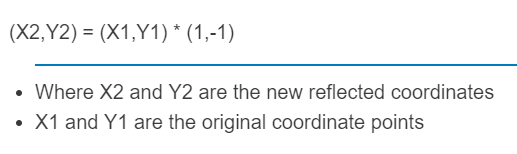
Reflecting a point across the X-axis keeps the X-coordinate the same and flips the sign of the Y-coordinate.
For reflection across a horizontal line y = k (the X-axis is the special case where k = 0):
- x — original X-coordinate (unchanged after reflection)
- y — original Y-coordinate
- k — Y-value of the horizontal line you are reflecting across
Notes: the X-axis is the line y = 0, so 2k − y reduces to −y. The distance from the original point to the line of reflection equals the distance from the line to the reflected point. Points already on the line do not move.
Quick Reference
Common reflections across the X-axis:
| Original Point | Reflected Point | Quadrant Change |
|---|---|---|
| (3, 5) | (3, -5) | I → IV |
| (-2, 4) | (-2, -4) | II → III |
| (-6, -1) | (-6, 1) | III → II |
| (7, -3) | (7, 3) | IV → I |
| (4, 0) | (4, 0) | on axis (no change) |
How a function transforms when you reflect its graph across the X-axis:
| Original Function | Reflected Function |
|---|---|
| y = x² | y = -x² |
| y = √x | y = -√x |
| y = sin(x) | y = -sin(x) |
| y = f(x) | y = -f(x) |
Example and FAQ
Example: Reflect triangle ABC with A(1, 2), B(4, 2), C(4, 6) across the X-axis.
- A(1, 2) → A'(1, -2)
- B(4, 2) → B'(4, -2)
- C(4, 6) → C'(4, -6)
Does the shape change size? No. Reflection is a rigid transformation. Side lengths, angles, and area stay the same. Orientation reverses.
What if a point is on the X-axis? It maps to itself. The Y-coordinate is already 0, and -0 = 0.
How is this different from reflecting over the Y-axis? Across the Y-axis the rule is (x, y) → (-x, y). The X-coordinate flips instead of the Y-coordinate.
What about reflecting twice? Reflecting over the X-axis twice returns the point to its original location, since -(-y) = y.