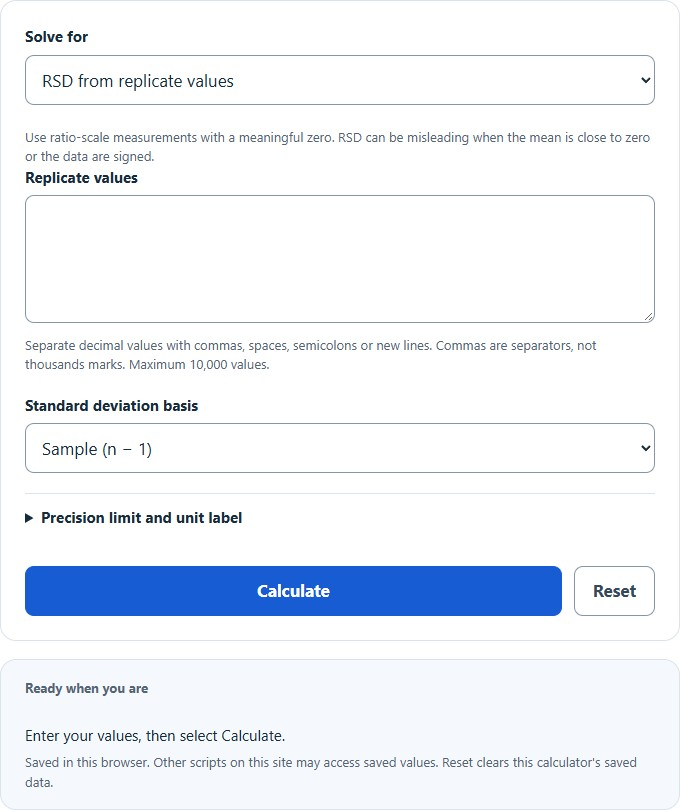
Calculate RSD from raw data or mean and standard deviation, compare sample and population results, check a precision limit, and reverse-set target SD.
Related Calculators
- Weighted Mean Calculator
- Index of Dispersion Calculator
- Inverse Z Score Calculator
- Welch’s T Test Calculator
- All Statistics Calculators
Relative Standard Deviation Formula
The following equation is used to calculate the relative standard deviation of a given data set.
- Where RSD is the relative standard deviation (%)
- SD is the standard deviation
- |M| is the absolute value of the mean
Relative Standard Deviation Definition
Relative standard deviation (RSD) is a statistical measure used to express the variability or dispersion of a data set relative to its mean. It is a dimensionless quantity expressed as a percentage and enables comparison of the variability between different data sets or populations.
RSD is calculated by dividing the standard deviation by the absolute value of a nonzero mean and multiplying by 100. It is most meaningful for ratio-scale measurements with a meaningful zero. Changing a positive multiplicative unit scale leaves RSD unchanged. Comparisons still require compatible quantities and measurement definitions; an arbitrary zero or a mean close to zero can make the ratio misleading.
By utilizing RSD, researchers and analysts can assess the consistency and reliability of data sets. A low RSD indicates less spread relative to the mean magnitude. It does not by itself establish accuracy, absence of bias, or reliability. Conversely, a high RSD signifies a greater spread of values, indicating greater variability and less precision in the data.
The importance of RSD lies in its ability to provide a standardized measure of dispersion, allowing for meaningful comparisons between different data sets. It is particularly valuable when dealing with data sets of varying scales, where comparing the absolute standard deviations might be misleading due to the different units involved.
RSD enables researchers to identify and quantify the extent of variability within a data set, which is crucial for decision-making and drawing meaningful conclusions. It helps determine the consistency and repeatability of measurements, aiding in quality control processes and assessing the reliability of experimental results.
Use care with financial returns: this absolute-mean ratio treats positive and negative mean returns of equal magnitude alike and can become extreme near a zero mean. It is not a universal ranking of investment risk or suitability.
Relative Standard Deviation Example
How to calculate relative standard deviation
- First, determine the standard deviation
Calculate the standard deviation of the data set.
- Next determine the mean of the data set
The calculator will use the absolute value of this mean for the calculation.
- Finally, calculate the relative standard deviation
Choose RSD from mean and SD and enter those values, or choose RSD from replicate values and supply the data. Select Calculate. The target-SD mode instead uses a supplied mean and target RSD.
FAQ
What is the significance of using the absolute value of the mean in the RSD calculation?
The absolute value of the mean is used in the RSD calculation to ensure the result is a non-negative percentage. This makes the arithmetic non-negative, but does not make signed data or means near zero suitable for interpretation. Use a meaningful ratio scale and retain the mean's direction separately.
How does RSD differ from standard deviation?
While standard deviation measures the amount of variability or dispersion from the mean in a data set, RSD expresses this variability as a percentage of the mean. This makes RSD a dimensionless quantity, allowing for comparisons between data sets with different units or scales.
Why is RSD considered a useful tool in finance and investment analysis?
RSD expresses spread relative to mean magnitude. With signed returns, it discards the mean's direction and can be unstable near zero, so it should not be used alone to compare investment risk.
Can RSD be applied to any type of data set?
No. RSD is most meaningful for ratio-scale measurements with a meaningful zero and a nonzero mean. Celsius and Fahrenheit have arbitrary zero points. A zero mean makes RSD undefined, and a near-zero mean makes the ratio unstable. Supply a method-specific precision limit when a limit comparison is needed.