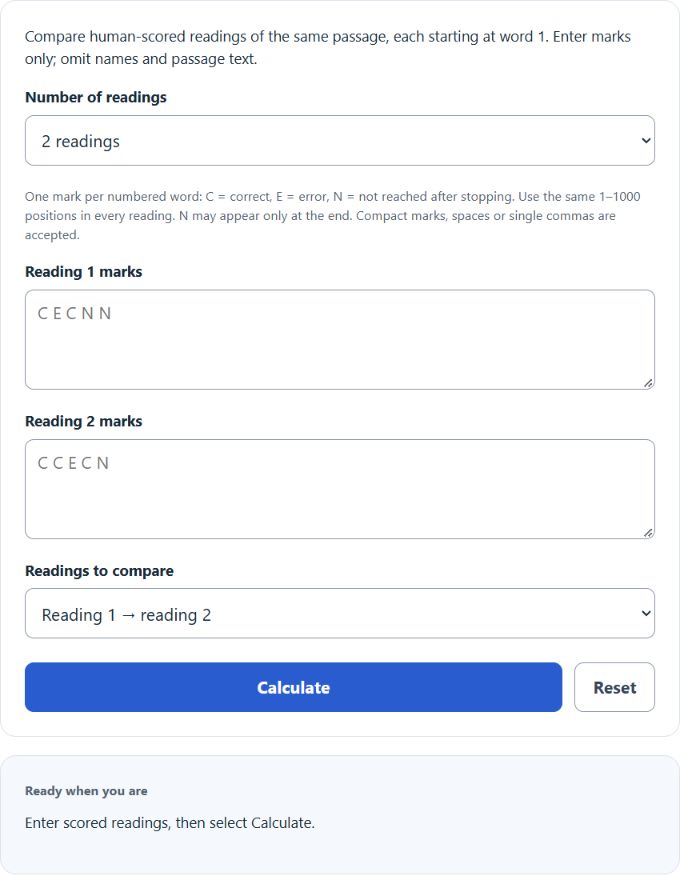
Compare errors across two to four scored readings of the same passage. See which word positions changed while excluding words that were not reached.
- WCPM Calculator
- Reading Fluency Progress Monitoring Calculator
- Reading Accuracy Rate Calculator
- Everyday Life and Education Calculators
- Maze Reading Comprehension Score Calculator
- Reading Fluency Percentile Calculator
Word-Position Comparison Method
Use the same numbered passage and scoring rules for every reading, starting at position 1. Enter C for human-scored correct, E for error, and N for positions beyond the stopping point. N is not a correct or incorrect response.
For the selected earlier-to-later pair, count only positions scored C or E in both readings:
- E→C: error changed to correct.
- E→E: error in both selected readings.
- C→E: correct changed to error.
- C→C: correct in both selected readings.
Shared scored positions = E→C + E→E + C→E + C→C. Counts are exact word positions. Any position with N in either selected reading is excluded; details list positions scored only earlier, only later, or unreached in both. With no shared scored positions, the comparison is Unavailable.
How to Use the Calculator
- Choose two, three or four readings. Enter one mark per position, using equal-length sequences:
CECNN,C E C N NorC,E,C,N,N. Lowercase is accepted. - Put N only at the unreached end. A scored omission before the stopping point needs a mark under your provider’s rules; do not add passage positions for spoken insertions or repetitions.
- Choose an earlier-to-later pair and select Calculate. Open Calculation details for position lists and all reading histories; scroll the history table sideways when needed.
Each reading accepts 1–1000 positions and 5000 text characters. These are software limits, not recommended passage lengths or repetition counts. Blank entries and unequal lengths are rejected.
Worked Example
These fictional marks represent eight fixed word positions:
| Reading | Positions 1–8 |
|---|---|
| 1 | C E E C E C N N |
| 2 | C C E E C C C N |
Positions 1–6 are scored in both readings. E→C occurs at 2 and 5, giving 2 positions. E→E occurs at 3, C→E at 4, and C→C at 1 and 6: 2 + 1 + 1 + 2 = 6 shared positions. Position 7 is scored only later; position 8 is unreached in both. Both are excluded.
FAQ
Is E→C a self-correction?
No. It compares separate readings. Score a self-correction within one reading under your provider’s rules before entering that reading’s mark.
Does error in both mean every reading was incorrect?
No. It refers to the selected pair. For history E C E C, readings 1→3 are E→E, 1→4 are E→C, and 2→3 are C→E. The full history retains those changes.
Can I compare different passages or infer mastery?
No. Matching lengths cannot establish the same words, and the tool cannot verify passage identity. Counts describe your marks; they do not establish comprehension, mastery, diagnosis or an instructional decision.
Sources
- IES: Reading Interventions for Grades 4–9 (2022), Recommendation 2 — purposeful repeated-reading context.
- University of Oregon: DIBELS 8 Scoring Guide (2026), ORF pages 73–77 — an example of provider-specific scoring rules. The position-transition method is defined above.