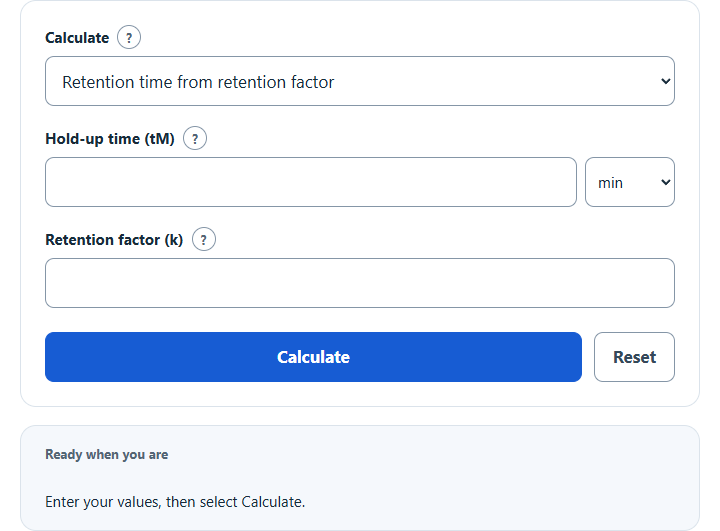
Calculate chromatography retention time from the hold-up time and retention factor, or find the adjusted retention time, hold-up time or retention volume.
- All Chemistry Calculators
- Selectivity Factor Calculator
- Retention Factor Calculator
- Relative Retention Time (RRT) Calculator
- Column Volume Calculator
- Detention Time Calculator
Calculator Functions
The calculator works out retention times for column chromatography, such as HPLC and gas chromatography. Retention time is the time from injection to the top of a compound’s peak.
| Function | Use it when | You enter |
|---|---|---|
| Retention time from retention factor | You know a compound’s retention factor and want the time its peak appears | Hold-up time and retention factor |
| Adjusted retention time and retention factor | You have a measured retention time and want the part due to the stationary phase | Retention time and hold-up time |
| Hold-up time of the column | You need the time an unretained compound takes to pass through | Hold-up volume and flow rate, or the column’s diameter, length and porosity |
| Retention time from retention volume | A method lists a retention volume and you run at a known flow rate | Retention volume and flow rate |
To compare two peaks, use the Selectivity Factor Calculator. For a peak against a reference peak, use the Relative Retention Time (RRT) Calculator, and for the Rf value of a thin-layer plate, the Retention Factor Calculator. For a tank or basin, where retention time means volume divided by flow, use the Detention Time Calculator.
Retention Time Formulas
| tR | Retention time: injection to the top of the peak |
| tM | Hold-up time: the retention time of a compound the column does not retain |
| t′R | Adjusted retention time: the time held by the stationary phase |
| k | Retention factor, a plain number |
These are the IUPAC definitions. The adjusted retention time is the total retention time minus the hold-up time, and the retention factor is the adjusted retention time divided by the hold-up time [1]. Putting the two together gives the first line. With a hold-up time of 1.5 min and a retention factor of 4, tR = 1.5 × (1 + 4) = 7.5 min, of which 6 min is the adjusted retention time.
The retention factor measures how long a compound stays in the stationary phase compared with the mobile phase. The fraction of the compound in the mobile phase is 1 ÷ (k + 1) [1], so at k = 4 it spends 80% of the run in the stationary phase. Older texts call k the capacity factor or capacity ratio and often write it k′ [1]. The hold-up time is also known as the dead time or void time, t0.
Hold-up time of the column
VM = ε × π ÷ 4 × d² × L
VM is the hold-up volume, the mobile phase needed to carry an unretained compound through, and F is the flow rate. The hold-up volume includes the injector, detector and connecting tubing as well as the column [1]. When it isn’t known, the second line estimates it from the column: the column volume is its cross-section times its length, and the porosity ε is the share of that volume the mobile phase fills [1]. A 4.6 mm by 150 mm column has a volume of 2.493 mL. With a porosity of 0.7 the hold-up volume is 1.745 mL, and at 1 mL/min the hold-up time is 1.745 min.
Retention time from retention volume
The retention volume VR is the mobile phase that enters the column between injection and the top of the peak, and each retention time is the matching volume divided by the flow rate [1]. A compound with a retention volume of 12 mL comes out at 12 min when the flow is 1 mL/min and at 6 min when it is doubled.
Limits of This Estimate
- A retention factor belongs to one compound on one column under one set of conditions. The formulas assume it stays the same for the whole run, which isn’t true when the mobile phase or the temperature changes during the run.
- The hold-up time worked out from the column’s size leaves out the injector, tubing and detector, and it depends on the porosity you enter. The peak of an unretained compound gives a surer figure.
- In gas chromatography the carrier gas is compressed along the column, so retention volumes need a compression correction. In liquid chromatography that compression is negligible [1].
Sources
- International Union of Pure and Applied Chemistry, Nomenclature for chromatography (IUPAC Recommendations 1993), Pure and Applied Chemistry 65(4), 819–872: the definitions of hold-up time and volume, total and adjusted retention time, retention factor, column volume, porosity and flow rate