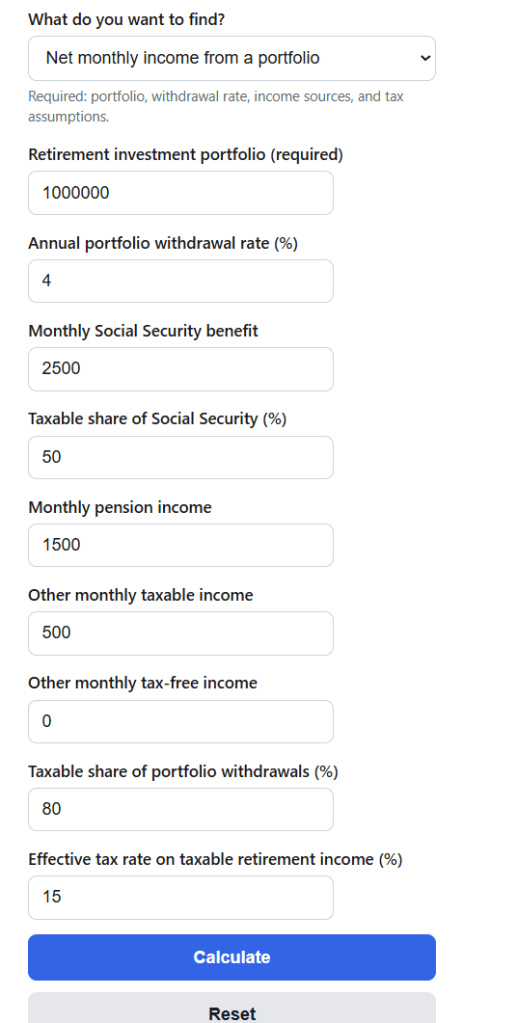
Estimate net monthly retirement income from investments, Social Security, and pensions or calculate the portfolio needed for a target income after tax.
Retirement Income Formula
Retirement income combines portfolio withdrawals with Social Security, pensions, and other income, then subtracts estimated tax.
Estimated annual net income is:
Net\ Income=Gross\ Income-Taxable\ Income*Effective\ Tax\ Rate
To solve for the portfolio:
Portfolio=Income\ Gap/[Withdrawal\ Rate*(1-TaxableShare*TaxRate)]
Variables:
- gross income includes all entered sources
- taxable income uses the selected taxable shares
- the effective tax rate applies to modeled taxable income
- the withdrawal rate determines portfolio cash flow
Income mode estimates net monthly income from a known portfolio. Portfolio-needed mode starts from a target and fills the gap after fixed income.
Taxable-share inputs allow a mix of traditional, Roth, and taxable accounts.
A withdrawal rate is a planning assumption, not a guarantee of sustainability.
Monthly Income Source Example
Illustrative gross cash flow before the simplified tax estimate.
| Source | Monthly | Annual |
|---|---|---|
| Social Security | $2,500 | $30,000 |
| Pension | $1,500 | $18,000 |
| Other taxable income | $500 | $6,000 |
| 4% from $1,000,000 | $3,333 | $40,000 |
| Total gross | $7,833 | $94,000 |
Example Problems
Example 1: Estimate net income.
A $1 million portfolio at 4 percent adds $40,000 annually to $54,000 of fixed income before the tax estimate.
Example 2: Solve for a portfolio.
Enter a $7,000 net monthly target and the calculator divides the remaining after-tax gap by the after-tax withdrawal rate.
Frequently Asked Questions
Should Social Security be entered before tax?
Enter the gross benefit and estimate its taxable share.
How do I estimate portfolio taxable share?
Weight the expected withdrawals from traditional, Roth, and taxable accounts.
Does this model inflation?
It is a one-year income snapshot; use consistent current or future dollars for every input.