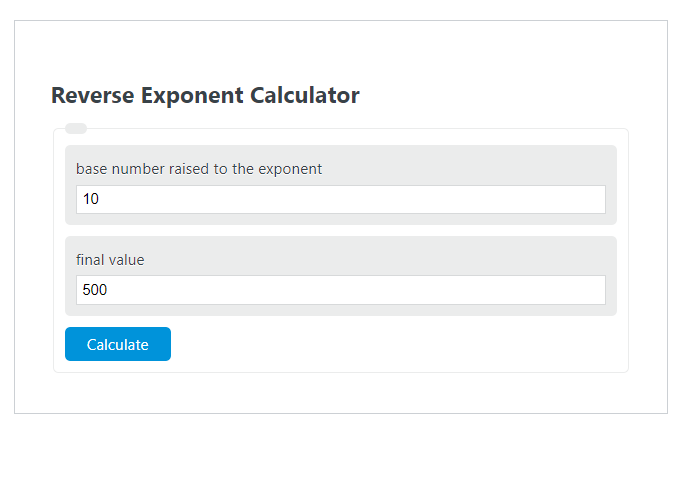
Calculate the exponent, base, or result in an exponential equation with real-domain checks, inverse substitution, precision control, and sensitivity.
Related Calculators
- Inverse Log Calculator
- Exp Calculator
- Increase Per Day Calculator
- Fourth Root Calculator (4th Sqrt)
- All Math and Numbers Calculators
Reverse Exponent Formula
The calculator solves for whichever piece of an exponential expression you do not know.
Find the exponent when you know the base and the result:
Find the base when you know the result and the exponent:
Find the growth rate when you know the start, end, and number of periods:
- b is the base.
- x is the unknown you are solving for.
- y is the result of the exponential expression.
- n is the exponent or number of periods.
- r is the per-period growth rate as a decimal.
The exponent mode requires a positive base (not 1) and a positive result so the logarithm has a real solution. The base mode allows a negative result only when the exponent is an odd integer. The growth mode requires both initial and final values to be positive.
Reference Tables
Use these to sanity check a result before you trust it.
| Equation | Solve for | Answer |
|---|---|---|
| 2^x = 32 | x | 5 |
| 10^x = 1000 | x | 3 |
| 5^x = 20 | x | 1.8614 |
| x^4 = 81 | base | 3 |
| x^3 = 125 | base | 5 |
| x^5 = -32 | base | -2 |
| Total change | Periods | Per-period rate |
|---|---|---|
| Doubled (×2) | 5 | 14.87% |
| Doubled (×2) | 10 | 7.18% |
| Tripled (×3) | 10 | 11.61% |
| Halved (×0.5) | 5 | -12.94% |
| +50% | 5 | 8.45% |
Worked Example
Suppose you invested 1000 and ended with 1500 after 5 years. To find the annual rate:
- Divide: 1500 / 1000 = 1.5.
- Take the 5th root: 1.5^(1/5) = 1.0845.
- Subtract 1: 0.0845, or 8.45% per year.
Why does the exponent calculator reject base 1? Because 1 raised to any power is still 1, so there is no unique exponent that produces a different result.
Can the base be negative? In the base-finding mode, yes, but only when the exponent is an odd integer. Even exponents on negative bases work mathematically but produce two valid bases (positive and negative), so the calculator returns the positive root and notes the alternative.
What if my result is between 0 and 1? That is fine. It just means the exponent is negative (when the base is greater than 1) or the rate represents decay rather than growth.