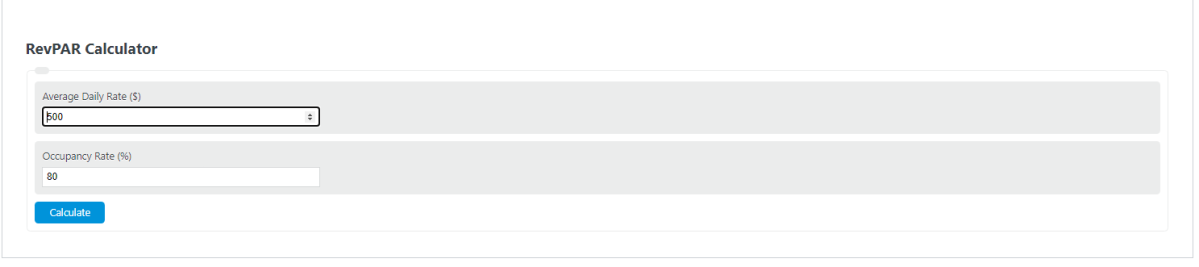
Calculate hotel RevPAR from room revenue and available room nights or from ADR and occupancy, and solve for revenue, ADR, occupancy, or room inventory.
- All Business Calculators
- Occupancy Percentage Calculator
- Occupancy Rate Index Calculator
- Cost Per Occupied Room Calculator
- Hotel Days Calculator
- Average Rate Calculator
RevPAR Formula
The calculator uses three formulas, one for each mode.
Revenue ÷ rooms mode:
ADR × occupancy mode:
Market index mode (RGI):
- Room Revenue: total rooms-only revenue for the period (exclude F&B, spa, parking).
- Available Room-Nights: total rooms in inventory multiplied by nights in the period.
- ADR: average daily rate, equal to room revenue divided by sold room-nights.
- Occupancy: sold room-nights divided by available room-nights, expressed as a percentage.
- Compset RevPAR: the RevPAR of your competitive set or market segment.
- RGI: RevPAR Generation Index. 100 means parity with the compset.
The first mode is the cleanest if you have direct totals from your PMS. The second mode is useful when you only have ADR and an occupancy percentage, which is common in forecasts and budgets. The third mode benchmarks your performance against a compset using STR-style index logic. Anything above 100 means you are capturing more than your fair share of market revenue.
RevPAR Benchmarks and Interpretation
Use the tables below as rough reference points. Actual ranges shift with location, season, and chain scale.
| U.S. Chain Scale | Typical ADR | Typical Occupancy | Typical RevPAR |
|---|---|---|---|
| Economy | $70 to $90 | 55% to 60% | $40 to $55 |
| Midscale | $110 to $130 | 60% to 65% | $70 to $85 |
| Upscale | $160 to $200 | 68% to 73% | $110 to $145 |
| Upper Upscale | $220 to $280 | 70% to 75% | $155 to $210 |
| Luxury | $400+ | 68% to 74% | $270+ |
| RGI Score | Reading |
|---|---|
| Below 90 | Significantly underperforming the compset. |
| 90 to 95 | Lagging the market. Investigate rate or mix. |
| 95 to 105 | Fair share. Roughly in line with peers. |
| 105 to 115 | Outperforming. Healthy premium captured. |
| Above 115 | Strong leader. Test rate ceilings. |
Worked Examples
Example 1: Revenue ÷ rooms. A 120-room hotel runs 30 nights in November. Available room-nights are 120 × 30 = 3,600. Total room revenue is $396,000. RevPAR = 396,000 ÷ 3,600 = $110.00.
Example 2: ADR × occupancy. ADR is $185 and occupancy is 72%. RevPAR = 185 × 0.72 = $133.20. A one-point occupancy gain to 73% would add 185 ÷ 100 = $1.85 to RevPAR.
FAQ
Does RevPAR include taxes or resort fees? No. Use net rooms revenue only. Exclude taxes, resort fees if booked separately, and non-room revenue.
What is a good RevPAR? There is no universal number. RevPAR is only meaningful against your own history, your budget, or a compset of similar properties in the same market.
How is RevPAR different from TRevPAR? RevPAR uses room revenue only. TRevPAR uses total revenue including F&B, spa, and other outlets, divided by the same available room-nights.
Should I count out-of-order rooms as available? Standard practice is yes. Available room-nights use total inventory regardless of whether rooms were sellable. Some operators track a separate net RevPAR that excludes out-of-order rooms.