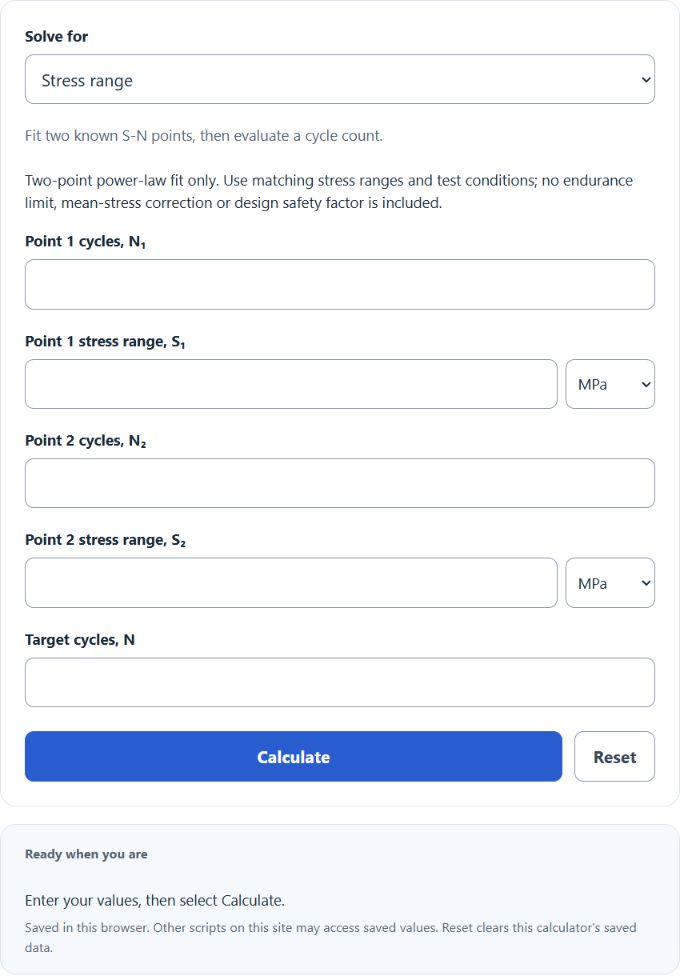
Calculate stress range, cycles to failure, or material constants K and m for an S-N fatigue curve using known points and stress units.
- All Construction Calculators
- Failure Rate Calculator
- Shear Force Calculator
- Bending Stress Calculator
- Compressive Stress Calculator
SN Curve Formula
The following formula is used to calculate the SN Curve.
Variables:
- N is the number of cycles to failure
- S is the stress range
- K is the fitted coefficient, dependent on the stress unit and test conditions
- m is the positive fitted exponent for a decreasing stress-life curve
The calculator fits two known points using S = A × Nb, with b = ln(S₂/S₁) / ln(N₂/N₁). The equivalent form above uses m = -1/b and K = Am. Supply matching stress ranges and complete cycles, not mixed amplitude/range or cycle/reversal data. The fitted curve has no endurance plateau, mean-stress correction, fatigue-scatter allowance or design safety factor.
How to Calculate SN Curve?
The following steps outline how to calculate the SN Curve.
- First, obtain two positive known stress-range and cycle-count pairs from matching material and test conditions.
- Enter both known points; their cycle counts must differ and stress must decrease as cycles increase.
- Select the stress-range or cycles solve and enter the corresponding positive target.
- The calculator fits b and A, then reports equivalent K and m using point 1’s selected stress unit.
- Select Calculate and distinguish interpolation within the known cycle counts from extrapolation beyond them.
- After inserting the variables and calculating the result, check your answer with the calculator above.
Example Problem:
Use the following variables as an example problem to test your knowledge.
stress range S = 400. To reproduce this illustrative curve in the calculator, use known points (N₁ = 1,000,000, S₁ = 400) and (N₂ = 2,000,000, S₂ = 25) in one consistent stress unit, then solve cycles at S = 400.
material constant K = 4.472136×10⁶ (cycles · [stress unit]m)
material constant m = 0.25
N = K * S^-m = 4.472136×106 * 400^-0.25 ≈ 1,000,000 cycles