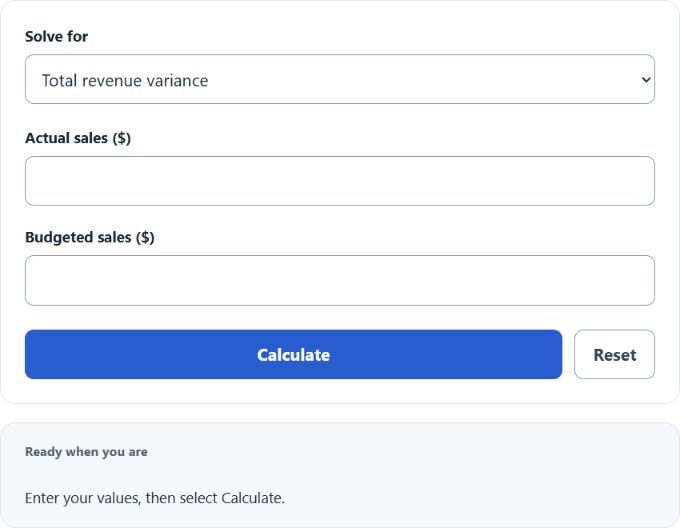
Calculate your sales variance, including the sales price variance and sales volume variance, by comparing actual results to your budget.
Related Calculators
- Variance Calculator
- Budget Variance Calculator
- Projected Sales Calculator
- Average Sales Calculator
- Cost Volume Profit Calculator
- All Business Calculators
Sales Variance Formula
Total sales variance compares the revenue you actually earned to the revenue you budgeted:
Total Sales Variance = Actual Sales - Budgeted Sales
When you know unit prices and quantities, you can split that total into a price effect and a volume effect:
Sales Price Variance = (Actual Price - Budgeted Price) x Actual Units
Sales Volume Variance = (Actual Units - Budgeted Units) x Budgeted Price
Where:
- Actual Sales is the revenue you actually recorded for the period.
- Budgeted Sales is the revenue you planned or forecast for the period.
- Actual Price and Budgeted Price are the selling price per unit you achieved and the price you planned.
- Actual Units and Budgeted Units are the quantities you sold and the quantities you planned to sell.
For a single product or a consistent aggregate, the sales price and volume revenue variances add up to total sales variance. Positive is favorable to revenue and negative is unfavorable; this does not establish the effect on profit. Percentage variance is total variance divided by budgeted sales times 100, and is undefined when the budget is zero.
Interpreting Your Variance Results
Use the tables below to read the sign of your result and to decide which variance answers your question.
| Result | Meaning |
|---|---|
| Positive variance | Favorable. Actual revenue is above budget. |
| Negative variance | Unfavorable. Actual revenue is below budget. |
| Zero variance | Actual revenue matches budget. |
| Variance | What it isolates | Main driver |
|---|---|---|
| Sales Price Variance | Effect of charging a different price | Selling price changed versus plan |
| Sales Volume Variance | Effect of selling a different quantity | Units sold changed versus plan |
| Total Sales Variance | Combined revenue gap | Price and volume together |
Example Section
Example 1, total variance. You budgeted $100,000 in sales and recorded $120,000. The total sales variance is $120,000 - $100,000 = $20,000, a favorable variance of 20 percent.
Example 2, price and volume breakdown. You budgeted 10,000 units at $10 and sold 9,000 units at $12. The sales price variance is ($12 - $10) x 9,000 = $18,000 favorable. The sales volume variance is (9,000 - 10,000) x $10 = -$10,000 unfavorable. The total sales variance is $18,000 - $10,000 = $8,000 favorable, which is 8 percent of the $100,000 budget.
FAQ Section
What is a sales variance? A sales variance is the difference between your actual sales revenue and your budgeted sales revenue for a period. It tells you how far results landed from plan and, when broken down, why.
Is a positive sales variance good? A positive sales variance is favorable to revenue because actual sales exceed budget; a negative variance is unfavorable to revenue. Costs and margins must also be considered before drawing conclusions about profit.
What is the difference between sales price variance and sales volume variance? Sales price variance measures the revenue effect of selling at a price different from plan, holding quantity at the actual level. Sales volume variance measures the revenue effect of selling a different quantity than planned, holding price at the budgeted level. Added together, they equal the total sales variance.