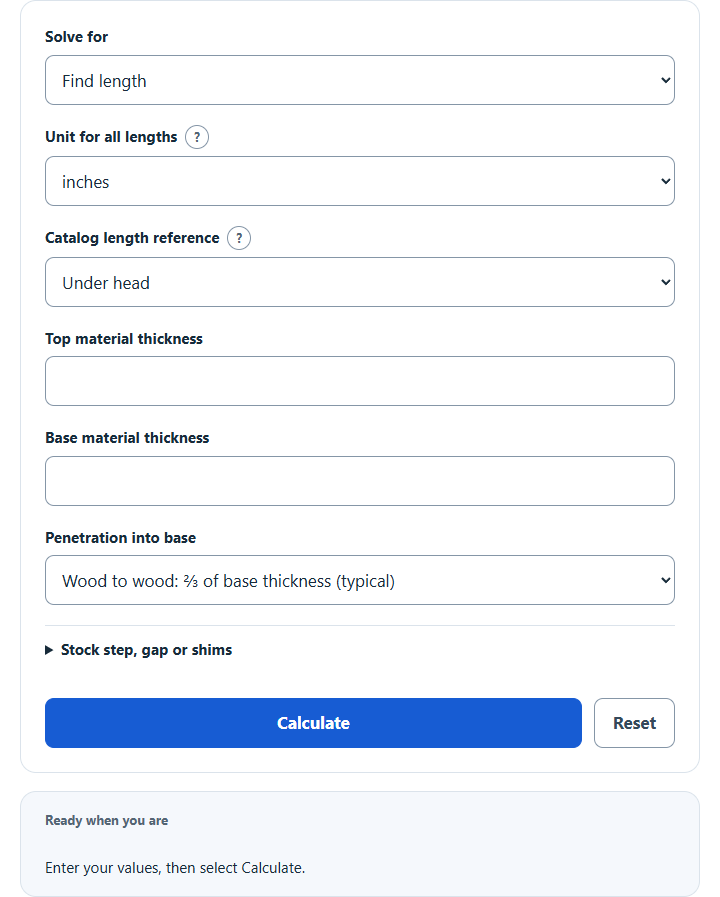
Calculate the screw length you need from the thickness of the top and base materials, using a typical two-thirds penetration rule or your own depth.
Related Calculators
- Shelf Load Capacity Calculator
- Awning Height Calculator
- Gate Weight Calculator
- Lead Angle Calculator
- All Construction Calculators
Bolt length, timber spacing and withdrawal
For an assembly held with a bolt and nut, use the Bolt Length Calculator for a rough estimate that includes grip thickness, packing and washers. Confirm the actual nut, thread projection and engagement requirements for your fastener.
Screw length alone does not determine fastener spacing or withdrawal capacity. For a deck ledger, the Deck Ledger Fastener Spacing Calculator counts fasteners or checks a planned spacing within its stated assembly conditions; its structural-screw option needs an approved product spacing and model or report reference.
For conventional wood-screw or lag-screw withdrawal, the American Wood Council Connection Calculator applies the 2024 NDS to the selected fastener, wood members and adjustment factors. Proprietary structural screws require the exact manufacturer’s evaluated design values and installation requirements. Check head pull-through, edge and end distances, grain direction and other connection requirements separately; a withdrawal result is not a complete connection design.
Screw Length Formula
The following formula gives the geometric minimum length. Use the same unit and catalog reference plane for all lengths. Choose target penetration from applicable fastener specifications; this calculation does not determine a secure connection or effective thread engagement.
Variables:
- SL is the minimum catalog-reference screw length (inches or millimeters)
- MT is the top material thickness measured from the same reference plane; G is any gap or shim thickness (blank means zero)
- PD is the desired geometric tip penetration into the base, in the same unit
Add top thickness, any gap, and a penetration rule or custom penetration. Find length rounds this minimum up to a positive multiple of your entered stock increment; confirm actual size availability. Check length evaluates a candidate. Tip-to-back-face distance is base thickness minus tip reach; a negative value means protrusion.
What is Screw Length?
For the usual protruding-head screw, catalog length is measured under the head to the tip. For a flat head seated flush, overall length includes the head. Use the actual product drawing when conventions differ. This geometric model assumes the selected reference plane and axial installation; it does not model countersink depth, raised oval heads, thread engagement, strength, or tolerances.
How to Calculate Screw Length?
The following steps outline how to calculate the Screw Length.
- First, select one common unit and the catalog length reference. Measure top thickness (MT) from that reference plane.
- Next, enter base thickness and the target tip penetration (PD), using applicable fastener specifications. Enter any gap or shim thickness (G) under Gap or shims.
- Next, gather the formula from above = SL = MT + G + PD.
- Finally, optionally enter a stock length step to find a modeled length, or select Check length and enter a candidate. Changing the common unit reinterprets the numbers; convert or re-enter them yourself.
- Select Calculate and review the modeled length, penetration, back-face distance and any protrusion or shortfall. A geometric match does not establish connection safety.
Example Problem :
Use the following variables as an example problem to test your knowledge.
material thickness (MT) = 5 mm
penetration depth (PD) = 30 mm. With no gap, a 40 mm base and a 5 mm length increment, the geometric minimum and selected length are 35 mm. Tip penetration is 30 mm, leaving 10 mm to the back face.