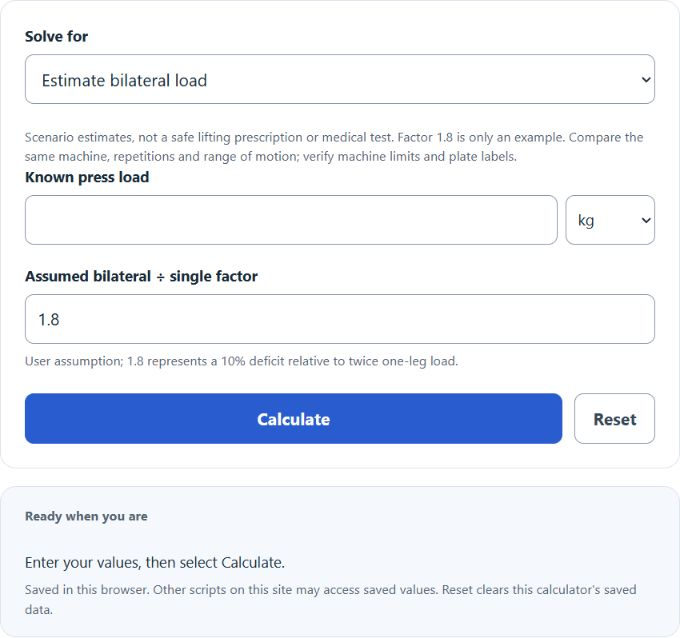
Calculate single-leg and bilateral leg press estimates from a chosen factor, plus plate loads per side and left-right strength imbalance.
Safety note: These results are estimates only. Leg press machines vary (angle, friction, leverages, and true sled/start weight), and plates may be stamped in lb or kg—verify before loading. Choose a starting load with a qualified coach and progress gradually; a calculated percentage is not a safety margin. If you have pain, a recent injury/surgery, or a medical condition that affects exercise tolerance, consult a qualified clinician or certified coach.
Single-leg Press to Bilateral Leg Press Conversion Formula
The formula below estimates the bilateral leg press weight from a given single-leg press weight. It uses a user-chosen bilateral factor (example shown: 1.8, equivalent to a 10% deficit relative to twice one-leg load). This is a scenario assumption; actual deficit or facilitation varies by person and testing setup.
Variables:
- BL: Bilateral Leg Press Weight
- SL: Single-leg Press Weight
- 0.9: Example efficiency factor (i.e., a 10% bilateral deficit). Your factor may be different.
With the 10% example above, you multiply the single-leg press weight by two and then by 0.9. This simplifies to multiplying by 1.8, which is an illustrative assumption, not a validated personal conversion or lifting recommendation.
| Single-Leg Press (kg) | Bilateral Leg Press (kg) |
|---|---|
| 20 | 36 |
| 30 | 54 |
| 40 | 72 |
| 50 | 90 |
| 60 | 108 |
| 70 | 126 |
| 80 | 144 |
| 90 | 162 |
| 100 | 180 |
| 110 | 198 |
| 120 | 216 |
| 130 | 234 |
| 140 | 252 |
| 150 | 270 |
| 160 | 288 |
| 170 | 306 |
| 180 | 324 |
| 190 | 342 |
| 200 | 360 |
| 220 | 396 |
| *Uses an illustrative assumption: Bilateral ≈ 1.8 × Single; Single ≈ Bilateral ÷ 1.8. Factor is unit-agnostic (kg or lbs) and may vary by person and setup. | |
What is the Single-leg Press to Bilateral Leg Press Conversion?
This conversion provides an estimate of the weight you might press using both legs on a leg press machine, based on the weight you can press with one leg. Because the size of the bilateral deficit varies, it’s best treated as a rough guideline rather than an exact equivalence.
How to Calculate the Bilateral Leg Press Equivalent?
Follow these steps to determine an estimated bilateral leg press weight:
- Measure or determine the weight used during a single-leg press (SL) in your chosen unit (kg or lbs).
- Choose your assumed bilateral factor. For the illustrative 10% deficit scenario, multiply SL by 1.8. Match machine, repetitions and range of motion when comparing loads.
- Record the result as an estimated bilateral leg press weight (BL).
- If you have the bilateral leg press weight and want to estimate the single-leg value, divide by your chosen factor.
- Use the calculator to compare scenarios. Plate mode adds nominal starting load to plate mass for bookkeeping, not measured force; verify the exact machine, capacity and plate inventory. Imbalance mode reports the difference divided by the larger load without a medical threshold.
Example Problem:
If one leg presses 100 lbs and you use a factor of 1.8, then the estimated bilateral leg press weight is calculated as follows:
100 lbs × 1.8 = 180 lbs