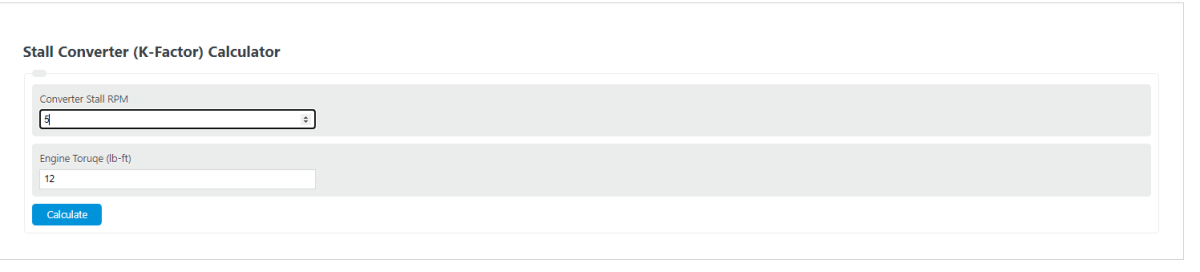
Calculate torque converter K-factor, stall RPM, or engine torque, plus estimate GM 298mm K-code stall and torque-based stall changes.
- All Automotive Calculators
- Stall Speed Calculator
- HP to Torque Calculator
- Boost to HP Calculator
- Engine Hours to Miles Calculator
K Factor Formula
The following formula is used to calculate the k-factor (capacity factor) of a torque converter.
- Where K is the k-factor (capacity factor) of the torque converter
- RPM is the converter's stall RPM
- T is the engine torque (input torque) at stall (lb-ft)
To calculate the k-factor of a torque converter, divide the stall RPM by the square root of the torque output.
Stall Converter Definition
A stall converter (high-stall torque converter) is a torque converter used in an automatic transmission that is designed for a particular stall speed. At stall (when the turbine is held), the converter produces its maximum torque multiplication.
Example Problem
How to calculate k-factor?
- First, determine the converter's stall RPM.
For this example, the stall RPM of the torque converter is found to be 4000 RPM.
- Next, determine the maximum engine torque output.
For this example, the engine can output a maximum of 400 lb-ft of torque.
- Finally, calculate the k factor.
Using the formula above, the k factor is found to be:
K = RPM / Sqrt (T)
K = 4000 / Sqrt (400)
K = 200