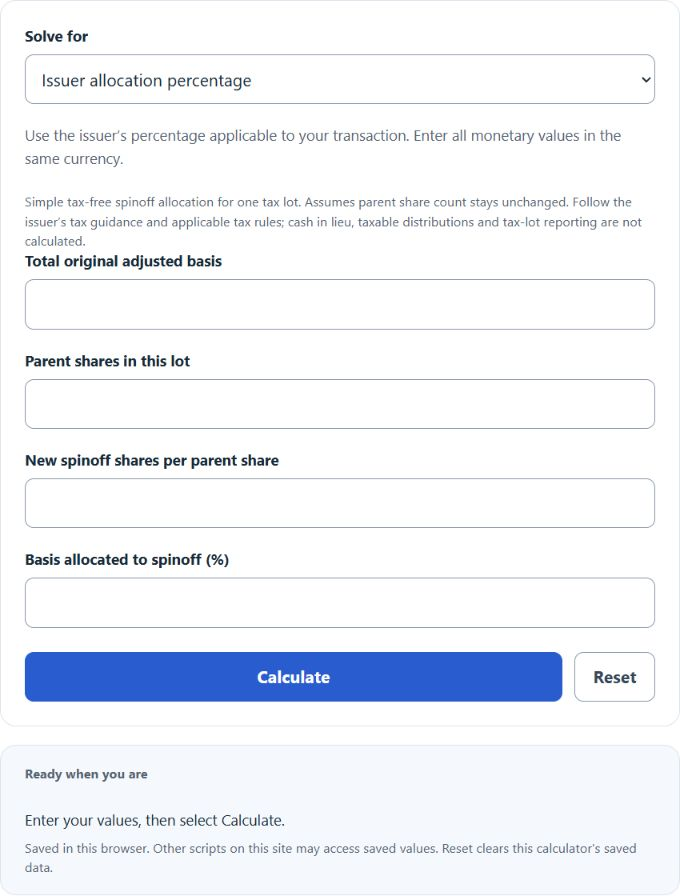
Calculate how your original cost basis is allocated between your parent shares and new spinoff shares after a corporate spin-off.
Spinoff Cost Basis Formula
When a company spins off a subsidiary in a tax-free distribution, you split your original cost basis between the parent shares you keep and the new spinoff shares, in proportion to their fair market values right after the spinoff. If the company publishes an allocation percentage on Form 8937, you use that percentage directly.
Spinoff Basis = Total Original Basis * (Spinoff Allocation % / 100)
Parent Basis = Total Original Basis * (Parent Allocation % / 100)
Spinoff Allocation % = (Spinoff Shares * Spinoff Price) / (Parent Shares * Parent Price + Spinoff Shares * Spinoff Price) * 100
Where:
Total Original Basis is the adjusted basis of one tax lot immediately before the spinoff, including applicable prior adjustments and acquisition costs. Spinoff Allocation % is the share of that basis assigned to the spinoff company, either taken from Form 8937 or computed from prices. Parent Allocation % is the remaining share, equal to 100 minus the Spinoff Allocation %. Parent Price and Spinoff Price are consistently determined fair market values per share under the valuation method applicable to the distribution. Spinoff Shares equals your Parent Shares multiplied by the spinoff ratio.
To get per-share basis, divide each company’s allocated basis by the number of shares you hold in that company.
Where to Find Your Inputs
Allocation percentages come from each company’s Form 8937 and vary by deal. The table below shows where each input comes from. Always use the figures your company publishes.
| Input | Where to find it |
|---|---|
| Allocation percentage | Form 8937 on the parent company investor relations page |
| Share prices after spinoff | Consistent documented values under the issuer’s guidance for the distribution |
| Spinoff ratio | Deal announcement or Form 8937 (new shares per parent share) |
| Original cost basis | Your brokerage purchase records |
Example Problem
You own 100 parent shares with a total original cost basis of 10,000 dollars. The company spins off a subsidiary at a ratio of 0.5 new shares per parent share, and Form 8937 states that 30 percent of your basis is allocated to the spinoff.
First, find your spinoff shares: 100 multiplied by 0.5 equals 50 spinoff shares. Next, allocate basis: 10,000 multiplied by 30 percent equals 3,000 dollars to the spinoff, and the remaining 7,000 dollars stays with the parent. Finally, find per-share basis: 3,000 divided by 50 equals 60 dollars per spinoff share, and 7,000 divided by 100 equals 70 dollars per parent share.
FAQ
What if my company did not issue a Form 8937?
Confirm that the distribution qualifies for tax-free basis allocation and obtain the applicable valuation guidance. Relative fair market value can allocate basis in a qualifying transaction; arbitrary current prices are not a substitute for the required valuation.
Does the spinoff change my total cost basis?
No. In a tax-free spinoff your total basis stays the same; it is only divided between the parent and the spinoff. The parent basis plus the spinoff basis equals your original basis.
Which share price should I use for the fair market value method?
Use a reasonable, consistent fair market value method supported by the issuer’s tax guidance and applicable rules. This calculator does not establish that a particular price or date is accepted for your transaction. Allocate each tax lot separately and handle cash in lieu of fractional shares separately.