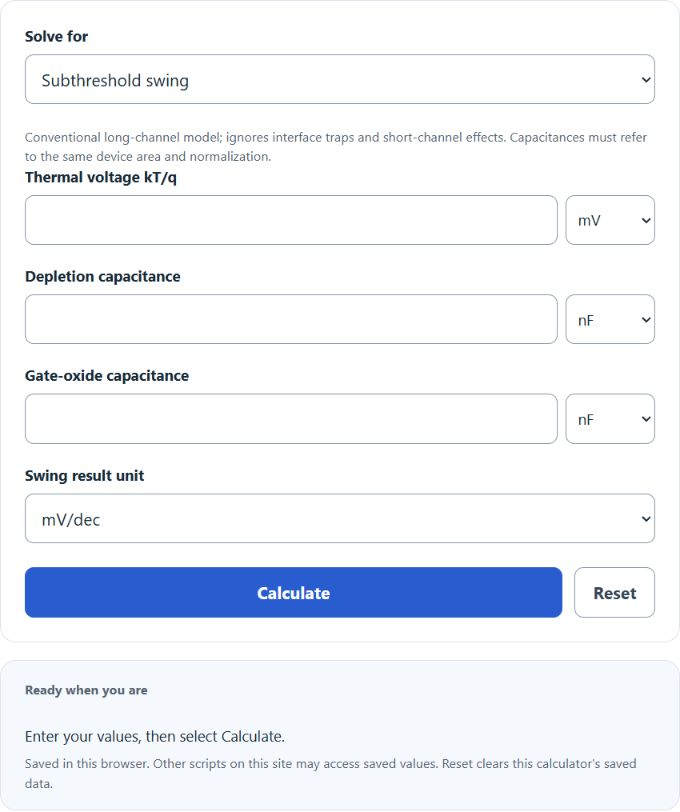
Calculate subthreshold swing, thermal voltage, depletion layer capacitance, or gate-oxide capacitance from the other three values with unit conversion.
- Parallel Wire Capacitance Calculator
- Coax Cable Calculator (Impedance-Inductance-Capacitance)
- Velocity Factor Calculator
Subthreshold Swing Formula
Subthreshold swing describes how much gate voltage is needed to change the drain current by one decade while a MOSFET is operating in the subthreshold region. It is typically reported in mV/dec. A lower subthreshold swing means the transistor switches more sharply and requires less gate-voltage change for the same current reduction.
If the thermal voltage is written explicitly, the same equation becomes:
This relationship shows that subthreshold swing depends on both temperature and device electrostatics. Increasing depletion capacitance raises the swing, while increasing gate-oxide capacitance lowers it.
Variable Definitions
| Variable | Meaning | Typical Unit |
|---|---|---|
| S | Subthreshold swing | mV/dec or V/dec |
| VT | Thermal voltage | mV or V |
| Cd | Depletion layer capacitance | F, mF, µF, nF |
| Cox | Gate-oxide capacitance | F, mF, µF, nF |
| k | Boltzmann constant | Constant |
| T | Absolute temperature | K |
| q | Electron charge | Constant |
Useful Rearrangements
Choose one of the four explicit solve targets. The conventional model requires positive thermal voltage and oxide capacitance, nonnegative depletion capacitance, and S ≥ ln(10)Vₜ. At the thermal-limit boundary, solving for oxide capacitance is nonunique or has no finite solution, depending on depletion.
How to Calculate Subthreshold Swing
- Determine the thermal voltage.
- Measure or estimate the depletion layer capacitance.
- Measure or estimate the gate-oxide capacitance.
- Compute the capacitance ratio Cd/Cox.
- Add 1 to that ratio.
- Multiply the result by ln(10) and the thermal voltage.
For the capacitance ratio to be valid, Cd and Cox must refer to the same device area and normalization. Their selected units are converted automatically, and the output unit is selected separately. This simplified long-channel model omits interface-trap and short-channel effects.
Example Calculation
If the thermal voltage is 30 mV, the depletion layer capacitance is 14 nF, and the gate-oxide capacitance is 30 nF, then:
This means the gate voltage must change by about 101.3 mV to change the drain current by one decade in the subthreshold region.
How to Interpret the Result
- Lower S: steeper turn-on behavior and better switching efficiency.
- Higher S: more gate-voltage change is needed for the same current change.
- Higher Cd: increases the body effect and worsens swing.
- Higher Cox: improves gate control and reduces swing.
- Higher temperature: increases thermal voltage and usually increases swing.
Body Factor Form
Many semiconductor texts group the capacitance term into a body factor:
In this form, n captures how strongly the depletion region weakens gate control. The closer n is to 1, the closer the device is to ideal subthreshold behavior.
Ideal Room-Temperature Reference
At approximately room temperature, the thermal voltage is about 25.85 mV. If the depletion effect is negligible, the minimum long-channel MOSFET swing is near:
This reference point is useful when comparing real devices to ideal switching behavior.
Common Input Mistakes
- Using capacitances with different device-area normalizations, or selecting a unit that does not match the entered number.
- Entering temperature or MOSFET threshold voltage when the calculator expects thermal voltage kT/q.
- Forgetting that subthreshold swing is expressed per decade.
- Assuming a larger gate-oxide capacitance increases swing, when it actually reduces it.