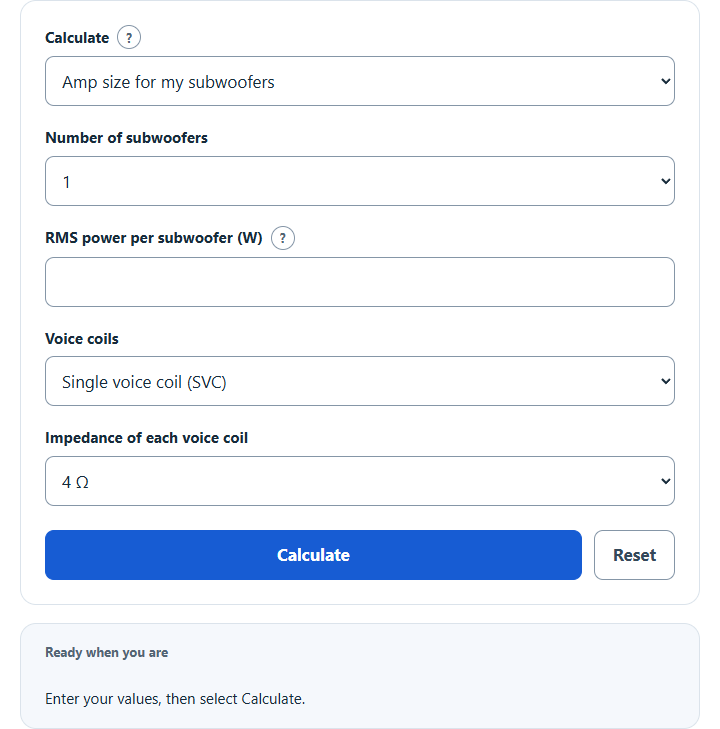
Find what size amp your subwoofers need: the final impedance from the voice coil and sub wiring, and the RMS power the amp should deliver at that load.
- All Physics Calculators
- Speaker Impedance Calculator
- Amplifier Gain Calculator
- Subwoofer Crossover Calculator
- Speaker Output Calculator
Calculator Functions
The calculator works out the load your subwoofers present to an amplifier and the RMS power the amplifier should deliver into that load. Select a function to open it in the calculator.
| Function | Use it when | You enter |
|---|---|---|
| Amp size for my subwoofers | You are choosing an amplifier for your subs | Number of subs, RMS rating, voice coils, coil impedance and wiring |
| Check an amp | You have an amplifier in mind and want to see if it matches | The amp’s RMS rating at the final load, plus the same subwoofer details |
The wiring choices appear when they apply: coil wiring for dual voice coil subs, and sub-to-sub wiring when there is more than one sub.
Subwoofer Amp Formulas
| Z | Combined impedance of the coils or subwoofers, ohms |
| Z1, Z2 | Impedance of each voice coil or subwoofer |
Speaker loads combine the way resistors do [2]. For identical loads, series multiplies the impedance by their number and parallel divides it. A dual voice coil sub with two 4 Ω coils is 8 Ω with the coils in series and 2 Ω in parallel [2], and two single-coil 4 Ω subs give 2 Ω in parallel or 8 Ω in series [1]. With four subs, two series pairs wired in parallel bring the load back to one sub’s impedance.
Amplifier power
Here P is the RMS rating of each sub and n the number of subs. Look for an amplifier whose RMS output is between 80% and 120% of the subwoofers’ total RMS rating, measured at the final impedance the subs are wired to, and which is stable at that load [1]. Amplifiers give a different RMS rating at each load, so read the figure for your final impedance. When there is more than one sub, they should share the same coil type and impedance so that each gets an even share of the power [1].
Worked example
Two single voice coil 4 Ω subwoofers rated at 300 W RMS each add up to 600 W RMS. Wired in parallel they present 2 Ω, so the amplifier should deliver 480 to 720 W RMS at 2 Ω. An amp rated 250 W RMS at 4 Ω and 500 W RMS at 2 Ω gives these subs about 250 W each, 83% of their rating [1].
Limits of This Estimate
- Use RMS (continuous) ratings for both the subs and the amp. Peak or maximum ratings are not comparable.
- The impedances are the nominal ratings printed on the coils. A speaker’s actual impedance changes with frequency, so the combined load is a nominal figure too.
- Check that the amplifier is rated stable at the final impedance before wiring the subs to it [1].
Sources
- American Bass, How to Match Your Amplifier and Subwoofer for Maximum Performance (2025): amp RMS output of 80% to 120% of the subwoofers’ RMS rating, stability at the final impedance, series and parallel examples and matching coil types
- HyperPhysics, Georgia State University, Resistance and Resistivity: Resistor Combinations: the series and parallel combination rules