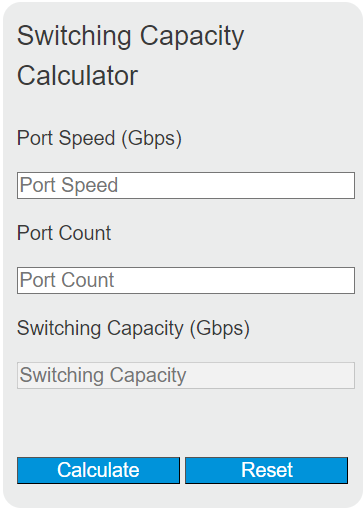
Calculate switching capacity, port speed, or port count from any two values using full- or half-duplex and Gbps, Mbps, or Tbps units.
Related Calculators
- High Voltage Spark Gap Calculator
- Phase Angle Calculator
- Conductance To Resistance Calculator
- Transformer Loss Calculator
- All Physics Calculators
- CCTV Network Switch Port Capacity Calculator
Switching Capacity Formula
The basic switching capacity formula is:
SC = PS × PC × DF
- SC = switching capacity
- PS = port speed
- PC = port count
- DF = duplex factor, usually 2 for full-duplex or 1 for one direction
To calculate port speed:
PS = SC / (PC × DF)
- PS = port speed
- SC = switching capacity
- PC = port count
- DF = duplex factor
To calculate port count:
PC = SC / (PS × DF)
- PC = port count
- SC = switching capacity
- PS = port speed
- DF = duplex factor
The calculator converts Mbps, Gbps, and Tbps to a common Gbps base before calculating. Full-duplex switching capacity counts transmit and receive traffic, so the factor is 2. If you only want one direction, use a factor of 1.
Common Port Speeds and Full-Duplex Capacity
| Port speed | 1 port full-duplex capacity | 24 ports full-duplex capacity | 48 ports full-duplex capacity |
|---|---|---|---|
| 100 Mbps | 200 Mbps | 4.8 Gbps | 9.6 Gbps |
| 1 Gbps | 2 Gbps | 48 Gbps | 96 Gbps |
| 2.5 Gbps | 5 Gbps | 120 Gbps | 240 Gbps |
| 10 Gbps | 20 Gbps | 480 Gbps | 960 Gbps |
| 25 Gbps | 50 Gbps | 1.2 Tbps | 2.4 Tbps |
Switching Capacity Unit Conversions
| Unit | Equivalent in Gbps | Example |
|---|---|---|
| Mbps | 1 Mbps = 0.001 Gbps | 1000 Mbps = 1 Gbps |
| Gbps | 1 Gbps = 1 Gbps | 48 Gbps = 48 Gbps |
| Tbps | 1 Tbps = 1000 Gbps | 1.2 Tbps = 1200 Gbps |
Example
If a switch has 48 ports and each port is 1 Gbps, the full-duplex switching capacity is:
SC = 1 × 48 × 2 = 96 Gbps
A 48-port 1 Gbps switch would need 96 Gbps of switching capacity to support full-duplex line-rate traffic on every port.