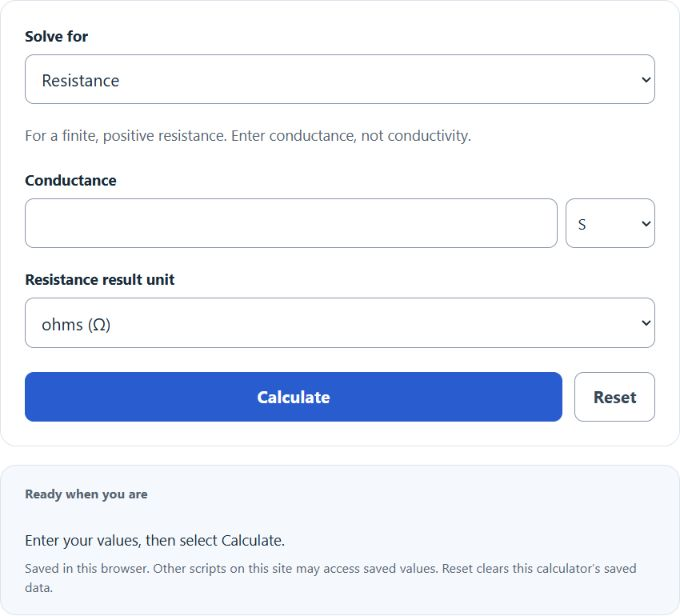
Convert conductance to resistance with R = 1/G, or resistance to conductance, using siemens, millisiemens or microsiemens and ohms, kilohms or megohms.
Related Calculators
- Motor Winding Resistance Calculator
- Resistor Heat Calculator
- Voltage Loss Calculator
- Inrush Current Calculator
- All Physics Calculators
Calculator Functions
| Function | What it does | What it requires |
|---|---|---|
| Resistance | Converts a conductance to the resistance it equals | Requires the conductance in S, mS or µS |
| Conductance | Converts a resistance to the conductance it equals | Requires the resistance in Ω, kΩ or MΩ |
Resistance can be shown in ohms, kilohms or megohms and conductance in siemens, millisiemens or microsiemens. Both inputs must be greater than zero.
Conductance to Resistance Formulas
| R | Resistance in ohms (Ω) |
| G | Conductance in siemens (S) |
The two units are defined as reciprocals of each other: the ohm is a volt per ampere and the siemens is an ampere per volt [1]. A part that drops 1 V while carrying 1 A is both 1 Ω and 1 S.
Resistance
0.5 S is 1 ÷ 0.5 = 2 Ω. Smaller conductances give larger resistances: 1 mS is 1,000 Ω and 10 µS is 100,000 Ω, or 100 kΩ.
Conductance
2 Ω is 0.5 S, and 4.7 kΩ is 1 ÷ 4,700 = 0.000212766 S, or 0.212766 mS. Because a siemens is an ampere per volt [1], conductance can also be worked out directly from a measurement as current ÷ voltage: 2 A flowing at 10 V is 0.2 S, the reciprocal of 5 Ω.
Limits of This Estimate
- Conductance belongs to a particular component or length of wire. Conductivity, in siemens per meter, belongs to the material, and it cannot be turned into ohms without the length and cross-section.
- The reciprocal holds for direct current and purely resistive parts. With alternating current through capacitors or inductors, conductance is the real part of admittance and is not simply 1 ÷ R.
- Zero has no reciprocal, so a perfect insulator or a perfect conductor cannot be entered.
Sources
- National Institute of Standards and Technology, Guide for the Use of the International System of Units (SP 811), Chapter 4, Table 3: the ohm as a volt per ampere and the siemens as an ampere per volt