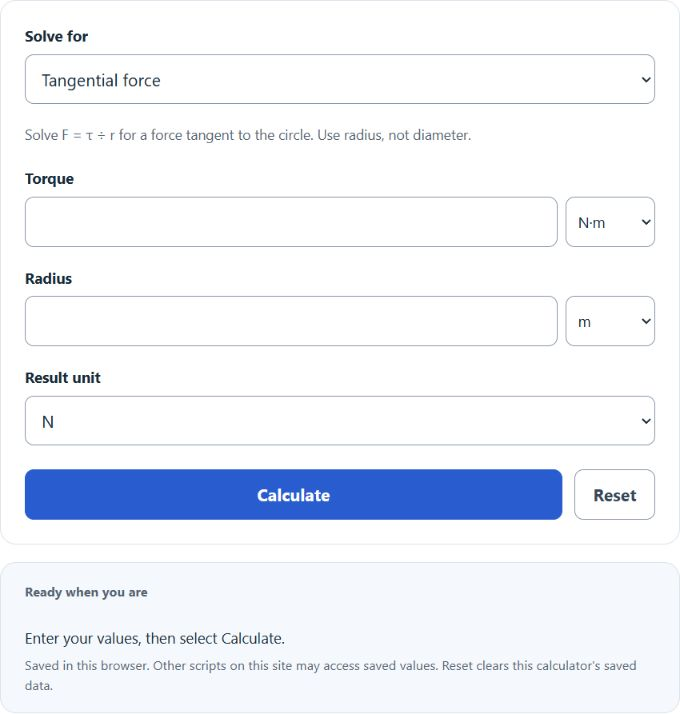
Calculate tangential force, torque, or radius from the other two known values, with newton, pound-force, kilogram-force, torque, and length unit conversions.
- All Physics Calculators
- All Force Calculators
- Angular Force Calculator
- Tangential Velocity Calculator
- Tangential Acceleration Calculator
Tangential Force Formula
The calculator uses the tangential torque relation: Ft = τ / r, τ = r Ft, or r = τ / Ft. The force is perpendicular to the positive radius; signed force and torque follow the same chosen tangent and axis orientation, as described in OpenStax’s torque relationship. The related point-mass dynamics equation below is background, not a separate mass-and-angular-acceleration input mode.
| Variable | Meaning | Common SI Unit |
|---|---|---|
| Ft | Tangential force | newtons (N) |
| m | Mass of the object | kilograms (kg) |
| α | Angular acceleration | rad/s² |
| r | Radius from the axis of rotation | meters (m) |
In that point-mass model, tangential force increases directly with mass, angular acceleration, and radius. If one doubles while the others stay constant, the tangential force doubles. An extended rotating body generally needs its actual moment of inertia; replacing it with a point mass at one radius is not always valid.
How the Calculation Works
Tangential force comes from linear acceleration along the circular path. The tangential acceleration at radius r is:
Applying Newton’s second law in the tangential direction gives:
Combining the two equations produces the related point-mass equation:
The point-mass relation applies to a mass at a fixed radius. For an extended rotating body, use its moment of inertia in τ = I α, then use the known torque and force-application radius in this calculator. See OpenStax’s derivation for a point mass and rigid body.
Connection to Torque
Tangential force and torque are closely related. A tangential force applied at a radius produces torque about the axis:
If torque is known, the equivalent tangential force at that radius is:
For a point mass, this is consistent with rotational dynamics because the moment of inertia is:
How to Use the Calculator
- Choose whether to solve tangential force, torque, or radius.
- Enter the other two known quantities in the displayed fields.
- Use a positive radius. Signed force and torque must refer to the same tangent and axis orientation.
- Select the input units and desired result unit. Changing an input unit converts the entered quantity.
- Select Calculate and review the result and details. Reset clears this calculator’s inputs and saved browser snapshot.
Be careful to use the radius, not the diameter. The radius is the distance from the axis of rotation to the object or point where the force acts.
Example
If a 3 kg mass rotates at a radius of 5 m and the angular acceleration is 4 rad/s², then:
So the tangential force in this point-mass example is 60 N. Its torque is τ = 5 × 60 = 300 N·m. To reproduce the force with this calculator, choose Tangential force and enter 300 N·m torque and 5 m radius.
Tangential Force vs. Centripetal Force
Tangential force is not the same as centripetal force. Tangential force changes the speed of the object around the circle, while centripetal force changes the direction of motion toward the center.
In many rotating systems, both force components can exist at the same time: one along the tangent and one toward the center.
Unit Notes
The calculator converts force to N, torque to N·m, and radius to m before solving. The related point-mass equation uses kg, m, and rad/s². For that background calculation by hand, these angular-acceleration conversions are useful:
Keeping all inputs in compatible units prevents most calculation errors. The calculator uses 1 lbf = 4.4482216152605 N, 1 kgf = 9.80665 N, 1 ft = 0.3048 m, and 1 in = 0.0254 m, from the NIST force definitions and conversion tables. With zero force and zero torque, any positive radius satisfies the relation; nonzero torque with zero force has no solution. A nonzero force with zero torque cannot yield a positive radius.
Common Input Mistakes
- Using diameter instead of radius.
- Confusing kilograms of mass with kilograms-force (kgf). One kgf is 9.80665 N under standard gravity.
- Confusing angular acceleration with angular velocity.
- Using centripetal force when the problem asks for tangential force.
- Using the point-mass equation for an extended body without its correct moment of inertia. This calculator converts a known torque and tangential force at a positive radius.
When This Calculator Is Most Useful
- Wheel and pulley motion problems
- Rotating mass and rim-force calculations
- Introductory physics and engineering homework
- Converting a known torque into equivalent tangential force
- Checking force requirements at a known distance from an axis